

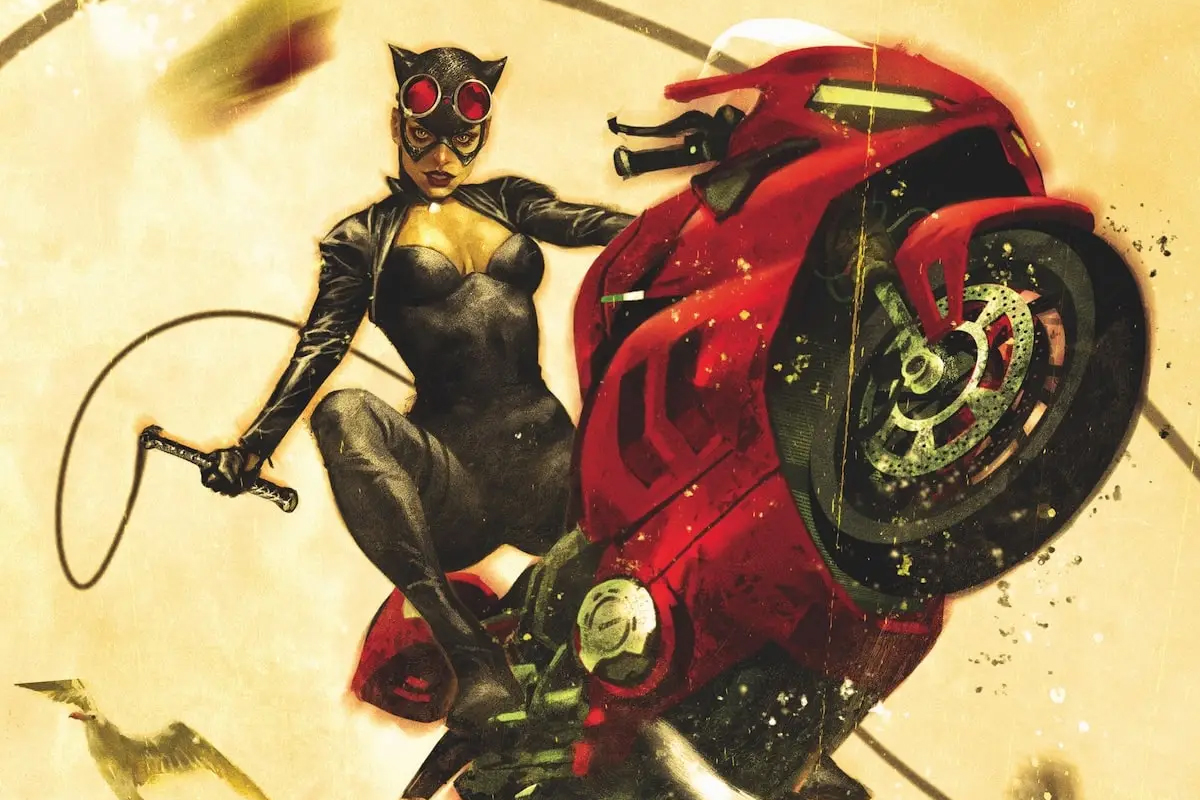

Selina Kyle having some kind of connection to the mafia has been a popular idea for two decades. The possibility of Selina being the daughter of a crime boss was first explored in 2004’s Catwoman: When in Rome by Jeph Loeb and Tim Sale. Her actually being the daughter of a crime boss named Rex Calabrese became her New 52 origin during Genevieve Valentine’s Catwoman run. Her being the daughter of Carmine Falcone was also her origin in the 2022 Matt Reeves’ film, The Batman.
Now that Torunn Grønbekk has concluded her Russian mafia arc in Catwoman #78, the writer, alongside artists Danilo Beyruth and Patricio Delpeche, decides to revisit Selina Kyle’s childhood. Though DC Universe Rebirth has since restored Selina’s post-Crisis origin of being the daughter of Maria and Brian Kyle, this isn’t stopping Grønbekk from revisiting a mafia family connection in Catwoman #79.

DC Comics
One of the strengths of Grønbekk’s second arc is exploring Selina’s relationship with both her mother and sister, Maggie. It also does an excellent job at exploring how all three of these women dealt with abuse, especially when her father was around. As is often the case with domestic abuse, the abused parties (often one parent and the children) will wait for the abuser to be out of the house before they do anything fun, or partake in an activity the abuser disapproves of.
Another thing Grønbekk does well in this issue is exploring how these women cope with the presence of an abusive husband and father. Grønbekk very accurately captures how abused parents will often try to protect their children from abuse, but there’s also that desire from the child to protect the abused parent from the abuser. Grønbekk similarly spotlights the tactics that abusers use to emotionally harm their victims, such as shaming and gaslighting, and how this often erodes the self-esteem of abuse survivors.

DC Comics
The most intriguing plot point Grønbekk introduces in Catwoman #79 is the idea of Maria Kyle looking for a way out of her abusive marriage by working for Carmine Falcone. Though it’s implied in this issue that she only showed up for the “interview,” it does come off as though she was already making plans to become more financially independent of her husband in a fast, convenient way. Unfortunately for Maria, going from Brian Kyle to Carmine Falcone is a case of leaping from the frying pan straight into the fire, with Grønbekk making it clear that exchanging one abuser for another is an easy trap to fall into. It’s also a trap that abusers often exploit when they know their victims are in a vulnerable position.
The plot point with Maria Kyle having a link to Carmine Falcone drives Selina’s character arc in this new storyline. Not only does it make Selina’s newest heist much more personal for her (which is an improvement over the previous storyline), but also offers insight into how Selina felt about her mother. Though this was explored a few times in the post-Crisis DC continuity, it wasn’t given the same level of attention that Grønbekk is clearly aiming for here. This creates an exciting emotional hook for Selina’s new adventure that I look forward to seeing play out as the storyline unfolds.

DC Comics
One more thing that’s great about Catwoman #79 is the artwork from Danilo Beyruth and Patricio Delpeche, who set a visual tone that calls back to Darwyn Cooke’s art from Ed Brubaker’s run. Though not exactly similar art styles to Cooke, the more simplistic pencil work coupled with the use of pastel colors helps make the comic feel like it’s returning to a more familiar status quo – or at the very least, returning to the pre-Flashpoint status quo. This will be sure to please Catwoman fans who loved this era of comics, as it resulted in many of Selina’s best stories.
The only drawback to Catwoman #79 is that returning to the post-Crisis status quo may confuse some fans who have only read The New 52 Catwoman run and are more familiar with her mafia origin from that era. Beyond that, however, Catwoman #79 is a pretty straightforward read, and it’s not too continuity-heavy to the point where readers won’t be able to follow along. Grønbekk throws in just enough information to orient readers who have been reading DC Comics for years (or decades), but keeps it self-contained enough to draw in new readers. Aside from setting up the second story arc, Catwoman #79 also serves as a good jumping on point for lapsed readers.




You must be logged in to post a comment.