

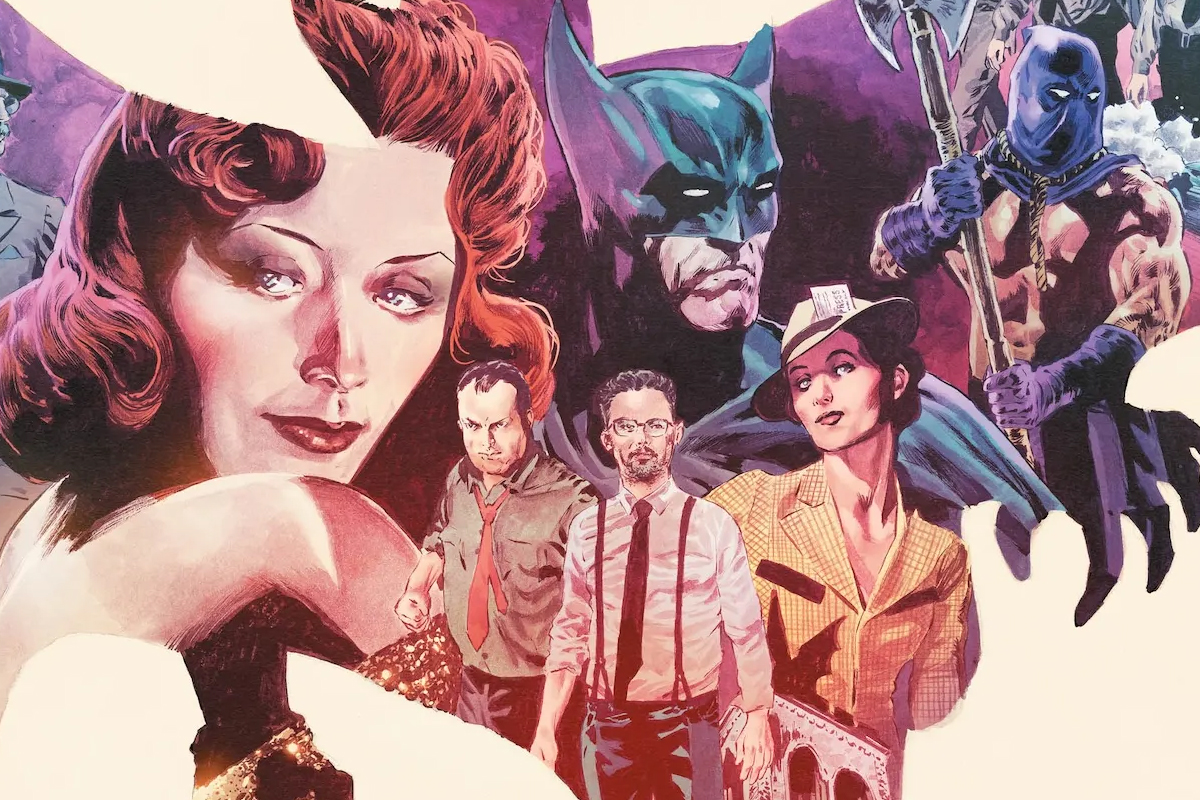

After the masterpiece that was The Bat-Man: First Knight (which revisited The Dark Knight’s Golden Age), it only made sense for DC Comics to follow that up with a sequel: The Bat-Man: Second Knight. Just like the first miniseries, the sequel by Dan Jurgens, Mike Perkins, and Mike Spicer doesn’t disappoint in its ability to tell a 1930s noir story, while grounding it with real-life events of that era. These events include the high unemployment rate as a consequence of The Great Depression and Europe entering the Second World War.
Another thing that’s great about The Bat-Man: Second Knight #1 is the returning supporting cast of Commissioner Jim Gordon (complete with his original 1939 look), Julie Madison (who was Bruce Wayne’s original fiancée in DC’s Golden Age), and new characters Martin Brock, Maxie Cross, Tillie, and Rabbi Jakob Cohen. Two other fun surprises in this first issue are the first appearances of the Golden Age versions of Lois Lane (complete with her original EIC, George Taylor, from The Daily Star) and Scarecrow. The issue also has fun callbacks to Batman’s original 1939 stories with images of the original Batgyro, and pictures of his first villains Doctor Death, the Mad Monk, and Frenchy Blake.

DC Comics
In addition to fully embracing Batman’s Golden Age history, Jurgens, Perkins and Spicer explore this era in an exciting new way, namely by tapping into the horror genre for Scarecrow’s introduction. Not only is Scarecrow truly terrifying in the way that he carries out his fear-based murders (which is unlike anything that’s been seen with the character before), but he teams up with an equally terrifying serial killer who looks like Watchmen’s Hooded Justice, or even a darker version of Al Pratt’s The Atom. In addition to a strong script from Jurgens, what truly sells the horror of the Scarecrow pages are Mike Perkins’ artwork coupled with Mike Spicer’s colors.
The use of shadows and sharp contrast creates the same kind of tension found in 1940s noir films. Furthermore, despite Scarecrow having the same appearance has his original debut in 1941’s World’s Finest Comics #3, his appearance is made more terrifying by Perkins and Spicer. Though he still looks like an actual scarecrow in Second Knight #1, his mask also looks as hideous as Freddy Krueger from A Nightmare on Elm Street. In other pages, he looks as terrifying as Leatherface from The Texas Chain Saw Massacre horror franchise. The latter image is further augmented by the gruesome ways the victims are killed, with Perkins and Spicer pulling absolutely no punches on how that’s depicted on the page. It’s gory, but, fortunately, not trauma-inducing.

DC Comics
Though Batman clearly has his detective work cut out for him with Scarecrow, he’s surprisingly the least intriguing character in the story. Instead, the character who steals the page throughout Second Knight #1 is the Golden Age Lois Lane. While Lois has always been famous for her dogged pursuit of the truth in order to expose white-collar crimes and all manner of corruption (even in her modern depictions), this quality stood out even more in the 1930s due to the social norms of the time. In a decade in which women were expected to be family caretakers and homemakers, Lois consistently challenged this norm by being career-oriented. This also made her truly ahead of her time. Jurgens, Perkins and Spicer bring back Lois’ gloriously ambitious personality in Second Knight #1. This stands out even more next to Julie Madison, whom she interacts with a bit in the latter half of the issue.
What’s great about seeing the original love interests of Batman and Superman interact is that it presents a golden opportunity to show how similar they are and how they differ without robbing either woman of agency. Lois has always had a bone for adventure and was something of an action girl in pursuit of a story, even in her original Golden Age appearances. Even when Lois inevitably fulfilled the role of the damsel in distress in those early Action Comics and Superman stories, she still got to participate in the action. Julie was never afforded that kind of agency in the Golden Age, which makes her impromptu team-up with Lois feel earned and refreshing. It gives Julie the opportunity to participate in the action, which is sure to play out in Second Knight #2.
Another way that Julie Madison is being done justice in Second Knight #1 is that she’s given more nuanced characterization and personality – especially now that she’s romantically involved with Bruce Wayne. One thing that’s always been great about Julie is that she was always the best character to explore the question of whether Bruce could truly marry and still be Batman. This idea wasn’t given much focus or development in the original 1940s comics. But the fact that she eventually left Bruce because he always kept her at arm’s length and never let her in on his secret was always ripe with story potential.

DC Comics
The fact that Jurgens, Perkins and Spicer are making Bruce and Julie’s romance a centerpiece of Second Knight is especially rewarding because they can more meaningly explore the reasons they ultimately never worked out as a couple. This is helped by the fact that – like Lois – Julie is also career-driven and wants to succeed as a Hollywood actor. At the same time, she wants to have a normal life, complete with romance (and, presumably, a family), which are exactly the kinds of things Bruce can’t give her at this point in time. It’ll be exciting to see how Jurgens, Perkins and Spicer further develop their relationship in Second Knight #2, especially since the cracks in their relationship are already starting to show – like Bruce being unable to fully commit to Julie in any meaningful capacity, or showing up to support her in her own career endeavors.
All in all, The Bat-Man: Second Knight #1 continues to be the gold standard for Batman stories set outside the main DC continuity. With Jurgens, Perkins and Spicer returning The Dark Knight to his 1930s roots, he not only feels new again, but it allows all three creators to tell bolder stories with the character that wouldn’t work within the confines of the main DC canon. Instead of existing in a much larger world that’s populated with hundreds of superheroes from all over the DC Multiverse, and where he has a massive Batfamily, this more isolated approach helps restore Batman as a mysterious hero in the vein of pulp fiction. Though Batman himself isn’t given much to do in this first issue, the story threads that play out are sure to challenge The Dark Knight in both terrifying and interesting ways in the issues to come.




You must be logged in to post a comment.