

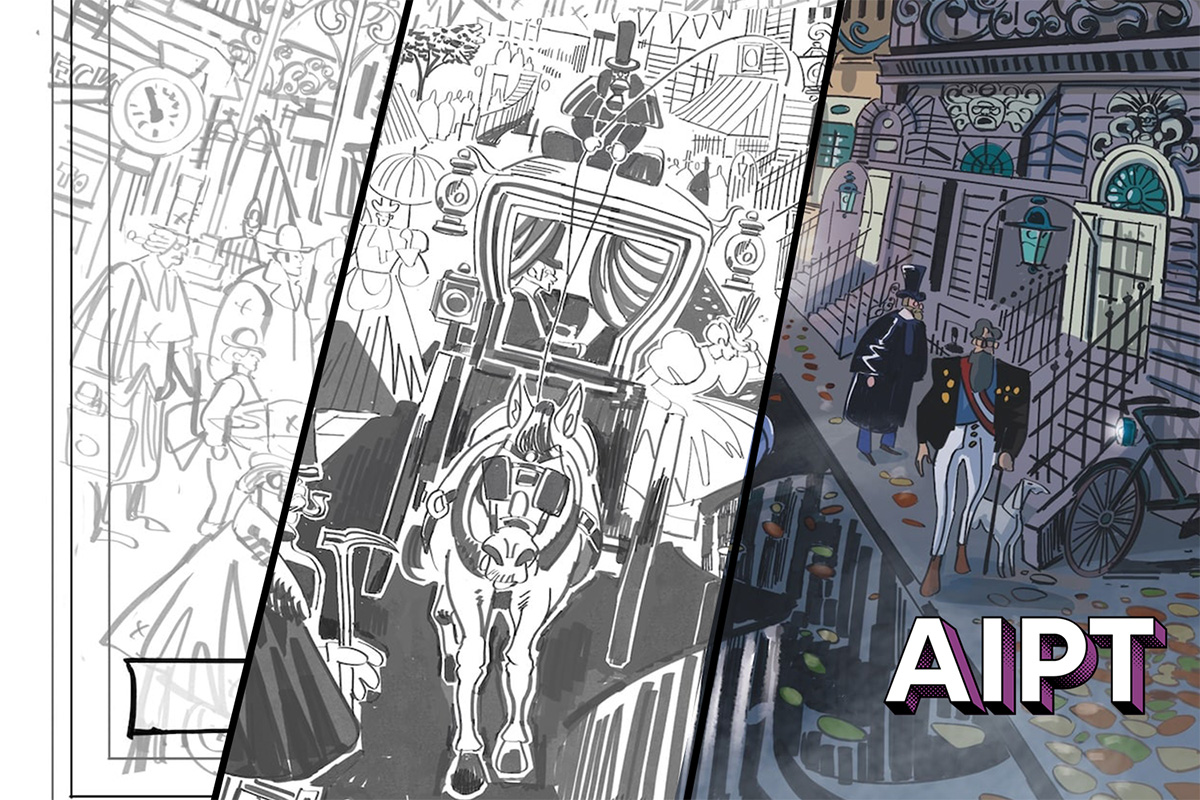

In Ripperland, the year is 2188, and Jack the Ripper stalks London once again. For over a century, a fractured post-Brexit England has functioned as a giant Victorian theme park in exchange for American protection. But when an American mogul’s grandson is murdered, the fragile balance unravels. The search for the truth pits American Special Agent Jesse Holden against British Detective Edwin Fogg, pulling them into a clash of ideologies, power, and identity in a foggy 22nd-century London.
The series, written by Steve Orlando (Midnighter, Marauders) and John Harris Dunning (Summer Shadows, Wiper), blends political satire, futuristic noir, and Victorian horror. With the trade paperback arriving on September 30th, artist Alessandro Oliveri gave us a behind-the-scenes look at his journey, the challenges he faced, and what Ripperland means to him.
Check out previous Anatomy of Design features here.
The Expressive Roots of Art
For Oliveri, drawing has always been about communication:
“I started drawing for a mainly expressive reason, as a kid it was the easiest way to communicate my emotions. I was also quite shy when I was a teenager — which is now totally gone. I believe comics played a critical role for me in creating an emotional bridge between my inner world and the outer world.”
This expressive drive continues to shape his work, infusing Ripperland with a tension between history and futurism, intimacy and spectacle.
Navigating the Challenges of Ripperland
A project as ambitious as Ripperland demanded resilience and adaptability. Oliveri reflects:
“The production of Ripperland was an important journey where I learned to manage the difficulties that may exist in a work group in a project of that magnitude and at that working pace. The result was a surprise — as we progressed through the project we tested ourselves more and more until we achieved the desired result. It was nice — like learning to drive a moving train. It was an experience from which I learned a lot, and I am very happy with the result.”
That “moving train” energy comes through in the book’s atmosphere: Victorian fog colliding with futuristic tech, and a narrative that never stops pushing forward.
A Future Haunted by the Past
Ripperland is more than a murder mystery — it’s a portrait of a country trapped between eras. As Orlando and Dunning’s story interrogates history and identity, Oliveri’s art gives form to a London at once theatrical, terrifying, and alive.
The trade paperback of Ripperland hits shelves on September 30th.



You must be logged in to post a comment.