


In terms of real-world locations to become the hotbed of a comic series, New England is rarely the first choice for any writer. It’s generally known for Super Bowls, ample snowfalls, and an overabundance of lobster and clams. It doesn’t have exciting names like Hell’s Kitchen, the population density of New York City, or the excitement of New Orleans. It does have “New” in the name, but that seems to be where the similarities end. In general, superheroes rarely find themselves in the heart of New England. That might be why Green Lantern Dark #7 focuses so heavily on New England.
The issue begins with the apparent death of the last Green Lantern. Green Lantern Dark #7 leaves the world seemingly embroiled in darkness forever, before a dead Green Lantern Corps helps Rina Mori see the light in the Lantern again. All the while, an especially beastly Beast Boy struggles with grief, love, and the weight of his regrets, as the world falls into darkness.
At its core, Green Lantern Dark has been a series that skews the perception of the Green Lantern Corps as a whole. Instead of featuring a band of heroes protecting the universe with an all-powerful ring that brings boxing gloves and lollipops, Green Lantern Dark twists the entire narrative.

DC Comics
The Green Lantern Corps itself is a fantasy, as there is only a single lantern left to protect the Earth. She doesn’t have the charisma of Hal Jordan, the arrogance of Guy Garner, or the fearlessness of John Stewart. She doesn’t view her Lantern as a gift, as the “gift” caused the deaths of her entire family. She has no guidance, no backup, and no will to save the world. After spending six issues exploring the world of this book, Green Lantern Dark #7 finally takes a look at its central character and explains why she is a Lantern in the first place when she hardly seems to fit the bill.
In this stunning finale, Tate Brombal, Werther Dell’Edera, Giovanna Niro, and Tom Napolitano came together to create a truly cinematic comic that ties up every loose end with finality. It’s a well-paced conclusion to a book that has stumbled with its pacing before, and it makes up for all the criticism that previous issues earned.
Whereas Green Lantern Dark #1 and its follow-ups struggled to make Lunette worthy of the truly worrying amount of praise that she received, Green Lantern Dark #7 made it clear that Lunette herself doesn’t matter so much as her name does. She’s a lantern, and she serves as the spark that Rina Mori needed in a moment of darkness. The Lunette character may still be painfully cliché, but the point is less about her character and more about the message behind her — something that this issue embraces.
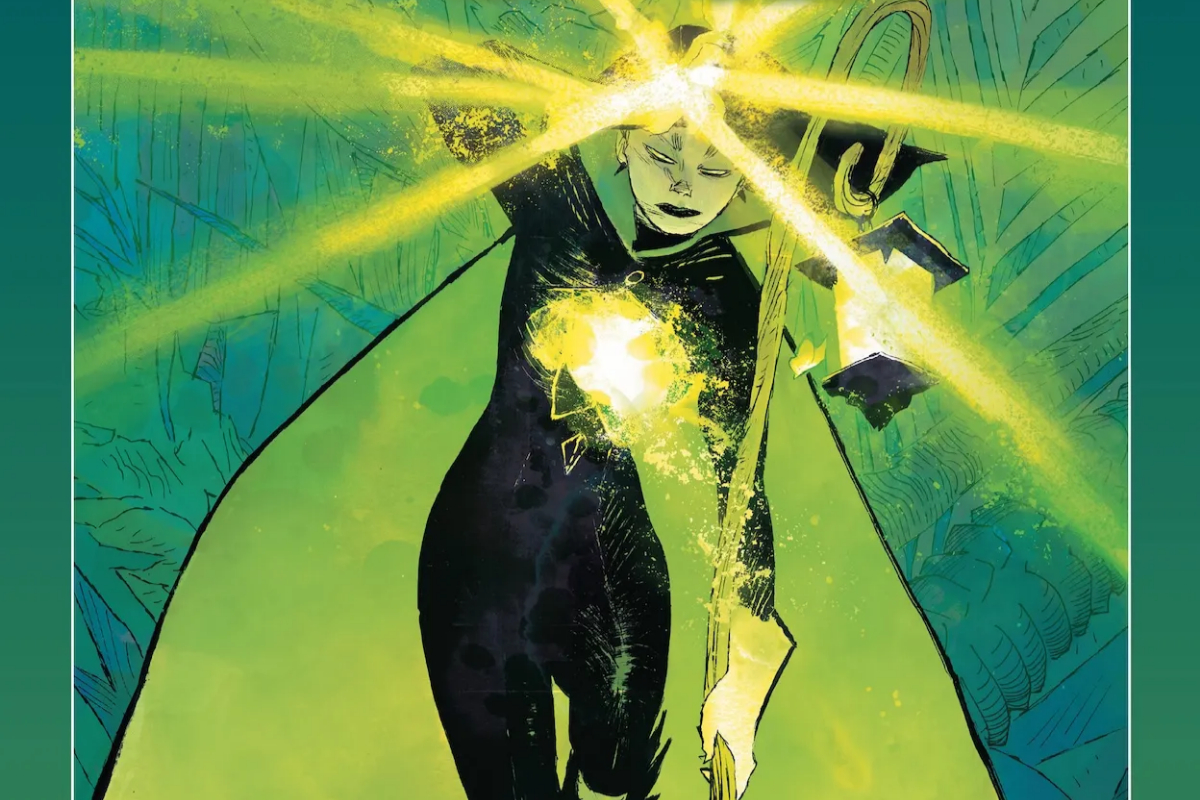
Instead of serving as a book about traditional superheroes, Green Lantern Dark #7 and its preceding issues focus on a character who can hardly be called a hero at all. Yet, when the world falls apart around her, Rina finally manages to embrace the light in the midst of the true blackest night. Rina never has the luxury of the bright lights of a cityscape around her to illuminate the way. There are no other heroes to lean on, nor is there a legacy to borrow early on.

DC Comics
It’s an aesthetic that Dell’Edera and Niro certainly embraced, as the sharply contrasting colors and sketch-like style of the book have managed to set it apart from the very beginning. There is no realistic style to the book at all, as entire pages are bathed in shades of one single color, while the imperfect drawings make Rina’s face both grounded and mythical.
The only real issue with the art in Green Lantern Dark #7 is during its climax, when a single panel fills an entire page with smooth, undetailed art that fails to capture the emotion of the moment. It feels like an attempt to mimic the impact of Kitty Pryde helping the world dodge a bullet in Astonishing X-Men, but it lacks the touch that the series had. Instead, it’s hard to see what happens at all. Any hint of a definitive and thrilling finale is ripped away in the moment of the villain’s big fall from grace. It’s easy to understand that it is meant to be a mute ending for a long-time enemy, but it just falls flat.
All-in-all, though, this is an excellent comic that understands how to subvert expectations for heroes without falling too far into grimdark. It emphasizes a message of hope and willpower, while acknowledging how hard it can be to find the light in the dark.
That might be why this book is set in New England. It’s a non-traditional place for a hero, and Rina is certainly a non-traditional hero. If this is a hopeful origin story, it’s not one that’s going to have a Saturday morning cartoon. It’s a perfect Halloween release for DC that captures a creepy setting, while also helping deliver its heroes to Providence in its final pages. If previous issues struggled, Green Lantern Dark #7 proved that this book is certainly worth a read.




You must be logged in to post a comment.