

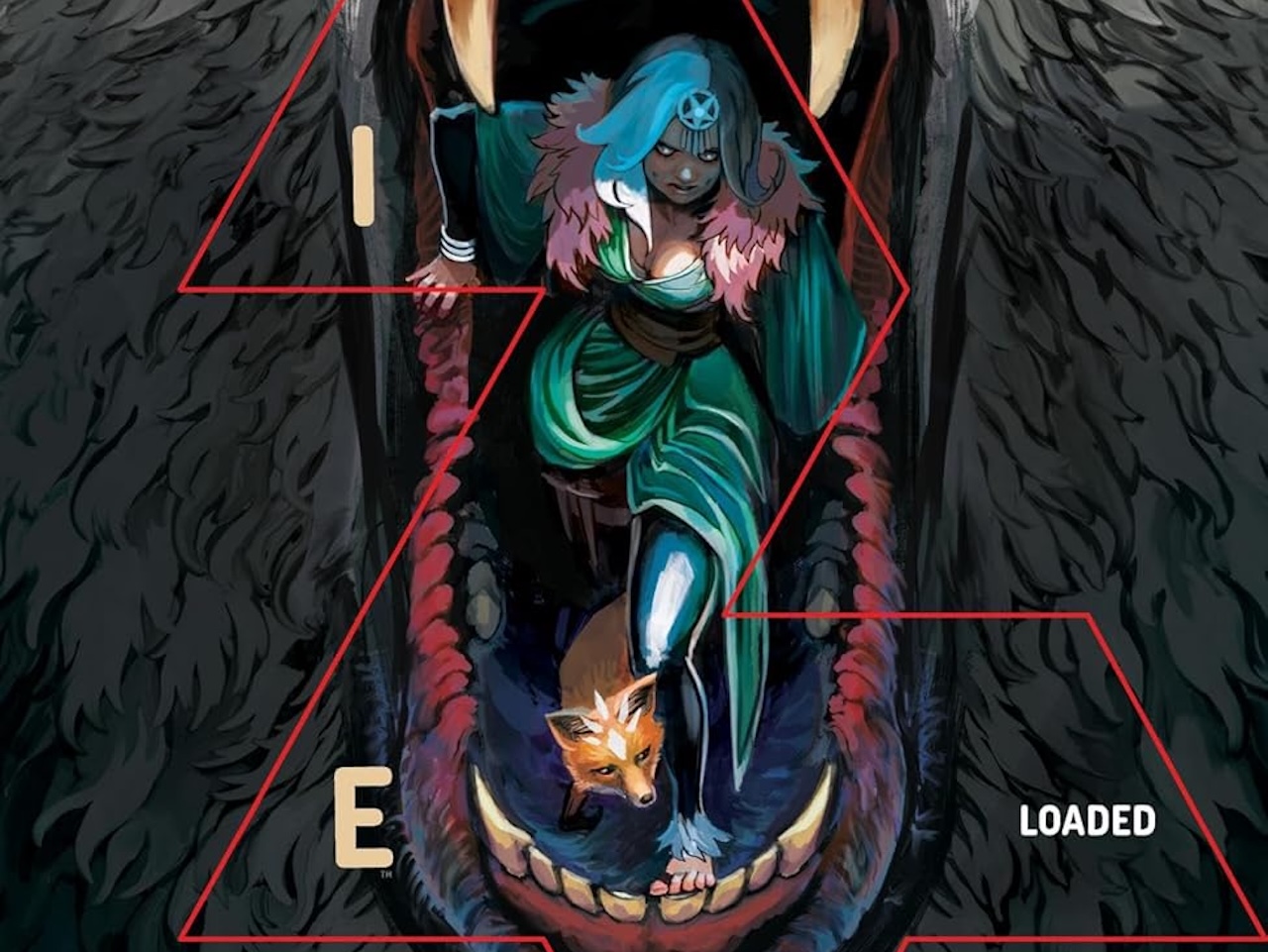

The party’s first quest through DIE as teenagers was a thrilling, terrifying, traumatic, and transformative adventure, during which they learned the rules of the game’s world. Their second quest was even more thrilling, terrifying, traumatic, and transformative, since the party now had to fight the game’s rules as much as they did vampires and steampunk armies while treating with hobbits caught up in World War I. Being a magical knight powered by your own sadness and depression is one thing when you’re a teenager. It’s another thing when you’re a man in your 40s who’s well aware of how poisonous wallowing in despair is for you, but if you don’t wallow in despair, a horrible monster will stab you.

Image
Hans’ illustrations give equal attention to a Balrog-esque embodiment of one of the leads’ worst aspects and to another bitterly laying out the physical and emotional consequences of crunch culture in game development. Her action moves like water, flowing and crashing, with big moments like the earlier-mentioned Balrog or the way the party sabotages a former friend’s attempt to railroad them onto an overly scripted quest. Gillen’s scripts click on multiple levels. The action and adventure are a bleak, worthy cousin to the bombast of his and Dan Mora’s Once & Future. The metacommentary is insightful and self-interrogative, as seen in a riff on Tolkien, where Gillen simultaneously expresses his frustration with Tolkien’s preference for the rural over the urban and demands that counterpoints and deconstructions actually engage with the work rather than merely exalt in grimdarkness for its own sake. And above all else, DIE’s character work is sublime. The party has history and baggage, and while they’re experienced and mature enough to work with it, they aren’t ready to face it.
DIE: Loaded sees Hans and Gillen reunite for a new game, and this first issue plays to their strengths as comic makers, and the strengths of the setting (a setting strong enough to be a game of its own) while flipping the script in a tremendously exciting way. The first party had history, both with DIE-the-world and with each other. The new party knows some of that history and some of the rules, but they do not know each other or DIE in the way the first party did. It creates space for Hans to showcase the powers players can wield through the eyes of a newcomer, as opposed to an old pro getting back in the saddle.

Image
But before Hans and Gillen start their game, they need to set the stage. Most of DIE: Loaded’s first issue is set in the real world, during the bizarre days of the pandemic post-vaccine, where “normality” was starting to settle. Hans’ colors are light but weighted, not oppressive but omnipresent. The first party returned from DIE changed, only to find that the world had changed with them, and unlike the fantastical world they spent two years fighting through, they hadn’t been through a pandemic like COVID before. There’s no escaping that, even for those players who do get pulled into DIE, where the peril is a different sort of overwhelming and the mitigation strategies are more a question of mastering fantastical powers than they are masking up and maintaining social distancing where necessary.
For one of the new party members, those powers are those of the Godbinder. She makes deals with the divine, deals that she needs to balance carefully. The gods will help her, but they have their own agendas and foibles, and lend her their power because they get something out of it. She’s not much of a tabletop gamer, but she knows tricky deals. Asking her new patron to reunite her instantly with everyone else who’s been pulled into DIE-the-world means taking on a debt she cannot pay without drowning in it. Instead, she makes a deal she can manage, one that brings her face-to-face with another player, one who’s carrying threads from the original run. It’s a strong cliffhanger, and it will be exciting to see how this develops.

Image
DIE: Loaded’s first issue is both a fine return and a strong start. Hans and Gillen are playing with the narrative rules they established in the first run in fun ways, the setting remains rich with possibilities, and the new leads make a fine first showing. It’s a game worth following and a comic worth reading.
Editor’s Note: Warning, spoilers for this issue ahead!
Stephanie Hans and Kieron Gillen’s DIE is a blast of a comic. What starts as, to quote Gillen’s shorthand, “Goth Jumanji” grows into a consistently beautiful and horrifying adventure with some impeccable character work. In 1991, six teens – two siblings, some friends, and several acquaintances – got together to play a home-brewed tabletop RPG. They vanished. Two years later, five of them returned, unable to speak about what had happened to them. Almost 30 years later, those five disappeared again. Two years afterwards, five returned to a world in the grips of the COVID-19 pandemic. One of them had been missing since ‘91, trapped in the world of DIE, a game he thought he had invented.
The party’s first quest through DIE as teenagers was a thrilling, terrifying, traumatic, and transformative adventure, during which they learned the rules of the game’s world. Their second quest was even more thrilling, terrifying, traumatic, and transformative, since the party now had to fight the game’s rules as much as they did vampires and steampunk armies while treating with hobbits caught up in World War I. Being a magical knight powered by your own sadness and depression is one thing when you’re a teenager. It’s another thing when you’re a man in your 40s who’s well aware of how poisonous wallowing in despair is for you, but if you don’t wallow in despair, a horrible monster will stab you.
Image
Hans’ illustrations give equal attention to a Balrog-esque embodiment of one of the leads’ worst aspects and to another bitterly laying out the physical and emotional consequences of crunch culture in game development. Her action moves like water, flowing and crashing, with big moments like the earlier-mentioned Balrog or the way the party sabotages a former friend’s attempt to railroad them onto an overly scripted quest. Gillen’s scripts click on multiple levels. The action and adventure are a bleak, worthy cousin to the bombast of his and Dan Mora’s Once & Future. The metacommentary is insightful and self-interrogative, as seen in a riff on Tolkien, where Gillen simultaneously expresses his frustration with Tolkien’s preference for the rural over the urban and demands that counterpoints and deconstructions actually engage with the work rather than merely exalt in grimdarkness for its own sake. And above all else, DIE’s character work is sublime. The party has history and baggage, and while they’re experienced and mature enough to work with it, they aren’t ready to face it.
DIE: Loaded sees Hans and Gillen reunite for a new game, and this first issue plays to their strengths as comic makers, and the strengths of the setting (a setting strong enough to be a game of its own) while flipping the script in a tremendously exciting way. The first party had history, both with DIE-the-world and with each other. The new party knows some of that history and some of the rules, but they do not know each other or DIE in the way the first party did. It creates space for Hans to showcase the powers players can wield through the eyes of a newcomer, as opposed to an old pro getting back in the saddle.
Image
But before Hans and Gillen start their game, they need to set the stage. Most of DIE: Loaded’s first issue is set in the real world, during the bizarre days of the pandemic post-vaccine, where “normality” was starting to settle. Hans’ colors are light but weighted, not oppressive but omnipresent. The first party returned from DIE changed, only to find that the world had changed with them, and unlike the fantastical world they spent two years fighting through, they hadn’t been through a pandemic like COVID before. There’s no escaping that, even for those players who do get pulled into DIE, where the peril is a different sort of overwhelming and the mitigation strategies are more a question of mastering fantastical powers than they are masking up and maintaining social distancing where necessary.
For one of the new party members, those powers are those of the Godbinder. She makes deals with the divine, deals that she needs to balance carefully. The gods will help her, but they have their own agendas and foibles, and lend her their power because they get something out of it. She’s not much of a tabletop gamer, but she knows tricky deals. Asking her new patron to reunite her instantly with everyone else who’s been pulled into DIE-the-world means taking on a debt she cannot pay without drowning in it. Instead, she makes a deal she can manage, one that brings her face-to-face with another player, one who’s carrying threads from the original run. It’s a strong cliffhanger, and it will be exciting to see how this develops.
Image
DIE: Loaded’s first issue is both a fine return and a strong start. Hans and Gillen are playing with the narrative rules they established in the first run in fun ways, the setting remains rich with possibilities, and the new leads make a fine first showing. It’s a game worth following and a comic worth reading.




You must be logged in to post a comment.