

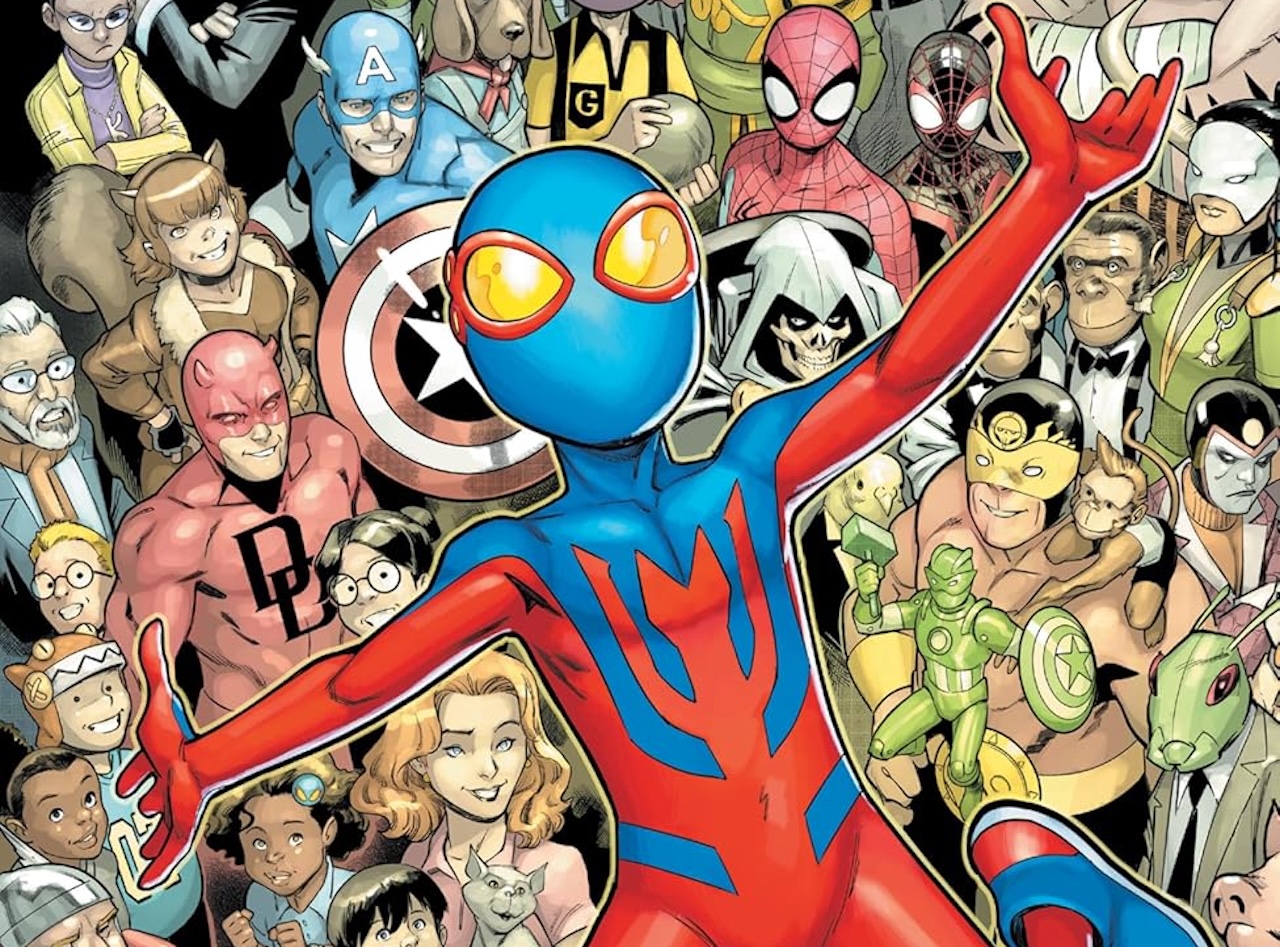

It’s never clear which Spider characters are going to stick around, or which ones are going to get some sort of solo focus beyond whatever Spider-event they’re attached to. When Spider-Boy debuted at the climax of the “End of The Spider-Verse” story arc it felt significant, like the editors at Marvel might actually be taking this little guy seriously. Full Circle proves that Spider-Boy is not just a funny experiment, but a character with real heart and long-term potential in the Marvel universe.
Spider Boy: Full Circle brings us to the conclusion of the Bailey Briggs saga by following through on its running themes of growth, trust, and starting over. It also contains a wacky one-shot that exemplifies the kind of life Spider-Boy might have now that this series is ending.
Mister Negative returns, and his role in Spider-Boy’s past and connection to Madame Monstrosity is revealed in dramatic fashion. As Bailey sets his sights on Negative, Spider-Man becomes fed up with Spider-Boy and cracks down on his vigilantism. On top of all this, he needs to break into a bank vault in order to save the day.

Marvel
Eventually, Peter starts to worry that Bailey will go or has gone rogue alongside the Gaping Maw, the clan of hyper-deadly ninja assassins he won in a tournament in the last book. Instead, he finds him fighting alongside his very own team, assembled from new and old heroes that he’s befriended along the way. Dan Slott does a great job of bringing loads of characters into this story without weighing it down. It’s pure fun, with enough comic continuity connections to make it a valuable read for longtime readers as well.
This clarity of vision carries over into the art, which is consistent, clean, and makes for a great partner to Slott’s script. The panel layouts are a big part of this visual clarity. Each page is filled with colorful visual humor and great character design. A lot of Spider-comics can go over-the-top with their page layouts by having the characters flying and crawling over the page and shooting web-fluid all over the place. That’s not the case here, and it allows all the zany plot elements to stand out in the rush of the narrative.

Marvel
For the entire run, Peter had been repeatedly telling Bailey that he can’t get involved with any of Spider-Man’s “A-Listers”, as in, his strongest (and most popular) villains. This gives the creative team a ton of room to create a funny and unique rouge’s gallery for Bailey. It also sets up an important part of the climax: the big fight between Mister Negative, Spider-Man, and Spider-Boy. Bailey finally takes on one of the big bads—and on his own volition, too—while holding his own both in the fight itself and on the page. In all of this drama, Bailey never feels like an afterthought between the two legends; he’s written right into the middle of it all, which feels like a funny analogy for how his character was introduced to this world in the first place.
One of this book’s greatest strengths is the creative team’s ability to tie Bailey’s adventures into wider events or storylines. These outside elements aren’t relied on or overly-referenced, but rather used to build a firm “web” of meaning for Bailey Briggs and the people he’s pulled into his orbit. It’s so fun to turn a page in this book and see classics like Daredevil, Peter, and Mister Negative pop up. It feels like Spider-Boy has actually always been in this universe because of how well he fits in with these icons, so the book’s other original characters give that same feeling of recognition by the end.
The book ends with a Kidpool/Spider-Boy special issue. It’s long, ridiculous, and ultimately very entertaining. It’s another blend of characters, plots and subplots, and weird creatures. The art in this issue is great, if a little bit busier than the rest of the book. Still, the art is full of details and the colors pop.

Marvel
This issue shows that Spider-Boy’s greatest strength is his adaptability and instant chemistry when paired with other Marvel characters. He’s so innocently antithetical to the heroes he meets, and it almost always makes for a great team-up. But when you pair him up with someone as weird as Kidpool it can bring out another side of Bailey altogether: the responsible side, the part of him that is most inspired by his mentor, Spider-Man.
Overall, the Spider-Boy series has been highly enjoyable, and quite a surprise to read each week. A lot of new characters that Marvel has been focusing on lately don’t have the staying power or narrative interest to maintain a series this long on their first time out. From the art, to Bailey’s journey in this “new” universe finding a satisfying conclusion, to all of the little crossovers and references, this book is a Spider-fan’s dream.




You must be logged in to post a comment.