

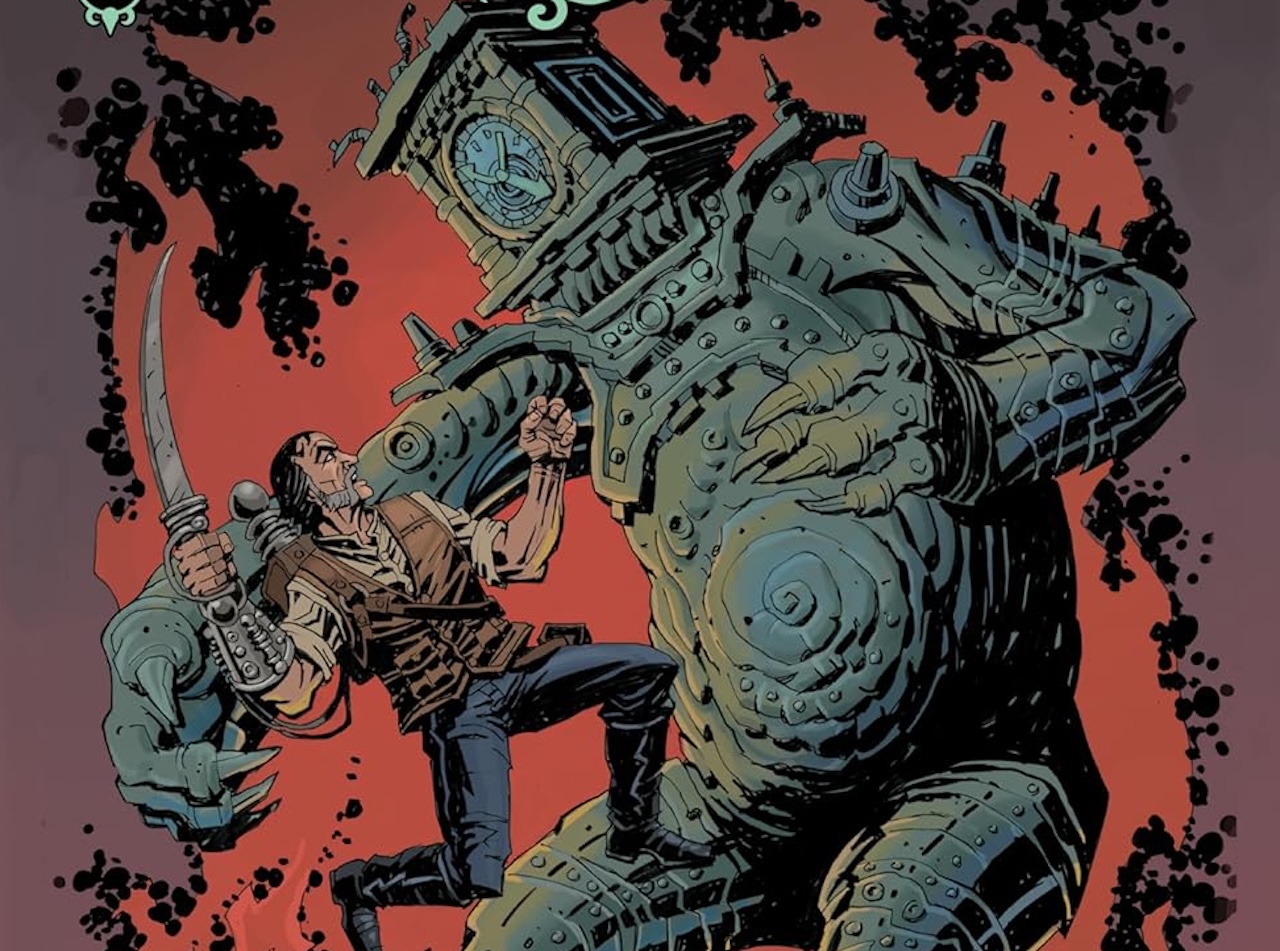

Captain Winston Henry continues his exile in the time travelers’ graveyard in Captain Henry and the Graveyard of Time #2 with a story by Mike Mignola and Bruce Zick and art and colors by Zick. The miniseries is a gloriously old-fashioned adventure with Jack Kirby-style art that makes the book feel like a lost story from a 1970s issue of Marvel’s Strange Tales.In this issue alone, we get time travel, a professor with an electric blaster weapon that looks like a giant tuning fork, and giant lumbering clockwork automatons, all within a dimension that looks like something out of Salvador Dali’s fever dreams, with the carcasses of thousands of defunct time travel vehicles littering the twisted terrain.
New character Bertram Archimedes Otterham, Philosopher of the Royal Order of the Aether, is introduced this issue and if that doesn’t tell you how divinely fantastic this book is then nothing will. Bertram’s one of those geniuses who’s also possibly borderline insane. He’s a great counterpoint to Captain Henry’s two-fisted Indiana Jones-type adventurer who throws hands first and asks questions later.
Bertram provides a lot of backstory and himself and this dimension they’re in. Bertram, who’s from the year 1778, postulates that there have been time travelers all the way back to the days of Ancient Rome. Many failed, but some were able to build rudimentary machines or suits that gave them access to the timestream. Somehow, they all eventually end up in this graveyard of Time Travelers.
It’s an intriguing concept that the idea of exploring time is as ancient as the Bible, that it didn’t start in the Industrial Age. It sparks the imagination, making me want to see stories of these other time travelers, maybe a scientist from renaissance England traveling to the end of the universe millions of years from now, watching the stars burn with scrolls of Shakespeare in his hand. Or a World War 2 scientist time traveling back to Napoleon’s time to witness his defeat in the Battle of Waterloo. We also get a taste of Bertram’s past adventures with his time machine (which he named Ophelia).
Bruce Zick’s artwork is magnificent throughout. When we first see Ophelia, every cog, gear, wheel, and bolt of her are rendered in striking detail. The machine is both sleek and formidable looking. If this were a DC book, I’d say it resembled a steampunk version of technology from Thanagar (Hawkman’s world).
With a strange unexplored new dimension, a great sidekick in Bertram, some exotic steampunk gizmos, and the prospect of a Doctor Doom-style villain next issue (we get a tantalizing glimpse of him here), the second half of the miniseries promises to be even more bizarre and pulpy as the first half and I can’t wait to see what’ s next.
Captain Henry and the Graveyard of Time feels wonderfully old school, like reading a classic Jack Kirby Strange Tales issue from the ’70s. It’s fun, fascinating and bizarre, in the best way.




