

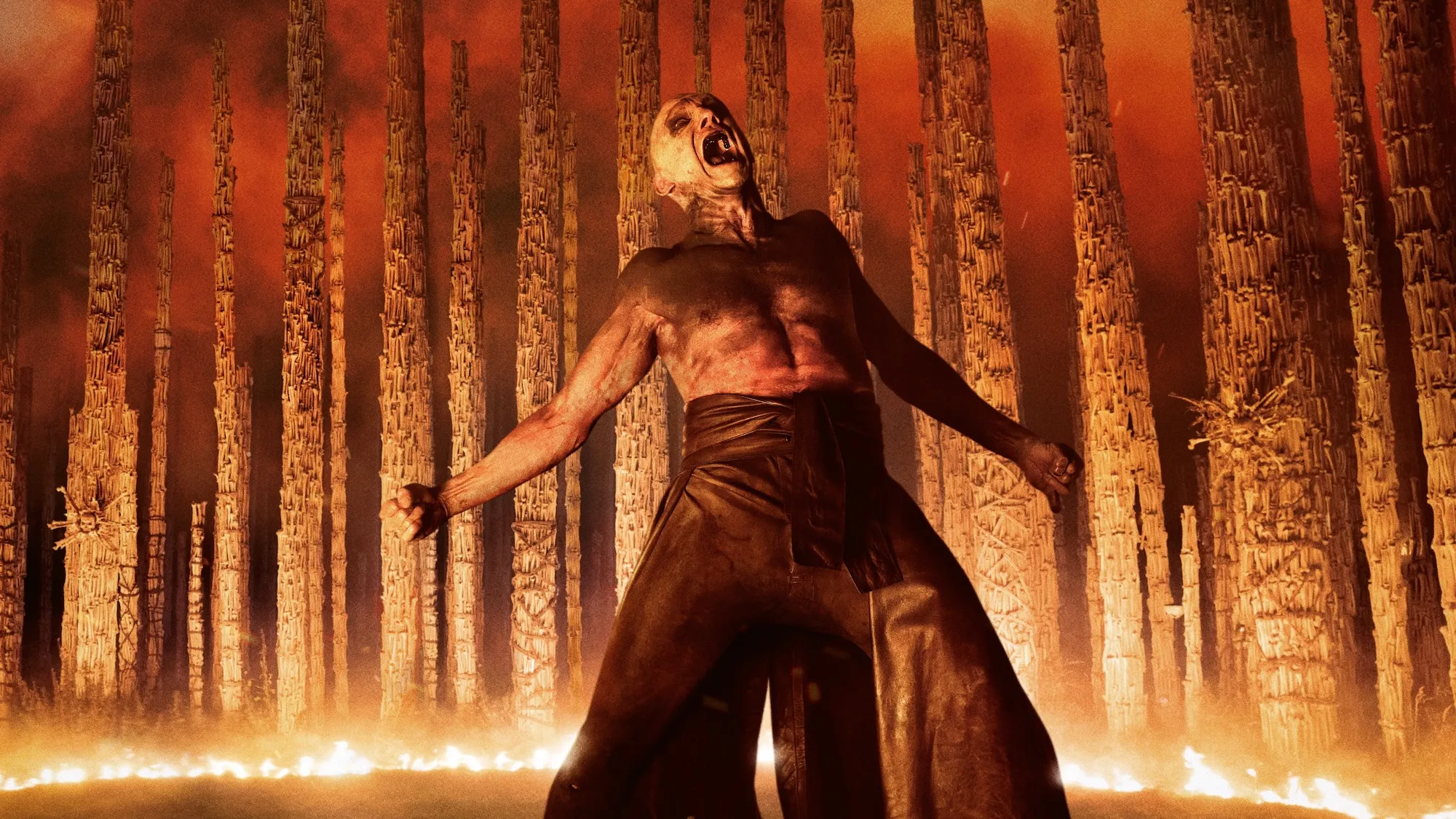

Last summer saw the long-awaited 28 Years Later, which reunited director Danny Boyle and screenwriter Alex Garland to re-explore a Britain plagued by the Rage Virus that they first introduced in 2002’s 28 Days Later. In this current era of legacy sequels, in which Boyle previously took part in with T2 Trainspotting, his return to this post-apocalyptic world felt more refreshing by focusing on another set of characters that was surviving the infection in their own way and the human drama that occurred within.
That drama continues in the shape of 28 Years Later: The Bone Temple, which picks up right after the events of its predecessor, in which the young Spike (Alfie Williams) is inducted into a gang of acrobatic killers led by Sir Lord Jimmy Crystal (Jack O’Connell). Meanwhile, Dr. Ian Kelson (Ralph Fiennes) comes into contact with an Alpha leader (Chi Lewis-Parry) of the infected as he tries to understand how the virus actually infects somebody.
The one notable difference between the two installments of this supposed trilogy is direction as Nia DaCosta takes over after Boyle. Being no stranger to franchise filmmaking and specifically horror with 2021’s Candyman, DaCosta fits nicely into this brutal and gory world where the infected are not the only predators to look out for. Whereas the previous film had a distinct visual presentation with the use of iPhone 15 Pro cameras for filming, DaCosta and cinematographer Sean Bobbitt take a more conventional approach using the Arri Alexa 35 digital camera, whilst displaying enough visual flourish that adds to 28 Years Later: The Bone Temple’s sense of dread.
While the infected deliver plenty of loud jump scares and gory violence that will delight those who like their zombie media, 28 Years Later: The Bone Temple’s most disturbing element is “the Jimmys”. Modeled after Jimmy Saville, which is always going to be questionable and uncomfortable given the controversy surrounding the late British media personality, they are a Satanic cult comprised of younglings who are learned the psychopathic ways of Sir Jimmy. He may have played a tap-dancing vampire brilliantly in last year’s Sinners, but Jack O’Connell may have delivered his most monstrous turn in a role that is both gleeful and terrifying with his ritualistic killings.
As this is smaller in scope compared to the previous film, The Bone Temple lacks anything new as it basically recycles a lot of the same locations from before. However, what it lacks in novelty, Garland’s script stills more depth to what is already there, with two narratives that will eventually collide with each other, while each presenting their own worldview. Considering that this series since its 2002 inception has always touched upon real-world politics and these recent installments evokes recent political and cultural detachment following Brexit and COVID-19, the film particularly leans into folk horror and surrealism to explore themes of evil itself and religion versus and atheism.
For as dark as The Bone Temple can get, much like the grim tone of a lot of recent post-apocalyptic media that is not always comfort food, it is the film’s few human moments that serve as a nice contrast, such as Spike trying to maintain his innocence despite being in the presence of psycho killers. As for Dr. Ian Kelso, who develops an odd relationship with the infected, Ralph Fiennes continues to brilliantly bring nuance to what could have been a cliched role within this genre.




