


When Angélique Roché talks about storytelling, she doesn’t separate craft from responsibility. With every interview, every edit, every script, she frames it as a way to “help good storytellers” and make sure stories reach the people who need them most.
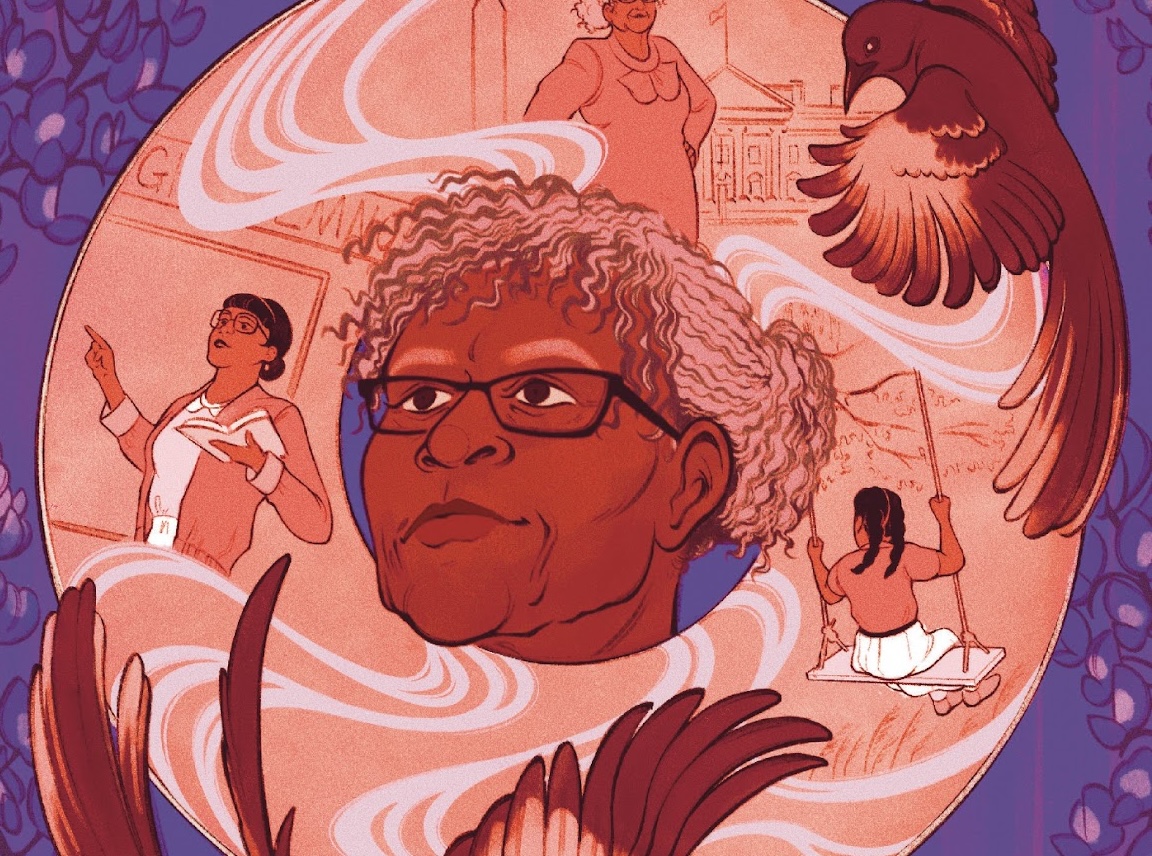
That very throughline now culminates in First Freedom: The Story of Opal Lee and Juneteenth, the first graphic novel dedicated entirely to the origins and history of Juneteenth (out this week, February 10, from Oni Press).
Roché’s path to comics wasn’t a straight line. As she told me recently, her childhood dream was a smidgen more theatrical: “I wanted to be on Broadway… I’m also a lawyer. I’m also a poet.” That multidisciplinary impulse explains how she’s been able to juggle hosting Marvel Studios gigs, journalism, editing Marvel’s Voices, and now longform graphic storytelling.
“It all leads to telling good stories,”Roché said. “If you would have told 10-year-old me I’d be doing this… yeah.”

Courtesy of Oni Press.
First Freedom as a Responsibility, Not Just Another Project
That sense of awe never leaves the work, even when the stakes are enormous.
First Freedom chronicles the life of Opal Lee, the “Grandmother of Juneteenth,” whose decades-long activism culminated in the holiday’s federal recognition in 2021. For Roché, the scale of Juneteenth’s history never eclipsed the human center of the book.
“There’s always an obligation to get the personal story right,”Roché said. “That means getting Dr. Lee’s story right, but also her character. Ms. Opal treats everyone with value, and keeping her voice was more important than anything. We didn’t just give her a voice.”
That insistence on specificity shows up everywhere, from the inclusion of Black soldiers present in Galveston on June 19, 1865, to naming Major Emory, who drafted General Order No. 3. Roché pushed back on the idea that history needs to be compressed for accessibility.
“People always say we don’t have enough space to tell the real history,”Roché said. “But do you? Or can you slow down and add those little details?”

Courtesy of Oni Press.
Juneteenth as Celebration and Remembrance
The book’s historical sections are precisely grounded, but Roché is equally intent on showing how delayed freedom a looked and felt. As she explained, Juneteenth marks not just celebration but failure — two-and-a-half years after the Emancipation Proclamation, enslaved people in Texas were still being held in bondage.
“There were no cell phones, no satellite communication,”Roché said. “Most enslaved people were illiterate because they were banned from reading and writing. Even if someone knew, you still had to go and enforce it.”
That enforcement came with trauma that didn’t just disappear on June 19.
“You’re dealing with 3.5 million people who’ve only lived one way,” Roché said. “They’ve been traumatized their entire lives.”
The book makes clear that legal freedom didn’t automatically translate into lived freedom, a theme Roché sees as central to understanding Juneteenth at all.
“Legal freedom does not always equate to freedom-freedom,”Roché said. “Freedom from discrimination, from inequality, from oppression — that’s the work.”

Courtesy of Oni Press.
How The Sausage is Made
Roché’s years working on Marvel’s Voices helped shape how she regarded comics as a medium. Reading countless scripts and interviewing creators demystified the form.
“Comic books are a team sport,”Roché said. “I wanted to write in a way that allowed the artists to bring their ideas.”
That devotion to collaboration was matched by an almost archival level of research. Roché traveled to Fort Worth and the surrounding areas to ground the book in real spaces, photographing neighborhoods, scanning historical images, and collecting visual references so the artists wouldn’t have to invent a world that already existed. She studied period-accurate cars, clothing, storefronts, and street layouts, and even pulled from Lee’s family materials, including reunion books and personal photographs spanning decades.
“Why would we make up something,” Roché said, “when the real thing that existed deserves to be the real thing?” The goal wasn’t rigid recreation, but freedom — giving the art team (including Alvin Epps, Millicent Monroe, and Bex Glendining) a truthful foundation so they could focus on emotion, movement, and life rather than guesswork.
That philosophy pays off in moments where the art deepens the narrative in surprising ways. One panel sequence that stayed withRoché shows Lee’s family home swarming with children said they after fireflies.
“The house doesn’t look like that anymore,” Roché said. “But seeing it full of life — I wanted to put it on my wall.”

Courtesy of Oni Press.
Honoring Lee’s Family in Story
That attention to lineage and lived history carries through the book in subtle but meaningful ways. Several figures are intentionally named to honor Lee’s own family, including Sergeant Edmund Banks, named after her great-grandfather, and a young woman who reads General Order No. 3, named after her great-grandmother. These choices aren’t meant as Easter eggs so much as grounding devices, ways of reinforcing that Juneteenth isn’t abstract history, but something carried forward through real people, real families, and real memory.
Spanning nearly a century of Lee’s life required constant calibration — when to widen the lens and when to stay intimate. Roché described it as a balancing act: “If Opal wasn’t at the center, she was in the peripheral. The world was influencing her life, but we never wanted to lose her.” Even moments of ordinary joy (teaching third graders, a courthouse wedding, festival music, etc.) have equal value alongside historical marches and legislation.

Courtesy of Oni Press.
Becoming a “Committee of One”
What surprised Roché most after spending time with Lee wasn’t a hidden side of her personality, but the lack of one.
“Her public image is exactly who she is,” Roché said. “She wears sneakers every day. She still reads the Sunday funnies. And don’t offer her help — she’ll say, ‘I got it.’”
That attitude underpins one of the book’s core ideas: becoming a “committee of one.” Lee’s mantra, as Roché explained, isn’t about working alone — it’s about refusing to wait for permission.
“Don’t wait for somebody else to do the right thing,”Roché said. “Bring people with you. Just don’t stand still.”
For young readers especially, Roché hopes First Freedom reframes history as something alive and interconnected.
“History has more avenues than your textbooks tell you,”Roché said. “You could be a nerdy, book-reading kid from Fort Worth, raised to believe everyone deserves dignity, and you can make a difference.”
That belief animates every page of First Freedom. It’s a biography, a history lesson, and a quiet invitation to act. It’s a story based not in mythologizing greatness, but in showing how persistence, empathy, and an unwillingness to quit can change an entire nation.
For even more on First Freedom, be sure to check out Roché’s recent appearance on the AIPT Comics Podcast.



You must be logged in to post a comment.