

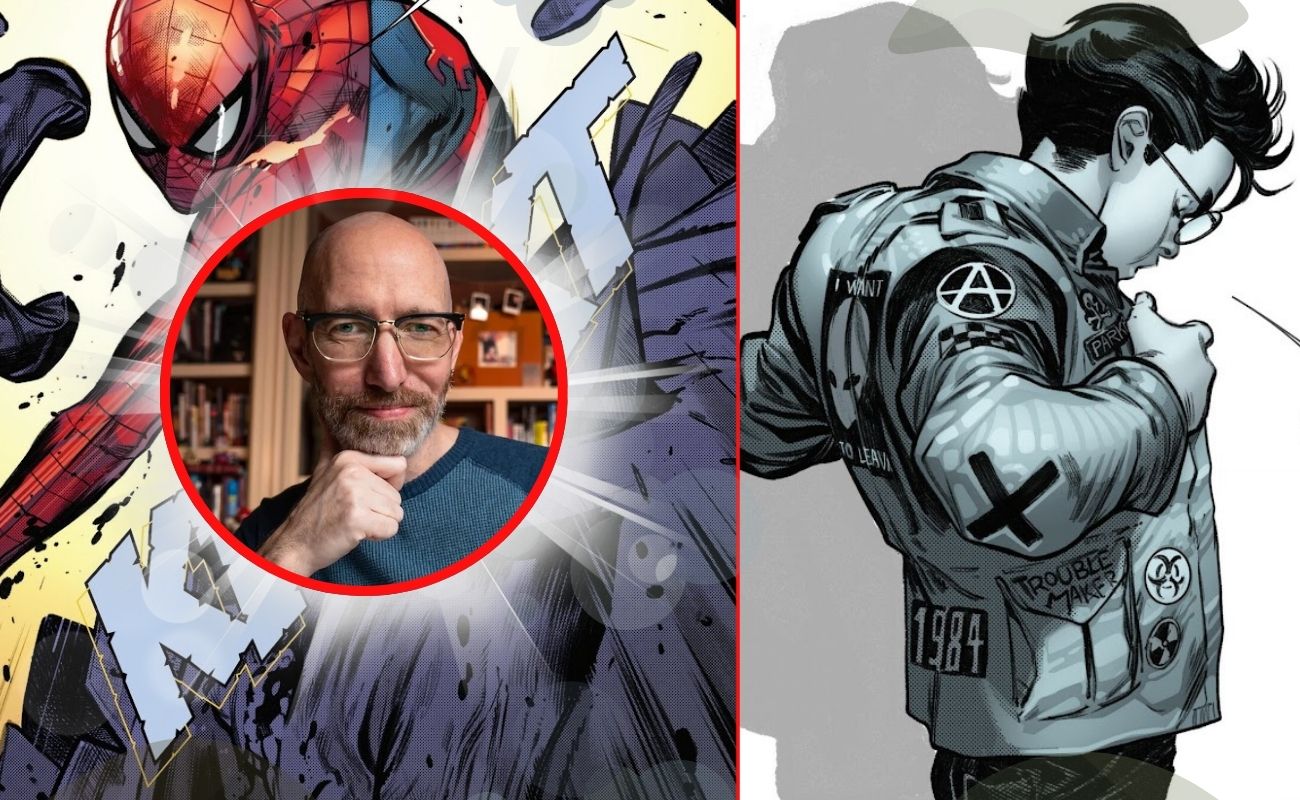

Where part three explored the expanding cast reshaping Spider-Man’s orbit, this latest chapter turns the emotional blueprint behind the mask. Here, we trace how Peter Parker’s childhood fears, anger, and fragile sense of identity continue to shape Spider-Man’s voice, humor, and moral resolve.
Spider-Man’s personality is inseparable from Peter Parker’s emotional history. Joe Kelly’s Amazing Spider-Man run examines that connection by revisiting Peter’s formative years while refining how Spider-Man’s voice communicates fear, humor, and moral conviction. The fact that Kelly is probing a painful era (the source of Parker’s pain as an orphan) makes this run particularly ripe for novel exploration. And that’s saying something for a character that’s over 63 years old.
In our conversation, Kelly believes Parker’s childhood contains emotional foundations that have rarely been explored in Spider-Man storytelling. By focusing on Peter’s years before high school, Kelly seeks to understand how fear and identity develop long before Peter becomes Spider-Man.
“For Peter specifically, it was kind of, I thought it was fun to go pre-high school,” Kelly said. “We’ve never looked at it.”
Kelly sees middle school as a critical emotional crossroads.
“Middle school Peter is fascinating to me,” Kelly said. “Because I think that’s a time where all, you know, we’re starting to bubble up our emotions in new ways.”

A flashback from Amazing Spider-Man #3. Courtesy of Marvel Comics.
During this period, Peter begins struggling with identity and emotional instability, both of which foreshadow his future as Spider-Man.
“You’re starting to figure out like, ‘Oh yeah, I’m not quite a kid, but I don’t know what I am yet,’” Kelly said.
To prepare for the process, Kelly revisited Peter’s early comic portrayals, which often emphasized anger and insecurity alongside his intelligence and compassion.
“When you look back at early Spider-Man issues, Peter was angry a lot,” Kelly said. “Like he got very angry, right? Really quickly.”
That emotional volatility can be traced back to Peter’s adoption and sense of displacement.
“It seemed pretty obvious that it was him acknowledging like, ‘Oh, I, you know, I’m adopted,’” Kelly said. “I don’t know anything about my parents.”
The looming loss of Aunt May and Uncle Ben further intensifies Peter’s fear of abandonment.
“The realization that one day, you know, Aunt May and Uncle Ben might not be around, and that’s scary,” Kelly said.
A similar psychological analysis has also been applied to Norman Osborn, exploring how trauma shapes villainy and redemption, especially in recent issues.
“To apply that same lens to Norman…almost to sort of imply that, like when you’re a Spider-Man, when you’re like swinging around, your present isn’t formed by your past,” Kelly said.
From there, Kelly wanted Norman’s story to confront generational abuse and emotional inheritance.
“To get to see the side of what happens when you’re, you know, raised in an abusive household,” Kelly said. “And what that really means and how that infiltrates his life as he’s trying to be a better person.”
Parker’s emotional history is directly related to how Spider-Man communicates during crises. He approaches Spider-Man’s humor as a psychological coping mechanism rather than simple comic relief.
“I definitely try to go back to…when does Peter use humor thing,” Kelly said. “Using humor as a shield, not a weapon, is really interesting.”

A Norman Osborn flashback from Amazing Spider-Man #20. Courtesy of Marvel Comics.
That said, humor can’t be used willy-nilly and must reflect emotional context. Or, as Kelly put it, it’s about “trying to put humor in as much as possible…when it’s appropriate.”
Equally important are the moments when Spider-Man stops joking entirely, signaling genuine emotional and physical danger.
“He does have to have a line where all of a sudden it’s like the jokes stop,” Kelly said. “Because things have gotten really serious.”
Above all else, though, Kelly thinks Spider-Man’s sincerity remains the character’s defining trait, adding, “He so wants to do the right thing.” The tension between honesty and secrecy also shapes Spider-Man’s internal conflict.
“He tries really hard not to lie,” Kelly said. “And then when he does, because he has to lie all the time…you know, it hurts.”
As for Kelly’s inspirations, that became abundantly clear when, quite excitedly, Kelly brought up One Piece and what manga pulls off with action and visual storytelling. That includes issues where there’s only action, and where internal narration often plays a larger role in revealing emotional nuance.
As someone who “reads a lot of manga,” Kelly noted that a lot of these stories get away with using fewer and fewer thought balloons. He said appreciates how those techniques allow readers to experience characters’ internal struggles more directly.
“Sometimes it’s balloon-less,” Kelly said. “It’s just floating internal stuff.” Knowing Kelly’s love of manga, you might be inclined to go back and read the last twenty-two issues of his run.
Kelly’s exploration of Parker’s childhood and Spider-Man’s voice reinforces his central belief that Spider-Man stories succeed when emotional vulnerability drives the narrative. By examining Peter’s earliest fears, and refining how Spider-Man expresses those fears through humor and sincerity, Kelly continues to redefine the character as both a superhero and a deeply human figure.
If you haven’t already, read part one and part two.
Upcoming Release Schedule
- Part V: Inside “Death Spiral” and Spider-Man’s breaking point (Tuesday 2/24)
- Part VI: The road to Amazing Spider-Man #1000 (Thursday 2/26)
- Part VII: Legacy reflections, Sal Buscema, and MAD About DC (Tuesday 3/3)



You must be logged in to post a comment.