


I’m not religious by any stretch of the imagination, but Cult of the Lamb has been a near spiritual experience.
Creators Alex Paknadel and Troy Little have taken what was a beloved “cult management simulator,” stretched its emotional and moral attributes to their respective and natural ends, and forged a story about servitude, family, and loyalty at a time when it seems hella apt.
But even the most affirmational stories must come to an end, and Cult of the Lamb does just that with its second extended finale, Last Sacrament Special (which follows last year’s excellent Cult of the Lamb: Schism Special). And regardless of your own faith, you should absolutely feel the holy ghost of great comics.
Here’s what you need to know heading into Last Sacrament: Nana (Lamb’s most beloved/faithful follower) has been slain, sending our hero into a murderous rage. Said murderous rage has meant that Lamb has all but abandoned their flock, which has led the nasty Amdusias to form a splinter group. And if all that strife and heartache weren’t enough, there’s two still more Bishops left to dispatch, Kallamar and Shamura (with Leshy killed in the 2024 series and Heket dispatched in Schism Special). Beat that bloody vengeance and in-fighting, most religious texts!
One of my core concerns with Schism Special was that, after getting four solid issues for the first half of the story (effectively), there was a lot crammed into one 48-page story. And Last Sacrament is very much in the same boat — you could argue there’s even more to accomplish with two Bishops to un-anoint. But Paknadel and Little do an even better job of balancing these many threads, and Last Sacrament feels busy without losing the plot, and robust without ever proving overwhelming.
Part of that effectiveness is that so much has been established already. Not just in that we know the score of the remaining story (kill the Bishops, serve The One Below, save the flock, etc.) but that the creative team have written themselves into a perfect ending of sorts. So, yes, this issue may rush through a couple “Bishop Boss Battles,” but there’s a tone and intent here that maximizes your engagement — it’s all about hitting “goals” with the utmost action, emotionality, thematic heft, etc.
It almost felt like some beloved TV show getting to come back for a final movie. Yeah, there’s so much to still do, and way more story that we could meander through to really let this “universe” hum a bit longer. But nobody’s got the time for that, and we need to hit the big points if we’re going to have our yummy, yummy resolution.

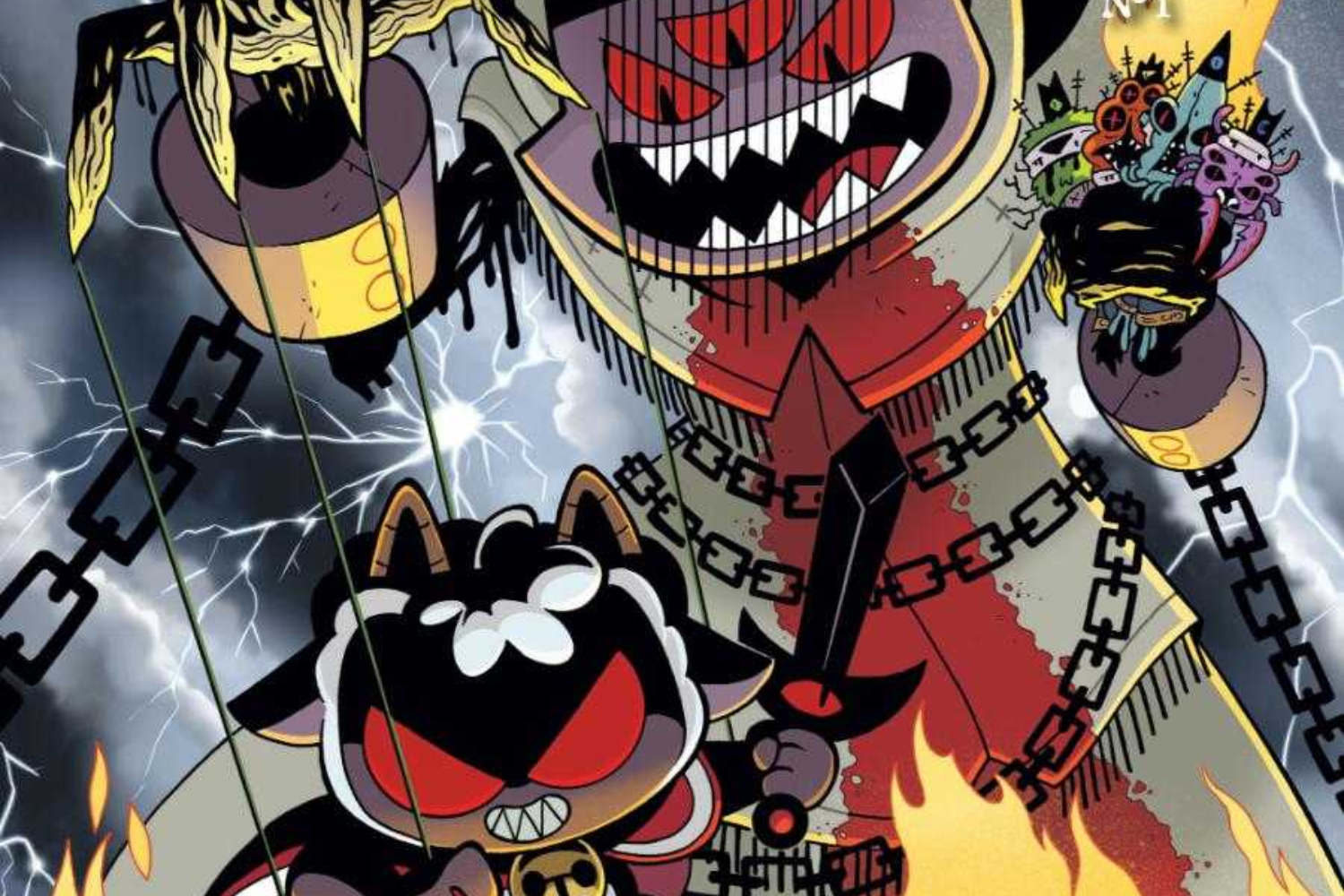
Main cover by Troy Little. Courtesy of Oni Press.
This whole dynamic is further aided by the continued excellence of the art team (with Little joined by colorist Nick Filardi and co-letterer Crank!) The Bishop battles have always been a huge source for inventive and thrilling emotion and action, and a way to really move through so much story in a way that never feels half-cocked or unsatisfying. And in Last Sacrament that’s very much the same: With spinning slashes, eldritch blood/gore by the metric tonnes, and a feeling of proper efficiency, these battles have become a way to let off so much steam and really savor something accordingly epic (while the book still dips and weaves with a certain leanness).
Perhaps we’d like more time with these moments given their significance, but as Last Sacrament makes clear, it’s not about length but stoking some emotional significance and giving us what we need: a clear resolution that satiates something deeper still.
You get some of those same energies exist outside the gnarly battles. Last Sacrament offered heaps more time outside these grand encounters, with Lamb having to grieve, Amdusias further politicking (could he be the best Trump allegory to date?), and lots of castle intrigue that would make Game of Thrones feel inadequate.
Sure, these are decidedly more slow-burning, but they’re just as gripping and dramatic. Be it Paknadel’s ear for proper dialogue, the dramatic tinge of the lettering, or just some of the most emotive character work/designs I’ve seen in some time (not bad for woodland creatures!), Last Sacrament knows how to bring us in with lethal details and targeted sentiments. And in doing so, everything feels properly engaging and compelling even as some moments truly stand out.
I sort of liken it to watching “Shakespeare in the Park” or something. Even when, say, Hamlet has this long, drawn-out monologue that runs five minutes, and even if you’re waiting for more stabbings or talk of blood, everything feels heightened. You’re watching this practically living creature roll around in front of you, and at any moment it could thrash or crawl into itself, and all the time you can’t help but feel like you’re being consumed.
That’s exactly what you want out of a great story, right? This sense that we’re watching something huge and undeniable live and die right in front of us. And even if the neat-o sword battles seem more exciting than, say, talk of feeding your faithful, all of it is part of this larger experience. An experience, I’d add, that earns our slack-jawed attention with care, depth, energy, intent — this thing is alive in ways we’d only ever hope, and to watch it is an honor.
Because at the end of the day, what’s made Cult of the Lamb a success has little do with blood and guts, adorable animals monologuing like some grand thespians, or endless drama and theatricality — it’s the humanity. That thread of moral exploration has existed this entire time, but in Last Sacrament it too reaches an apex and a fitting conclusion.
This whole story has been a lesson in loving your neighbors (and thus yourself), how we survive together as communities, and what’s really worthy of your love and devotion. And, sure, some of that feels a wee bit heavy-handed across this latest special, but it’s “rewarded” because it finally, firmly lands. Without revealing too much, it takes some additional loss and chaos for Lamb to finally see what they should have done all along.

Variant cover by Rian Gonzales. Courtesy of Oni Press.
Their biggest battle isn’t with the final two Bishops, or dispatching any feckless heretics/traitors. It’s basically with themselves and all that they once believed. And while that’s translated literally in a finale that’s deeply, deeply satisfying to see play out, that moment is there for us to ogle (it is a comic book, after all). Ultimately, the larger value is moving the theoretical into the very real (as so much of this book has done already), and to show us and Lamb that not only is it better to be a good person, but the opportunity is right there waiting to be seized.
We won’t need to use an axe or sword to do anything — there’s no battle to prepare for, or great scourge to overcome — you just need the will to act to help and uplift your brothers and sisters. In that way, Last Sacrament has made real all of its emotional promises, and done so in a way that isn’t just affirmational but deeply practical and at a singular time when more of us just need that nudge forward to do something better.
From there, the question begs: Does Cult of the Lamb have a “good” or “bad” ending? Without revealing too much, the book utilizes a clever enough device to touch on such “simple” outcomes and moral inevitablities. But mostly it’s a final lesson that whatever you believe to be out there in the world, you can manifest it however you see fit. Also, that there are no conclusions, only decisions we make in the pursuit of our own dreams and whims. In short, we’re in charge, and the story ends with a reminder that no one else can tell this tale but us.
And that to me is maybe the best lesson of both Cult of the Lamb at large and the Last Sacrament: If we’re to have faith, maybe it should be in ourselves. Gods and whatnot are cool and all, but look at the power you already have. You can make a comic book about a Lamb creating a cult, and use it to teach people about love, forgiveness, community, etc. Or, you can read that comic book at not just giggle at the beheadings and cutesy animals, but decide that’s enough to make some real improvements as a person.
That’s the world we live in — not just one that’s dark and weird, but where we can embrace those things in the name of something better. Even if that “better” is just another chance to muck it up a little bit less the very next time.
A-flippin’-men.




You must be logged in to post a comment.