

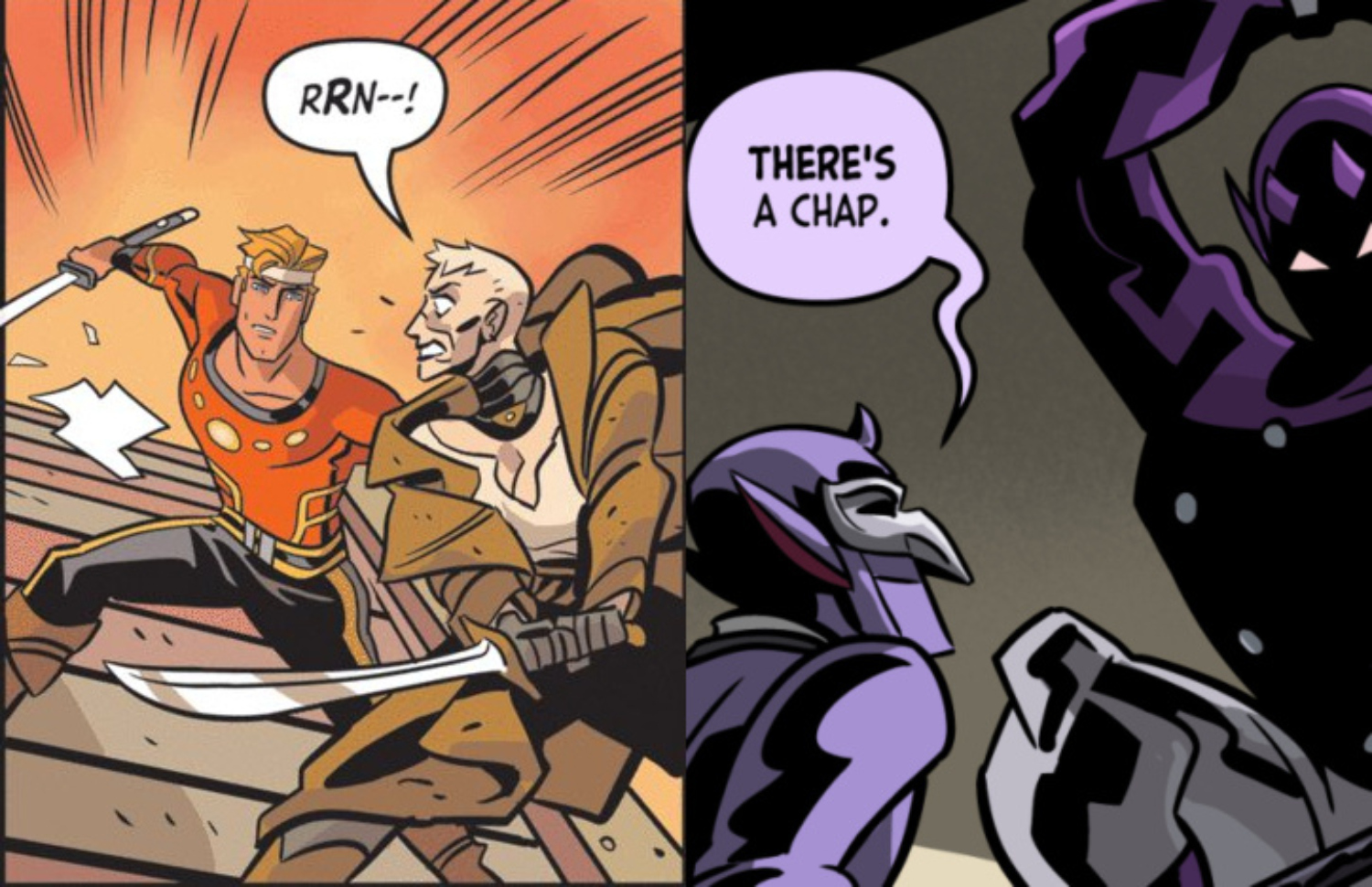

This is a story about destiny, and what happens when a storyteller gets an opportunity to explore what matters most.
It’s also about space men and monsters, if that’s more of your speed.
It all begins just a few years ago as writer/artist Dan Schkade was looking for work. So, being a most enterprising fella, he reached out to King Features, who syndicate everything from Alice to Sally Forth across some 5,000 newspapers worldwide.
“If there’s a strip that you’re looking for new talent on, I would love to try out for it,” Schkade told me of that call during own Zoom call late last fall. “I specifically said that if you’re essentially looking for somebody to modernize Rip Kirby, I would love to do that.”
By the time he reach Tea Fougner (who at the time was King’s editorial director), that group had another idea entirely for Schkade.
“So I get on the call, and she says it’s Flash Gordon, which is the last thing I expected,” Schkade said. “It’s also not a property I had a big attachment to,” adding that he was both anxious and excited to “dive into these waters that were unfamiliar to me.”
This is where the fate bit comes in. Because, almost entirely without intention, Schkade already had one project that had actually prepared him for this most curious endeavor: Lavender Jack.

Courtesy of the artist.
One Big Story?
Yes, some of that aforementioned preparation was in a more general sort of way.
“I was looking forward to trying out any daily strip because part of my pitch to Tea was that I’ve been doing a 35-, 40-panel weekly comic for years now,” Schkade said. “I felt like I’ve got a very rarefied skill set and I would have loved to try my hand at this.”
But I also meant that Lavender Jack (which ran from 2018 to 2022) ended in such a way that you’d swear Schkade planned it all along (which he sort of did?)
“My version of Flash is a spiritual sequel to what’s going on in Lavender Jack,” Schkade said. “Like, Lavender Jack ends where Flash picks up. There’s even the thing where the heroes raid an airship at the end of Lavender Jack, and that’s how Flash starts. Part of that was intentional. I was trying to ride my own momentum. But there’s also a lot of themes that carry over.”
But before we get to the really good stuff, there are other points of interaction (and even some contrast) between Lavender Jack and Flash Gordon. Motifs, ideas, sentiments, etc. that not only give us a lot of insight into Schkade the artist, but also what makes a good story, how to balance innovation with nostalgia, and even why some stories truly can last forever.
And with Lavender Jack being collected by Dark Horse Comics (and Flash Gordon still going strong), now’s the perfect time to compare and contrast our dashing heroes.
The Avenging Hero Type
But first, let’s jump back to when Schkade actually landed the Flash Gordon gig. As mentioned, he never grew up on the serialized epic. So, his first task was to do some homework.
“I had to learn about it and learn the characters, and really dig into why it’s been around for 90 years,” Schkade said. “My approach was to pop the hood and really see what was cool about it and what was working about it. As anybody knows who follows my work, I’ve got a huge love and appreciation for pulp stuff and Golden Age comics stuff.”
Schkade added, “So that became my pitch – we’re not going to reinvent the wheel, we’re just gonna do classic Flash Gordon, but it’s going to appeal to a modern audience. It’s going to be moving in a forward direction as opposed to just doing the origin story again.”

Courtesy of King Features.
A huge chunk of that core respect of the past is that Schkade has seen what happens when other creators don’t willfully engage with these essential, long-standing works.
“I swear, I read a pitch once for a property…I’m not going to say what it is, but it was the tone of the pitch,” Schkade said. “It actually said, ‘We’re finally going to actually take this property seriously.’ And it was a pitch that was going to be read by the creator of the character. Turns out that Alex Raymond and Don Moore knew what they were doing. Turns out, for a good while, Harvey Kurtzman was writing Flash Gordon.” (And it’s even more personal as Schkade said that his “good friend Jeff Parker and Doc Shaner also did Flash.”)
And it’s further evidenced in other stories he describes as tent-poles for much for the series’ overarching feeling and tone.
“I was really inspired by, when looking for touchstones, at Chris Samnee on Thor: The Mighty Avenger,” Schkade said. “Obviously a wonder for all ages; you know zero about Thor, and you pick up this book, and now like you’ve got a grasp of him and his place in the Marvel universe.”
Schkade added, “That, and All-Star Superman, which is a story that not only perfectly captures Superman – especially Silver Age and Curt Swan-era Superman – but it takes all that in a completely new direction. It’s telling a new Superman story that feels familiar, that rhymes with other stories that we’ve heard before, but it encourages the readers to feel like they’re charting new territory.”
But, as you might have already guessed, it’s also a lesson he gleaned most readily during his time on Lavender Jack. You have to have not only a well-developed lead (in this case, aristocrat-turned-avenger Sir Mimley Cedarbrook Bastrop), but also someone who balances those familiar tropes with something new and thoughtful.
“There’s a real push and pull with Mimley, especially when he’s in the costume, where he is a guy who would like everything to be fine, and for everyone to get along and we can just have a nice life and travel and see fun things,” Schkade said. “He wants to be like Bertie Wooster, but he’s also incredibly angry. He has suffered a great injustice and feels partially responsible for it. And he’s so offended that people empower others in acting this way.”
For Mimley, Schkade said that he “kept hearing Emma Frost when I meet him,” adding that he’s “often quite cruel and he’s an aristocratic bully. And that’s fun.” But unlike Emma’s journey and struggles, Mimley is faced with his own deeply personal quandaries.
“He has been put in positions where he has to answer the question, ‘Do you like this because you like the burn you get from being mean to people, to hurting people,'” Schkade said. “Or, ‘Are you building towards something? Are you trying to create a presence, a legacy that improves things?”
And there’s something like that in all of the main characters across Lavender Jack.
“And I feel like that’s the beauty of the [other] main characters,” Schkade said. “Ducky, who’s the brains behind the operation; Theresa Ferrier, the great detective; and Crab, who is the favorite character I’ve ever created because he’s just a dumb, straightforward person who just wants to figure s**t out and wants people to speak plain. You have people like Mimly and Ducky, who are lost in their cleverness. Then there’s Ferrier and Crab, who are like, ‘Well, the rubber’s gonna meet the road at a certain point.’”
The Bones of The Story
In some key ways, the resulting courage (at least in terms of making resonant characters) has helped Schkade do some important and inventive things across Flash.
“I definitely feel a pressure to the readers,” Schkade said. “I feel like I worked hard to win over the long-time readers that were not so warm to me when I showed up. And then I also have the new readers that I brought to the strip, people who knew me from Lavender Jack and people who just are attracted to the new approach.”

Courtesy of Dan Schkade/WEBTOON.
Schkade added, “But in terms of the legacy of the strip, I feel pretty comfortable there because I feel like we’ve carved out a version of this strip that’s very internally consistent, and that has its own vibe. And we have so many new characters that have fleshed out the world, but also have just given us new dynamics to play with.”
Case in point: Bones Malock. Not only is this Flash Gordon‘s very first non-binary character, but Bones typifies how Schkade has managed to create new characters without upsetting the rather delicate balance of the strip.
“It’s a balancing act,” Schkade said. “You can really easily run into the territory of..fan fiction. Bones, for example, is a pirate outlaw with a lightning sword; that is a very original character. But the key is to measure how interesting the character is against how much narrative space you’re giving them. When it comes to Bones, they have a lot of plot utility as [being] outside of society – an outlaw in a comic that’s very full of people who are enmeshed in a social role. They are levers for those people out of their social roles and you can move them around to different levels of society.”
As a “lever,” then, Bones gets to butt heads with the more established characters, and the end result is almost always extra interesting.
“Bones is the equivalent of an X-factor to Flash,” Schkade said. “While Flash is always forthright, doing the right thing, concerned about other people, Bones is at least nominally a little bit more of a murky character. You can hang a lot on Bones. Whenever Bones shows up, it’s always fun, but it’s fun because they don’t show up again for months and months and months.”
Even more “consistent,” long-running characters have the same kind of power of Bones under Schkade’s enthusiastic supervision. For example, Bok, the dragon-man who Schkade describes as a “mascot character for this version of the strip.” He may have been a “goon-tier character” beforehand, but Schkade has elevated him to the main cast to dazzling effectiveness.
“Bok is a reliable, observational character that can be put in, I think, almost infinite situations and not get tiresome,” Schkade said. “He has this thing that Hellboy or Ben Grimm or Brock Sampson has, where it’s a guy who is of this world, but just a little to the left, just a little. He’s taken the two steps back to line up the shot. Bok brings out really interesting colors in the other characters. Characters that show him respect, characters that don’t show him respect. In Flash, you see him have a buddy who’s more on his level, who isn’t a prince or a rocket scientist or a woman he’s in love with.”
Like Jackie Chan, Baby
Yet even Schkade is well aware that new characters like Bones may not last. And, to an extent, that’s a good thing as it always preserves what matters most about a series like Flash Gordon.
“Even if nobody picks up any of new characters again, like Bones, I feel like we’re creating a lot of special moments that will stand out if you’re going through the history of the strip,” Schkade said. “Other newer characters, especially newer villains, they have storylines and they serve their role, you just never want to run into a situation where you have all these new original characters and Flash and the other established characters are just watching.”
Schkade likens it to a “Jackie Chan movie,” adding, “You want to see him jump through something narrow. When you turn into Flash, you want to see him get in a sword fight and fly a rocket.” So then it becomes about not only keeping the spotlight where it matters, but doing so in a way that always honors the character’s essence while finding new ways to make that feel novel and special.
“But I would say the main thing that makes Flash Gordon stories thrilling is a guy who’s dropped into an alien situation,” Schkade said. “Whether it’s the entire planet or just a new nation he goes to.”

Courtesy of King Features.
Schkade added, “He’s confronted with hostility. People don’t know what to do with him. He’s often almost in a Quantum Leap…he finds himself in the middle of something where everybody’s against him. But through the strength of his character, his understanding, his willingness to extend the benefit of the doubt, people who were ready to be his enemies then turn into his friends. And if you do a story that’s just the same character as we’ve been seeing for 90 years, you’re missing out on something that makes Flash fun. So you have to keep giving him new people to be drawn into his spell, his gravity to really access everything this strip has to offer.”
For Schkade, Flash stories come down to “survival.” Lavender Jack, meanwhile, is all about “victory.” Which is to say, Flash is always trying to keep everyone as happy as he can as this fish out of water. Yet once he dons his own mask, Lavender Jack has some more specific foes to battle.
“Class is a big topic of discussion in both of them,” Schkade said. “Like, protecting people of different identities and walks of life. The idea that there’s no such thing as a person who’s better than another person. And when it comes to Flash, it’s about a beautiful, perfect guy who believes in you. And when it comes to Lavender Jack, it’s a little bit more of, ‘We are all part of one community, and we must band together.'”
Or, look at it this way: Both series are about folks coalescing, but they approach their respective problems and solutions in an entirely different manner.
“I think a difference would be that Lavender Jack is about collaboration about different people coming together,” Schkade said. “Whereas Flash is a little more about community in the face of adversity, in the face of tyranny, forces that are actively trying to destroy community. It’s different octaves but the same time.”
(Here’s a fun interlude stemming from that octaves bit. Schkade says he “doesn’t know how sound works, which is funny because there’s a sound villain in season two of Lavender Jack, The Black Note.” He said he was pushed so heavily to include musical double entendre that he eventually “made it a plot element that a character later calls him out on the idea that he doesn’t actually know much about music and he’s into the opera.”)
Whereas Bones and Flash eventually became a rather perfect lens for being an outsider and maneuvering society, similar ideas began percolating in Lavender Jack. In the first collected edition of the series, Schkade offers a special thanks to cartoonist Paul Guinan who introduced him to “the death of noblesse oblige.” (We’ll pause while you get out your French-to-English translator.)
“Up until the 20th Century and the Great Depression, there was this idea, at least this understanding, of this [societal] trade-off,” Schkade said. “The people who weren’t wealthy and powerful would wash your socks and cook your food. In exchange, you would protect them. If they were sick, you would provide for them. If they were under attack, you would defend them.”
But when almost everyone lost their fortunes in the Great Depression, Schkade said that whole concept was “nuked,” adding, “So if you still had money after, it is because you were better. You were smarter. God smiled on you and not on them. And, of course, it’s not true that having money after the Depression meant you were smart; it meant you were lucky. The same luck that made you born a baron is the same thing that enabled you to have money in the ‘30s.”
So, then, what’s got to do with Lavender Jack then? (And, by extension Flash himself?) Well, Schkade said Jack became an “avatar for that concept – for the idea that if you are powerful, you must, at bare minimum, not be a tyrant to those underneath you. And if you are, then you will be embarrassed and assaulted.” It’s an expression of anger Schkade felt during the first administration of Donald Trump, as we all searched around for heroes that might make it all better.
“It’s this idea that somebody stops waiting for permission to hold people to account and just does something,” Schkade said. “Trying to be good, trying to be better, is cringe. It’s embarrassing. And it often doesn’t work. People who don’t want to try will laugh at you. And so Flash is just like Brendan Fraser in George of the Jungle – just this handsome, simple guy that will stand next to you while you do this embarrassing attempt to be good.”
Denny, Frank, and P.G.
The Lavender Jack influence, however, will be seen more acutely in the coming storyline that plays out across Flash Gordon. Schkade that after being absent in recent years, Ming the Merciless has made his return as of late. And his latest clash with Mr. Gordon touches on similar ideas of acquiescing power and trusting in the elites who seem to have zero vested interest in your happiness or survival.
“And something we see right away, something we’re going to expand upon [in 2026], is that where Flash gives people permission to try to be their best selves, Ming gives them permission to be weak,” Schkade said. “To not even just be their worst selves – just to not try. Like, ‘It’s too complicated, let me tell you what to do.’ It’s a lead blanket – it’s oppressive, but it’s cozy. And so we see this is why they’re enemies. This is why they hate each other.”

Courtesy of Dark Horse Comics.
That “interaction” is another instance where Lavender Jack seems to “show up” amid Flash Gordon (which makes sense given the flow of time). But as Schkade was working on adapting Lavender Jack for the forthcoming print release, he also saw areas where he’d wished he’d done just a little better overall.
“There are some things I just know better now – like having the relationships between the characters be more well-defined,” Schkade said. “Because a lot of the characters in Lavender Jack just kind of know each other. I wish they had more time to coalesce together. And part of that was that I was, especially at the beginning, intentionally trying to chase the narrative aesthetic of P.G. Wodehouse’s Jeeves and Wooster stories. I was trying to combine that with a Denny O’Neil, Frank Miller type story.”
The same goes for Lavender Jack‘s more “verbose” tendencies. While Schkade thinks he “got some interesting moments” from characters talking out problems in real-time, he’s learned something vital from his more recent work with Flash.
“I’ve really come to appreciate the value of taking what a character thinks and putting it in one little statement that lets us know what their point of view is and what’s important to them right now,” Schkade said. “Because as much as I love how philosophical and conversational Lavender Jack is, it’s very much like a West Wing-type of free-for-all at times. There’s a reason why I think that show works is because it feels very homely and comfortable because you get that low pace and opportunity to watch people’s brains work it all out. Especially if you like the characters – it’s fun to see them put through their paces like that.”
That’s not to say that he sees Lavender Jack as “somehow being a bad comic.” Rather, “every new piece of information you give the reader is an opportunity for them to lose the point of what you’re saying.. And that’s always a balance. You want to have context, but you want to make sure your point gets across and not just a political or philosophical point, but a plot point.” Plus, Schkade had to “re-letter everything. So I am acutely aware of how much I suck. I wish I hadn’t written so much.”
But in a further blurring of chicken-egg, Schkade said that the idea of putting characters through “their paces” very much shows up in Flash Gordon.
“Flash directly influenced Superman and directly influenced Star Wars and directly influenced Stargate,” Schkade said. “There are so many direct lines to draw. And I think people get lost in that. They get lost in the legacy. They make him too heroic, too iconic.”
Schkade added, “I was doing an AMA once, and Jadzia Axelrod (who is a talented writer) asked if it was intimidating taking on these characters. I said, because I didn’t know them going in, and because I feel like the popular culture understanding of these characters is so broad and flattened, I feel less like I am trying to measure up to the characters and more like I’ve discovered these cool guys. Like, how excited I get to tell my girlfriend that I made a new friend at the bar.”
“My Sin City“
Of course, for all the overlap between these two stories, Schkade does recognize that there are some clear, often unavoidable differences. He made one slightly specific but really important analogy to explain the distinction.
“It’s like talking to somebody in a club versus when you’re at home,” Schkade said. “At home, you can have a long-winded conversation, but if you’re in a club, you have to be like, ‘She isn’t into you, and you need to drop this.’ Flash Gordon is comics in the club.”
OK, what Schkade is getting at here is part of an answer to when I asked if Flash Gordon is somehow a chance to “correct the record” of Lavender Jack. For Schkade, it’s instead an “opportunity to look at those same themes in a different setting with different characters, and with different narrative responsibilities. We literally can’t sit around and talk about things like we used to.”
Schkade added, “All the philosophical stuff in Lavender Jack has to be evidenced through action in Flash Gordon. And, you know, the way that Flash fought to liberate workers from the satellite plant this summer, and the way that Dr. Zarkov approached being forced to work on a weapon of mass destruction in Sky City. These are all things that are digestible in four-panel chunks that explore the same themes. But you couldn’t just post four panels of a Lavender Jack discussion.”
And, of course, each project has its own unique challenges and opportunities (even as, once again, they both were/are weekly comics). For Flash Gordon, Schkade had to overcome the issue of canon for a series dating back nearly 100 years.
“King didn’t roll out that there would be a new version of the strip – it just started one day,” Schkade said. “So they were a little confused at first, but they’ve come to understand that as a basic rule of thumb, anything that happened in the first 10 years of the strip basically happened in our version. The nations coming together, overthrowing Ming – that’s where our strip starts.”

Courtesy of King Features.
Along the way, Schkade and his editors have done “a lot of housekeeping with the continuity, and I purposely kept a lot of things open-ended because I realized early on that the more specific you get early on, the more you’re tied into it and the more stuff you have to remember.” At the end of they day, Schkade added, “None of this is real. We aren’t setting up an RPG book. We’re telling a cool science fiction fantasy story.”
As for Lavender Jack, the issue is maybe a little more first-world in nature.
“I have new Lavender Jack ideas all the time, especially now that I’ve been working on the collections and I just love these characters,” Schkade said, adding that he’d also like to do a young Theresa Ferrier series set in France in the 1870s. He added, “They just kind of write themselves. They’ve got such cool stuff they can do, and they’re made out of my big interests. Costume dramas and crime stories and science fiction and karate – this is like my Sin City.”
But given his obligations to Flash Gordon – “I’m doing at least another year on it. And I have an overarching idea for where the stories would end” – Schkade said he has to be “realistic about what I’m capable of, but I hope I get the opportunity to do at least half of it.” Schkade even likened weekly comics to “writing on Saturday Night Live,” adding that he would “love to go back to monthly comics. Because you have an opportunity to unpack themes a little bit more. I have the experience of having to condense things so much.”
But Schkade is grateful for getting to do both projects to whatever degree he can/could. At one point, he recounts a story from earlier in his career that has a lot to say about his current “predicament.” A decade ago or so, he teamed with Matt and Brennan Wagner for a 12-issue The Spirit miniseries over at Dynamite. He was a huge fan of the Will Eisner original, and he did a lot of research and planning to best honor the original adventures. This time around, though, Schkade is a much different creator, and he’s capable of standing on his own two feet.
“Those are very good, and they’re very fidelitous. I do think that they brought a freshness to the property,” Schkade said. “But I was also a lot earlier in my career. I would have been lost at sea if I was jumping into something completely new. But now that I’ve been doing it for a while, and I’ve been fairly successful with my own creations, I feel like [Flash] didn’t seem like a challenge so much as a really cool and rare opportunity.”
The New Revolution
Of course, this wouldn’t be a pulpy sci-fi epic, or even “steampunk Daredevil,” if the differing heroes didn’t come together near the end in the name of goodness and justice. For all their similarities and differences (aesthetically, narratively, etc.), there’s some rather important connective points between Flash Gordon and Lavender Jack we haven’t even addressed.
“If there’s one universal rule that occurs in both properties, it’s that anybody who strikes off on their own and rejects other people’s help will fail,” Schkade said. “And, no matter how smart or rich or good at karate you are, you are just a man. You are just flesh and blood. There’s no detective so brilliant that she doesn’t need somebody to watch her back.”
If that’s a little too feel-good for ya, there’s a similar idea that really extends and augments the shape of these two projects.
“If there’s a thesis for my entire body of work, it’s…everybody is the hero of their own story, and everyone’s also the villain of their own story,” Schkade said. “We all feel, on some level, like there are parts of us that are unsavable. And some of us are consumed by that feeling. Some of us become bad people because we’re so committed to trying to ignore that feeling.”

Courtesy of Dark Horse Comics.
Either way, they’re all ideas and sentiments that have become extra apparent in recent years. Schkade said he’s a person who “experiences a lot of anger. I’m a person who sees a lot of injustice around me.” And with so much of that going around these days, he believes that his make-believe heroes have some real-world representatives that are giving people more than just hope through deeply powerful fiction.
“I think that’s why the [Zohran] Mamdani campaign captured the nation’s imagination,” Schkade said. “The sentiment I kept hearing is like, ‘Oh, you’re allowed to do that. You’re allowed to just want a basic thing for the place where you live.’ And it turns out you are. Like, New York didn’t have the biggest voter turnout of the century because nobody had anything to do that Tuesday. He tapped into something.”
Schkade added, “And for a year that started with Luigi Mangione – I’m streamlining the calendar a little bit – that captured a very Lavender Jack kind of anger for a lot of people. Mamdani, I think, captured a very Flash Gordon type feeling.”
That overlap continues, of course, as Schkade moves into this next year behind Flash Gordon.
“I haven’t had the experience of writing a character like Ming in a long time – not since Lady Hawthorne in Lavender Jack,” Schkade said. “He’s so patient and so intelligent and so cruel in a way that feels mirthless. I feel like coming up in the spring, we’re going to get to actually spend some time with them. And I think people are going to, in a very tactile sense, understand why he’s Flash Gordon’s archenemy.”
Was it destiny that led Schkade to telling two stories with so many important connections (but also equally vital dissimilarities)? Kind of feels that way, doesn’t it? But if it’s not, then it’s still a wildly important case study for letting creators do their thing creatively. Maybe, then, it’s not about big, world-changing destiny. Instead, for Dan Schkade, his destiny (be it through both or either titles) is simple enough: Follow your muse, commit to the story, and hope it continues to make something perpetually wondrous.
“I try to make it at least interesting,” Schkade said. “Whenever I write something, and it’s just inert on the page, I’m like, ‘We’re going to have to cut one of their arms off. We’re going to have to give a guy a tail.’ You’ve got to make decisions and stick to them. Sometimes you get some really cool stuff out of that.”
The Lavender Jack volume one TPB is due out March 31. Read the latest Flash Gordon chapter (and the full archives) right here.



You must be logged in to post a comment.