


After three solid issues of Wrestle Heist, the main event is here at last.
And the whole dang affair leading up to now has been more packed than an ROH anniversary show circa 2008. Writer-artist Kyle Starks (joined by colorist Vladimir Popov) has used this grappling-centric caper as both a poignant love letter to and stern dissection of wrestling’s many wonders and shortcomings. And, as an extension of that, shown any non-devotees out there the ultimate power of proper rasslin’.
While the match that is Wrestle Heist ain’t over just yet, it’s the crowd that’s already taking a victory lap.

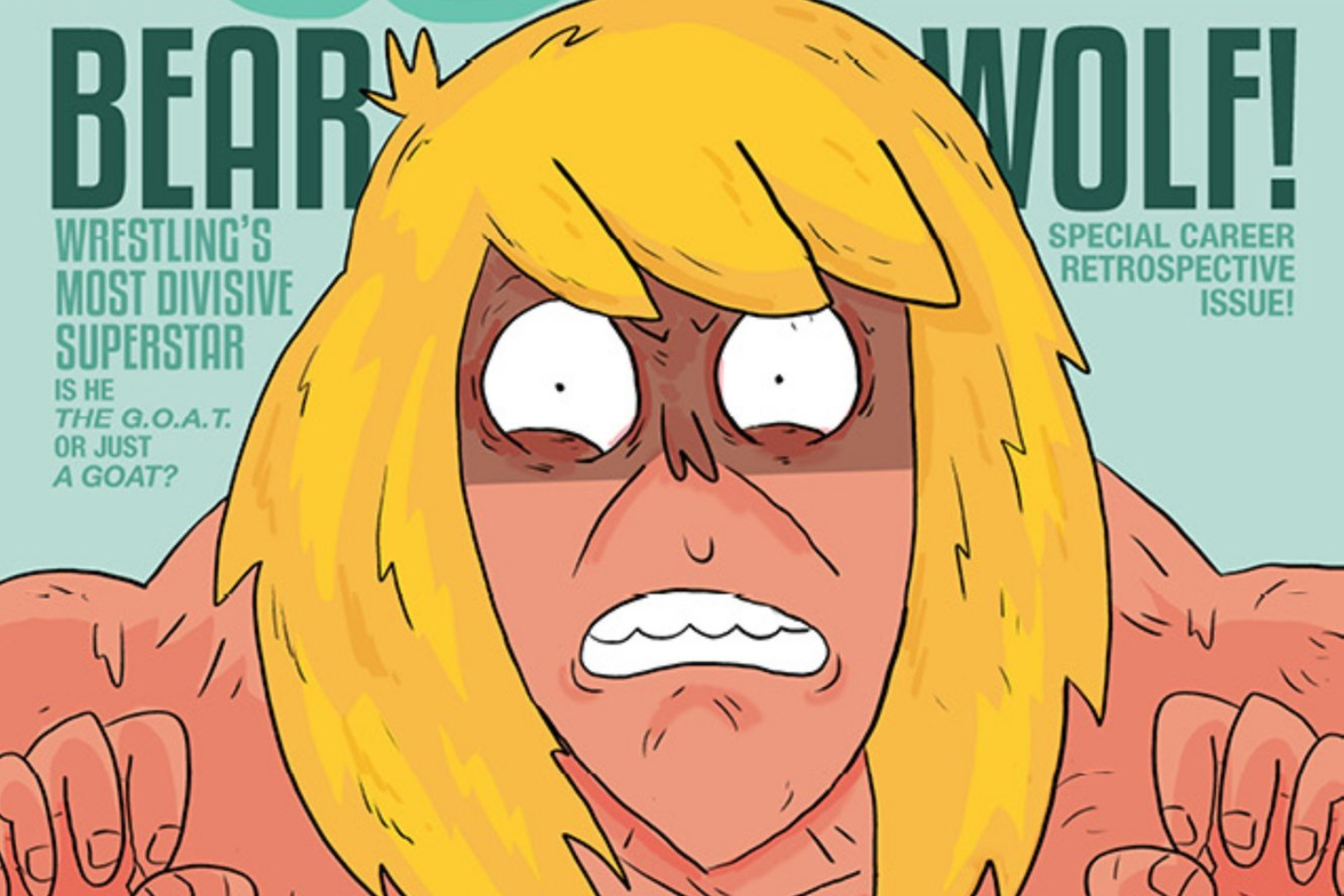
Variant cover by Kyle Starks. Courtesy of Image Comics.
Here’s what you need to know heading into Wrestle Heist #4: In an attempt to get back at nasty promoter Buddy Hansen (who nearly ruined his life), Sterling Steele has recruited Hansen’s other victims (Grave Digger, Bearwolf, Ocho Bola, and Hijo de Ocho Bola) to rob the jerkweed blind at his big Thanksgiving wrestle-palooza. And while everything seemed fine enough as the crew set about planning and getting to know one another like a de facto family, we learned that Hijo sold the crew out to Hansen. That’s more back-stabbing than a dozen versions of Seth Rollins betraying The Shield!
What we get with Wrestle Heist #4, then, is basically the first two falls in of a 2/3 falls match. So we get both the actual plan being spelled out to us and then the execution of said plan. And through that approach, there’s some really interesting stuff that takes hold.
In the execution part, we get a chance to once again enjoy the visuals. I said in my review of Wrestle Heist #3 that in a book about pro wrestling, and as tonally perfect as the resulting violence proved to be, Starks really shines with these “little moments.” Last time it was a moving, pre-robbery family dinner, and now it’s Sterling detailing the plan like a weirder, wilder version of Ocean’s Eleven. But there’s something charming about the visuals — the way things feel the right amount of cartoonish but also gritty and stylized — that truly exciting. Everyone is the right kind of scummy but endearing, and it feels like a way to position wrestling as this weirdly wonderful amalgamation of things and a vehicle for so many other ideas and genres and settings.
Starks really approaches this by splitting the difference between building a wrestling match and explaining a heist, and that does a lot for this book’s interests in further elevating wrestling as a storytelling medium. And if nothing else, the crew’s dynamic is so well established (and packed with proper development for each of the motley members) that I’d spend even more time immersed in their interactions/conversations.

Courtesy of Image Comics.
The best parts about wrestling (when done right) can be those unintended moments of storytelling might. There’s a reason backstage vignettes remain a huge part of wrestling: they bring us in like nothing else for the action ahead. Similarly, all the really good heist flicks I’ve seen do the same: It’s less about the action (though damn I still want that intensity) and more about the tension, humanity, and drama being fostered in those percolating moments just before it all pops off.
So not only does that elevate wrestling, but it’s an even more obvious commentary on the heist “genre,” and Starks is quite cleverly dissecting it all and comparing/contrasting things in a way that feels novel. It’s ultimately about a celebration of what makes a good story (the people, the internal challenges, the external obstacles, what they’ll do to reach their goal, etc.) and how that exists beyond genre and other such “confines.” The fact that it happens so effortlessly, too, is another comment on the nature of great stories: Even if you hadn’t consider this relationship before, it’s so intuitive that of course it just makes perfect sense. It’s a slower issue — slower than what we’ve gotten before — but I’m more jacked than Batista during his “Warrior Shake.”
https://www.tiktok.com/@wrestlerewindofficial/video/7535764215617850646
Yet it’s not just truly compelling warm-up as we efficiently move toward the first “half” of the actual heist. Without revealing too much, I do like the continually grounded and personal perspective that occurs as “phase one” unfolds. Despite the fact that it may involve a tight-rope walker, it’s decidedly “simple,” and we get to keep our eyes on each dude in a way that maximizes our immersion and fosters our connections even further. (Albeit in a way that’s different and thus offers fresh texture, like a wrestling card with both a deathmatch and a spot fest.)
And as you’d expect from any great heist, there’s lots of developments and turns that complicate the larger story. Dating back to the start of the issue, we get even more background into Hansen, and so by the time we see the heist unfolding, our hate is at nuclear levels and we’ve got even more reason to cheer on the crew. But if you’re looking for a real gut punch of emotion, there’s a moment between the Ocho Bola father-son duo that 1) is the quiet, poignant stuff that made Wrestle Heist #3 so dazzling and 2) plays around with the concept of heel-face turns in a way that feels even more effective than a lot of wrestling can offer. Hijo’s arc ain’t so predictable now (when we thought it might be), and that keeps us guessing like all great wrestling does.

Courtesy of Image Comics.
But if you’re instead looking for complicated moral interplay across Wrestle Heist #4, look no further than Sterling himself. Because just as the plan springs into action, there’s moments and reveals that prove that the true scope of it all may only be known our dashing lead. And there’s so much value to that subtle but potent “reveal.” For one, that layered morality is just wrestling 101, and using that as story device further shows how wrestling is so vital in understanding and exploring these big, multi-person dramas. I also think that, after the issue spent so much time focusing on Buddy’s BS, that showing Sterling being more sly or selfish (well, instilling a sense of doubt at least) is a great way to hone in on how so much of this book is about their relationships and all it represents.
Yet the book does that while allowing the rest of the crew to feel the gravity of Sterling’s movements and how it affects them personally. And that, folks, is what is really great about wrestling: Everything can turn and pivot on a moment (when laid out as brilliantly as this story, at least), and the morality pipeline is a greasy one at that. It’s not only even more shared goodness between heists and wrestling stories, but yet another way to surprise us at moment when we think we’ve got to all figured out. And maybe we’ve got the big beats, but we’re currently locked in a proper tussle with the creators, and that’s just more robust humanity that has made Wrestle Heist so utterly effective in its many goals.

Courtesy of Image Comics.
We’ve got to wait a month or so for the final fall to commence, and we’ve already got at least some inclination that it could be big, bold, and extra bloody. Will the right folks win and the wrong folks get their comeuppance? We can hope so, but this book is honest and inventive enough to make it clear that the world ain’t always so satisfying and direct.
But what I think we can count on is that Wrestle Heist will continue to treat this true sport of kings with the utmost respect and intent as it builds to a closing moment that should be impactful and well earned (no matter who is eventually staring up at the lights). That, and the ones walking away with that Big Gold Belt of Great Storytelling will likely be the audience.




You must be logged in to post a comment.