

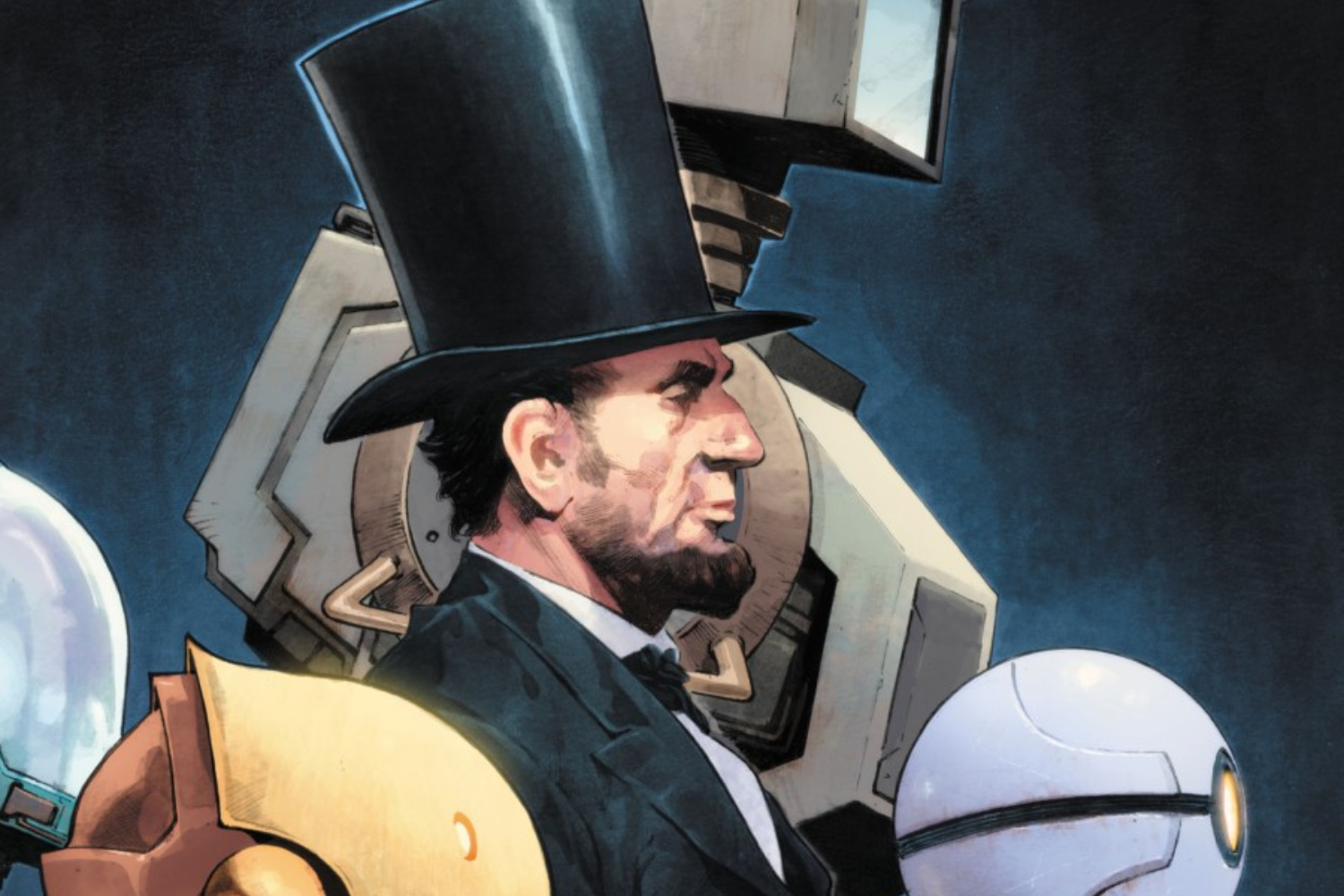

For a book about the end of humanity, If Destruction Be Our Lot is surprisingly alive.

Courtesy of Image Comics.
The new ongoing Image Comics series opens on a world where people are gone and the robots they left behind have kept on living. They still perform their functions, still move through routines, still maintain the machine of daily life.
But one of them, a robotic Abraham Lincoln named Abe, cannot shake the feeling that there has to be something more. That longing sends him out into the world in search of purpose, connection, and maybe a reason to keep going at all.
For series writer Matthew Rosenberg, that premise came from a few different places at once. Some of it grew out of his own creative process, and some of it came from the current moment, where artists and writers are once again being asked to justify why their work matters and if it’s really them creating it.
“This is my first interview about the book, so I don’t have my well-rehearsed answers,” Rosenberg said. “I tend to really inhabit a book when I make it. I tend to kind of live it every day and think about it nonstop.”
That habit, he said, means that every project changes him. By the time he finishes one, he often finds himself looking back at it from a different perspective, with new ideas and new questions. In that sense, If Destruction Be Our Lot grew partly out of what came after We’re Taking Everyone Down With Us.
“I spend so much time thinking about all these things and these ideas and themes of it that I sort of…not that this is the book that I wish I did because I’m very happy with We’re Taking Everyone Down With Us and we’re doing more of it,” Rosenberg said. “But this is a response to that book in some ways. This is saying a bunch of things that came to me that I didn’t think of or changed my views on.”
He stressed that the two books are not connected in continuity, but they are “in conversation thematically.” That helps explain why Rosenberg has now written back-to-back creator-owned books involving robots, and he had a laugh that readers are probably baffled by that on paper. Meanwhile, the other reason is more immediate and more personal.
“For the last bunch of years, especially if you’re working in a creative field, you’ve dealt with a pandemic that threatened to kill whatever creative industry you work in,” Rosenberg said. “And then you have emerged and found footing on the other side of that or, you know, in the middle of it still, but it’s sort of found a comfortable landing. And then AI comes in, and we’re once again finding people having to justify their careers and their jobs and the work they make and art.”
That tension sits at the very heart of the book. The world Abe inhabits is one where the systems of labor and function have survived humanity, but meaning has not. Rosenberg described a society where the robots are, in some ways, thriving.
“The idea has always been that robot society works smoother and is sort of happier without us, but has no purpose without us,” Rosenberg said.

Courtesy of Image Comics.
That contradiction is there in some of the book’s funniest and saddest imagery. Rosenberg pointed to one example early in the series, where a bus still drives its route every day despite carrying no one.
“The only person who gets on the bus is Abe, and he talks to the bus, and they’re friends,” Rosenberg said.
It is an image that feels absurd until it starts to feel deeply familiar. The bus is still doing its job. Abe is still trying to do his. Nobody quite knows what either of those things means anymore.
The same goes for the broader society around Abe. Rosenberg described the robots’ routines with a kind of deadpan precision: breakfast-making robots still make breakfast, maid robots still clear the table, and garbage robots still collect the discarded food. They are functioning perfectly inside a system that no longer has a purpose.
“I don’t think people have to dig too deep to see the metaphor of just people feeling like they’re going through a system that doesn’t appreciate them and they don’t see the purpose,” Rosenberg said. “I think we’ve all had those day jobs.”
Still, If Destruction Be Our Lot is not a bleak book, at least not in the straightforward sense. It is somber, lonely, and often reflective, but it is also full of humor, eccentricity, and wonder. Rosenberg said that balance was crucial from the start.
“I’m a big sucker for the idea that a lot of my favorite stories have a little of everything,” Rosenberg said. “They’re going to have some tragedy. They’re going to have some comedy. They’re going to have some action. They’re going to have all of these things, because I think that speaks to a greater human experience.”
He said the team never wanted to make “bleak dystopian” fiction for its own sake. Instead, the book keeps shifting tone and structure as Abe moves through different worlds and different arcs. Rosenberg said the plan is for each section of the series to change what readers think the book is ultimately about.
“The five arcs that we have planned are all wildly different,” Rosenberg said. “Different setting, different sort of different tone, different place, different characters, with Abe sort of passing through.”

Courtesy of Image Comics.
That rather lofty ambition helps explain why Rosenberg, co-writer Mark Elijah Rosenberg, artist Andy MacDonald, colorist Francesco Segala, and letterer Hassan Otsmane-Elhaou have been building the project for so long. Rosenberg said they have been working on it for nearly four years, and unlike many comics that launch with only a few issues completed, If Destruction Be Our Lot is already far ahead.
“We’re working on issue #11,” Rosenberg said. “We just wanted to make sure that no one would rush. We wanted to make sure everyone would be doing their absolute best work.”
That patience is visible in the pages. MacDonald’s linework and design sense are dazzling throughout the debut, from the emotional acting to the detail in Abe’s mechanical body to the series’ increasingly elaborate robot worldbuilding. Rosenberg was almost giddy talking about what MacDonald is doing in later issues.
“By issue #3, I was like, ‘OK, so Andy is maybe one of the most exciting cartoonists working right now,’” he said. “I don’t think there’s anyone doing this.”
He also spoke at length about MacDonald’s obsession with drawing certain parst of Abe’s robo-anatomy.
“He just spends all the time drawing Abraham Lincoln’s head coming apart with different robotics,” Rosenberg said with a laugh. “He’ll just send them to me like once a week. Sometimes it’ll just be his cheek is opened and you can see gears, and then sometimes it’s just like a full Terminator-style skull, but with all the Lincoln features floating around it.”
He called those sketches “so intricate and so beautiful” that he is determined to find a way to get them in front of readers.
There is a similar level of enthusiasm when Rosenberg talks about Segala’s colors and Otsmane-Elhaou’s lettering. Segala, he added, is doing “an Eisner-worthy job” on the series, while Otsmane-Elhaou remains, in Rosenberg’s eyes, “the best in the business.”

Courtesy of Image Comics.
That same feeling of deep collaboration also extends to his co-writer, who is not just another creator but his older brother. Mark Elijah Rosenberg works primarily in film, which gave the project a different energy than Matthew Rosenberg’s past collaborations in comics.
“He has a head for story and detail that I’m just constantly in awe of and always have been,” Rosenberg said.
The two had talked for years about doing something together, with Mark Elijah Rosenberg usually pushing for a film and Matthew Rosenberg usually insisting on comics. What finally unlocked the collaboration was that strange yet instantly memorable image of Abraham Lincoln wandering the Earth after humanity’s extinction.
“That was all I had,” Rosenberg said. “Humanity’s gone extinct. Abraham Lincoln is wandering, looking for something.”
From there, the two began building out a much larger mythology. Rosenberg said they knew early on that Lincoln came with a huge amount of political and historical connotations, and that part of the challenge was deciding which associations to use and which to resist.
“Abe Lincoln brings all of this baggage with him,” Rosenberg said. “You’re bringing politics into it. You’re bringing war into it. You’re bringing slavery and civil rights into it. You’re bringing assassination into it.”
At one point, the team seriously considered replacing Lincoln with another historical figure and brainstormed a wide range of options, including George Washington, Mark Twain, William Shakespeare, Kurt Cobain, Tupac Shakur, Humphrey Bogart, and even Martin Scorsese. In the end, Rosenberg said they decided to embrace the complications rather than avoid them.
“I think there’s something to defying the metaphor and defying expectation and upending what people think the book’s going to be,” Rosenberg said.

Courtesy of Image Comics.
That same desire to surprise runs through the book’s emotional core, which Rosenberg kept returning to in different ways throughout the conversation. He and his brother apparently debate this often — Mark Elijah Rosenberg insists that the series is about friendship, and Matthew Rosenberg pushes back by joking that all stories are about connecting with people. Yet Matthew Rosenberg kept circling back to the same point.
“This book is about trying to reclaim connections with people,” Rosenberg said. “It’s about trying to reclaim our humanity and what we’re missing.”
He connected that to the broader world, to life lived online, to cities that increasingly discourage public gathering, and to a culture that keeps stripping away places where people can simply exist together.
“It’s a war on public spaces,” Rosenberg said of New York. “We’re sacrificing the idea of being able to be around and interact with each other in ways that aren’t for profit.”
In that sense, Abe’s journey may be science fiction, but it is also about something painfully immediate. He is a machine trying to understand what humanity meant, and in doing so, he begins to expose how much of that humanity modern life has already worn away.
Or, as Rosenberg put it simply: “Abe is trying to understand what humanity is and what he thinks he is an approximation of and what that means.”
That search is what gives If Destruction Be Our Lot its distinct emotional pull. It is a funny comic about lonely robots, a philosophical comic about labor and meaning, a big sci-fi road story, and an intimate meditation on friendship and purpose. It is also, judging by how Rosenberg talks about it, one of the most carefully built books of his career.
And it sounds like readers have only seen the beginning.
“We build to it,” Rosenberg said of the story’s long-term prospects. “It’s not shock and awe. It’s a long book and we want it to amp up.”
If Destruction Be Our Lot #1 arrives May 6 from Image Comics. Final orders are due Monday, April 13.



You must be logged in to post a comment.