


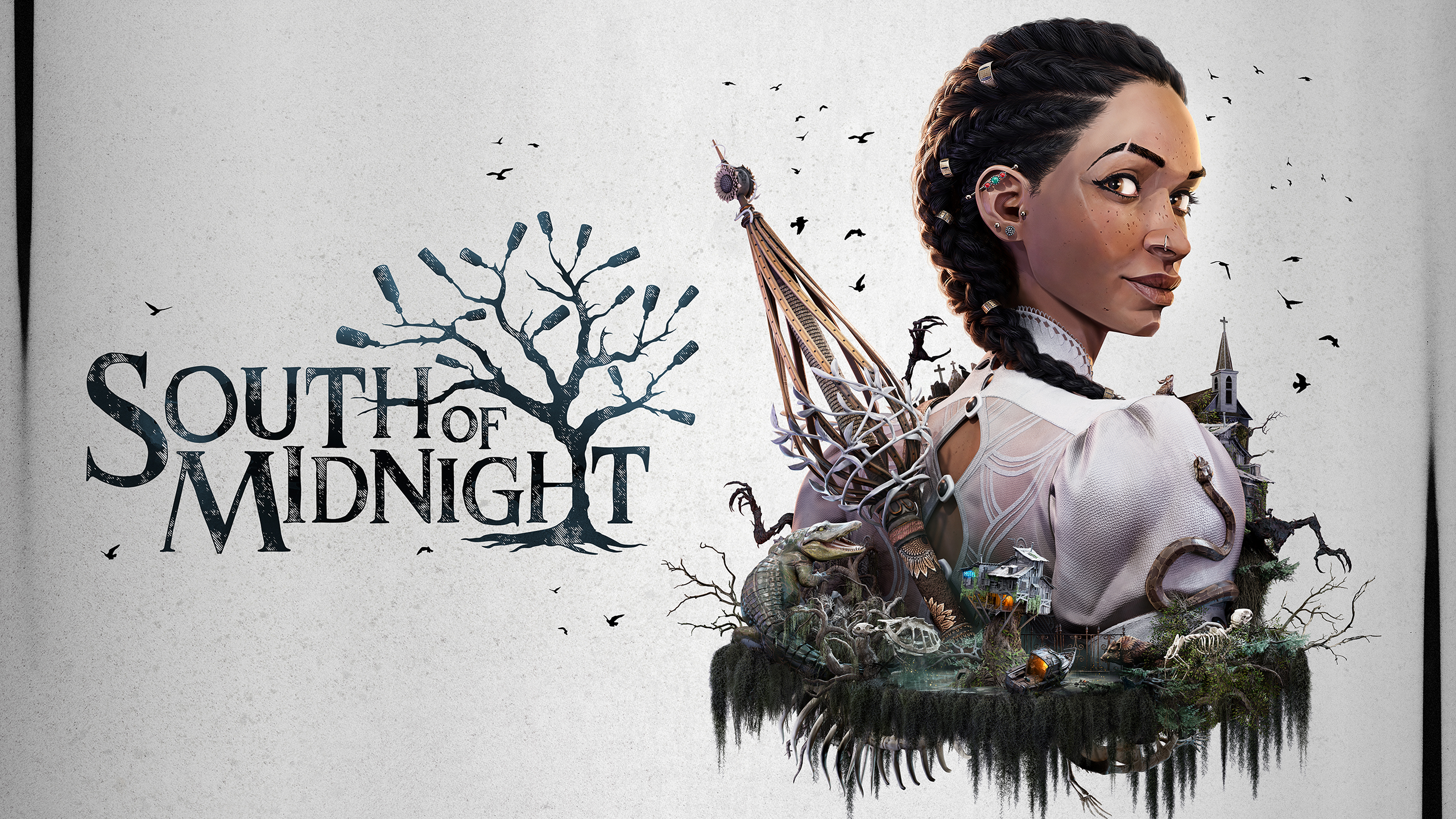

You’ve probably played a lot of games like South of Midnight. As a third-person action game with a linear platforming path, it immediately feels familiar in your hands. Jumping, gliding, and eventually double jumping through stretches of wilderness before getting locked into a small combat arena with progress impeded until you defeat every enemy.

You’ve also probably never played a game like South of Midnight.
At its core, South of Midnight is about trauma and the people who help us heal from it. It’s about mothers not knowing what to say to their daughters, and daughters not knowing how to feel about their mothers. It’s about loneliness and love, history and hope. It’s a deeply realized world that we don’t get to see very often.
Nestled on top of the marshes in modern day Chickasaw County, the town of Prospero is home to Hazel and her mother, Lacey. Hazel is a track star and her mother is a social worker. When a hurricane hits and floods the town, their house gets carried away with Lacey trapped inside. Hazel rushes after her mother, she sees things she can’t explain such as giant mythical creatures and unnatural yarn-like strands made of light that sing when you interact with them.
The reason Hazel sees (and hears) the strands is because she’s a Weaver, a magical member of the community who works to fix the grand tapestry of life. Prospero as a town is no stranger to sorrows, and that pain has manifested into these scary, otherworldly creatures known as the Haint, who want to tear you to ribbons.

The enemy variety in South of Midnight isn’t especially great. There are basic Haints that attack with claws, ranged Haints that snipe you, hives that produce insect-like Haints which seek you out, and a few others that get introduced further into the game. As a Weaver, you use special hooks to fight them, and as you progress through the game you unlock more abilities that can help you in combat. Combat, however, isn’t one of the game’s strengths. Even with a push and pull mechanic, a debuff that can make enemies take more damage, and the ability to recruit an enemy to fight on your behalf, at no point throughout the game did it really come together for me.
Between button mashing and timed dodges, there were moments I felt powerful but never like I was mastering the combat. Instead, most of the time I just thought I was lucky. The biggest reason for that is the sometimes-frustrating camera control as I could barely see when an enemy off-screen was ready to attack. I ended up mashing dodge more than I’d like to, because those abilities I mentioned work on insanely long timers. You can perform a special finishing move on defeated Haints to help with cooldown, but the battle was usually over before you got to use them a second time, except on harder difficulties.
Speaking of, the team at Compulsion Games really went above and beyond with their accessibility options. With five sets of difficulties and the ability to outright turn off combat and even boss fights, the world I loved so much can be experienced as stress-free as you’d like, though I cannot recommend playing the game without bosses.

Every few chapters there’s a boss fight against mythical creatures from southern folklore weaved (pun not intended) into the story in powerful but subtle ways. After multiple skirmishes with the Haint, a boss fight was always welcome to break up the monotony and give you bold set pieces that took what you learned, and put it to the test. I wish there were more of them.
While the platforming wasn’t a challenge, moving throughout the world always felt good, especially jumping and gliding. It sounds simple, but it can’t be overstated how much fun it was to simply exist in this world. Hazel’s animations weren’t just fluid and natural looking, they were so satisfyingly responsive. I wanted to explore every nook and cranny of each area because the basic things you do in the game feel exactly right. Exploring in South of Midnight usually rewards you with an in-game currency called Floofs that aid Hazel in upgrading her abilities for combat.
Apart from Floofs, the other collectibles you find scattered throughout the various levels are written diary entries, bank notices, letters, and signs that expand on the lore of Prospero. It is worth spending some extra time to look for these entries as they really help flesh out the world in a way that most game collectibles seldom do because they’re written so well. None of these feel like they were done to check a box to get a 5th collectible on this level; everything felt purposeful and powerful.

The world building in South of Midnight is some of my favorite in recent years. The distinct art style, the music, the voice acting, the locations – everything about the world works so well together. Especially the characters – the quiet sincerity of Catfish, the jealous pain of Rhubarb and Benjy, the disregarded Two-toed Tom, the quiet ostracizing of Laurent, the scar of Cheri that never healed – the more I learned about Prospero, the heavier my heart got. When she learns just how much heartache has transpired, Hazel says, “Hurt people hurt people” to Catfish as they navigate Chickasaw county after the storm, and so many people are hurting in Prospero.
While South of Midnight‘s combat felt mediocre, I wasn’t mad about it because defeating even the most persistent Haint unlocked a new part of the world for me to explore, and a new chapter of the story to wrap myself into. It took me to a part of the country rarely seen in games and gave wonderfully realized characters that helped elevate every moment of the experience. Most importantly, it made me care about righting the wrongs and healing the sorrows of characters in this world. I want more games like South of Midnight that are fun, unique, and concise worlds that respect my time and give me a story worth losing myself in.




You must be logged in to post a comment.