

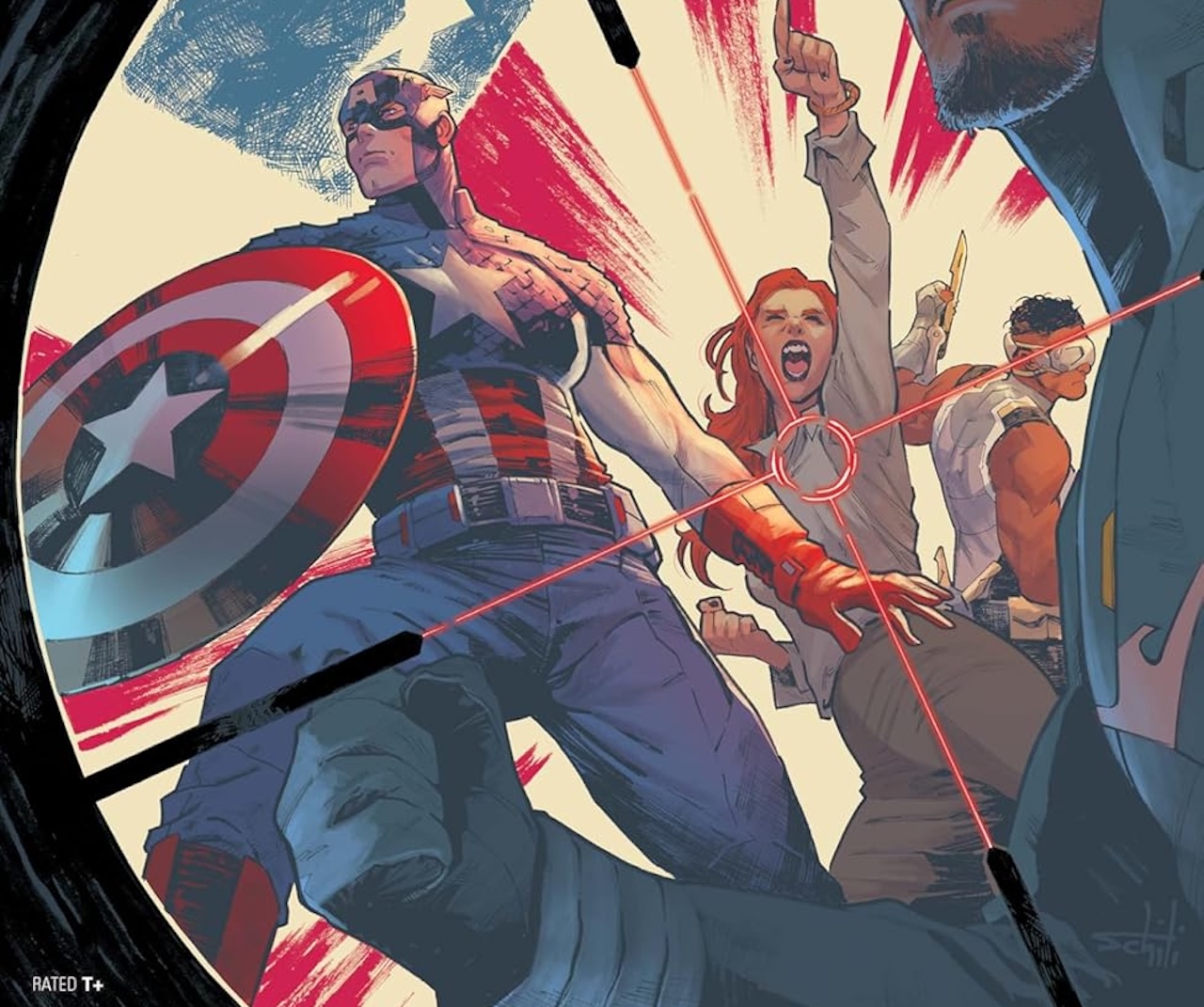

A staple of Captain America stories, Steve Rogers often rebels against his own government to the point that he even abandons his identity as Captain America. It’s allowed creators to thoroughly dispel the flawless boy scout image that seems to hang around Steve, while also touching upon America’s place in world events. So it’s no surprise that Chip Zdarsky continues this trend with Captain America #9, as Steve breaks ranks with the new S.H.I.E.L.D.
This time, it isn’t because of malevolent actions by Nick Fury, but rather the revelation that Marius Wolf aka Salvation has been murdering Latverian citizens who defy his rule. Most of those citizens are allied with Alina Von Doom, who seeks to transform Latveria into an actual democracy under the Homeland Party. As Steve, Alina and their allies rally to fight Salvation, S.H.I.E.L.D. continues its quest to find more of Doctor Doom’s weapons of mass destruction.
Throughout Captain America #9, Zdarsky doesn’t shy away from the paradoxes inherent within any revolution. Though Alina is a pacifist at heart, she knows that acts of violence will have to take place before Latveria is truly free. And while Steve is battling to save a country in one way, the new Agents of S.H.I.E.L.D. are also fighting to save Latveria by securing Doom’s weapons. Even Salvation is a walking paradox, as, despite his name, he’s taken the same tyrannical actions that Doom did while he was ruler. It’s these types of nuances that have made Zdarsky’s work on Captain America stand out, and one of the reasons why I’m intrigued to see how this all shakes out ahead of Avengers: Armageddon.

Marvel
Captain America #9 features yet another art shift, as Ton Lima takes over for artistic duties. Again, I genuinely love the work that Lima is bringing to the table, especially with the focus on characters’ faces; you can see the resolve in Steve’s face as he delivers an ultimatum to Salvation, and the doubt in Marius’ face as he faces the fallout of his actions. Lima also draws a hell of an action sequence, backed by Romulo Fajardo’s colors as Steve becomes a whirlwind of red, white, and blue on the battleground.
Yet I can’t help but feel this story arc is undergoing a bit of a shakeup in its visual identity. Between Lima, Jan Bazuldua, and the opening art team of Delio Diaz and Frank Alpizar, there’s been a grand total of four artists. I at least get why Diaz and Alpizar departed, as they’re handling art duties on Armageddon and event books tend to be bigger, but I hope Lima is staying on the book for the remainder of the arc – especially because of how great this art is.
Despite the art shifts, Captain America #9 still builds up an intense confrontation, as you not only have the three Latverian factions and S.H.I.E.L.D. in the mix, but Thunderbolt Ross as well. Any Marvel fan worth their salt knows a Hulk is a problem, but a Red Hulk is an even bigger one – especially one with military backup. How this all goes down will probably be covered in future issues, but a hell of a conflict is being set up.
Captain America #9 makes up for its art shifts with a well-crafted story as the conflict in Latveria continues to escalate. Zdarsky was right to call this arc “Doom’s Shadow,” as the influence of Doctor Doom looms large over every action in this comic.




You must be logged in to post a comment.