

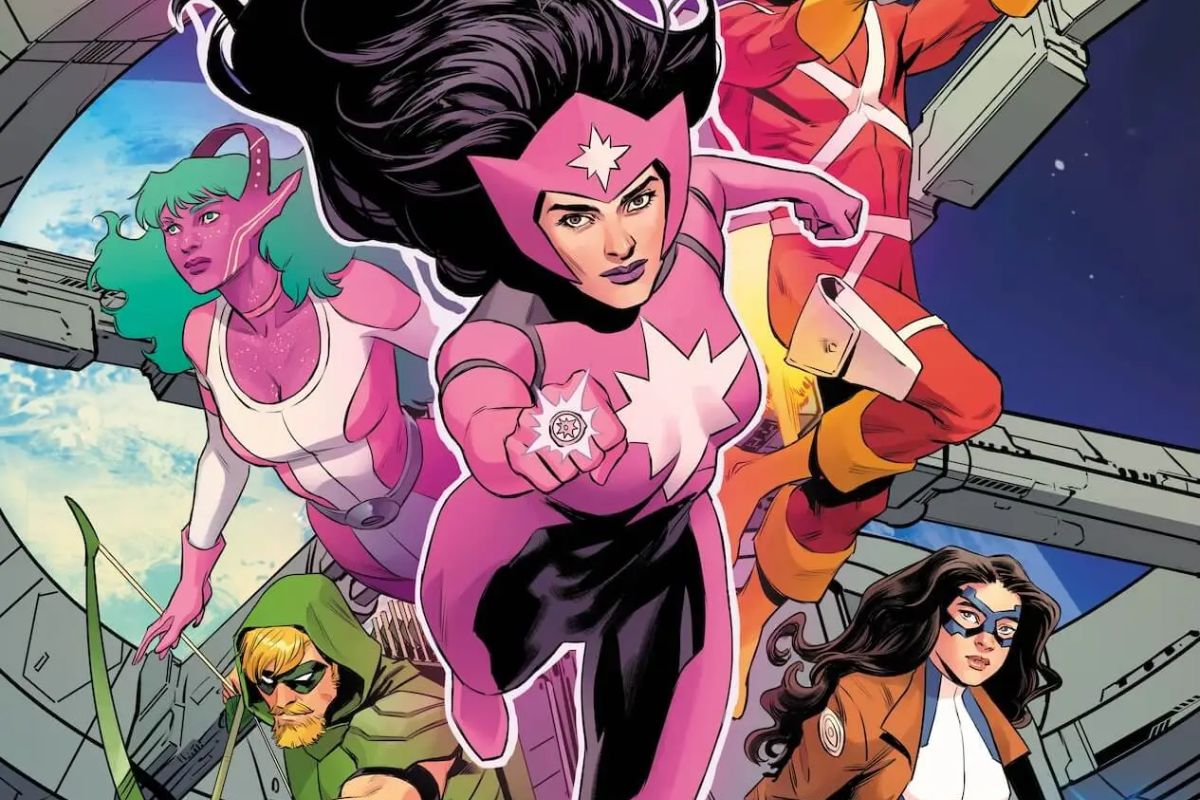

When the Justice League reformed in 2024 as Justice League Unlimited, the potential for bold new stories became truly limitless. Aside from leading DC’s major events like the recently concluded DC K.O., it has also paved the way for new miniseries and one-shots to spotlight characters outside of the larger DC brands. Justice League: Intergalactic Special #1 continues that trend by spotlighting two of the DCU’s trans heroes, Galaxy and Dreamer.
Written by Jadzia Axelrod and Nicole Maines, with artwork from Travis Moore and colors by Tamra Bonvillain, Justice League: Intergalactic Special builds on numerous developments that have taken place since Absolute Power ended in 2024. This includes the formation of the new Secret Six led by Dreamer and the events depicted in the 2023 Hawkgirl miniseries, Green Lantern and Justice League Unlimited. It also builds on Galaxy: The Prettiest Star, the DC YA graphic novel that introduced Galaxy.

DC Comics
Despite Intergalactic Special not being entirely standalone due to the various storylines it’s following up on, it’s still an easy enough story to read and can be enjoyed on its own. This is largely due to the story focusing on Galaxy wanting to become a valued member of the Justice League and Dreamer being a reluctant hero who has valid reasons for not wanting to join the League. This creates an interesting dynamic between the two women as they return to their planetary system of origin to confront their own past traumas.
Though the story itself depicts a straightforward mission of needing to stop the Witch Queen from destroying an entire civilization, the beating heart of the story is really the interactions between the heroes. Joining Galaxy and Dreamer on this mission are Star Sapphire, Adam Strange, and Green Arrow, but they’re not just there to offer muscle. They also function as emotional support to both Galaxy and Dreamer since neither one wants to really be where they are.
The Justice League’s role as emotional support becomes more important in the second half of the story, when the Witch Queen’s exploitation of an emotional trigger in Galaxy puts the lives of a team of Green Lanterns at risk. This effectively changes the conflict from a standard Justice League battle to a more personal battle for Galaxy and Dreamer. This also creates a golden opportunity for developing the characters of Galaxy and Dreamer, because it forces them to confront the very problems they’ve been avoiding in their own lives.

DC Comics
This combination of factors gives more emotional weight to a conflict that would otherwise be forgotten once the heroes saved the day. In addition to solid writing from Axelrod and Maines, Moore and Bonvillain also pull their weight in fleshing out Galaxy and Dreamer as characters. Whereas Axelrod and Maines excel at writing humorous interactions between the heroes without minimizing the source of their respective traumas, Moore and Bonvillain excel at depicting their vulnerabilities without making the story feel dour.
Moore has always been excellent at conveying strong emotions through his use of facial expressions and body language, and he brings that to the table in Intergalactic Special. This helps make Galaxy’s pain and anger over the loss of her homeworld (Cyandii) that much more real. Even more so when Adam Strange talks to her about his own failure to protect her world from annihilation. Moore even works his magic on Adam by presenting him as genuinely remorseful for overlooking Cyandii when the planet needed his help the most. Moore’s pencilwork is also augmented by Bonvillain, whose use of bright colors makes each page pop with strong sci-fi aesthetics. It also works to convey the strong emotions felt by each of the characters.
The only drawback to the special is that it doesn’t have a definitive conclusion and instead ends on a cliffhanger. On the one hand, the cliffhanger does create a strong hook for the upcoming DC Pride event, Justice League: Dream Girls, especially since the special includes a preview for the first issue. Though the preview doesn’t reveal much of the story, it is illustrated by fan-favorite artist Nicola Scott with colors from Annette Kwok. This only entices readers to check out the miniseries when it releases in June.

DC Comics
On the other hand, without a definitive ending, this could frustrate fans who came into this special expecting a one-and-done story. It also puts the burden on the Dream Girls miniseries to follow up and properly conclude the events of this special and not leave any threads hanging. This already proved to be a problem with Justice League: Dark Tomorrow Special, which never addressed its cliffhanger ending in either DC K.O. or Justice League Unlimited. (In the latter case, Airwave inexplicably escaped the Vanishing Point without the other heroes who accompanied him, and the mysterious time traveller’s identity was never revealed.)
All in all, Justice League: Intergalactic Special #1 is a fun and solid read from start to finish, complete with thoughtful character developments and amazing art. The only thing that may not work in its favor is the cliffhanger ending, especially if the follow-up miniseries doesn’t properly wrap up Galaxy’s and Dreamer’s character arcs.




You must be logged in to post a comment.