

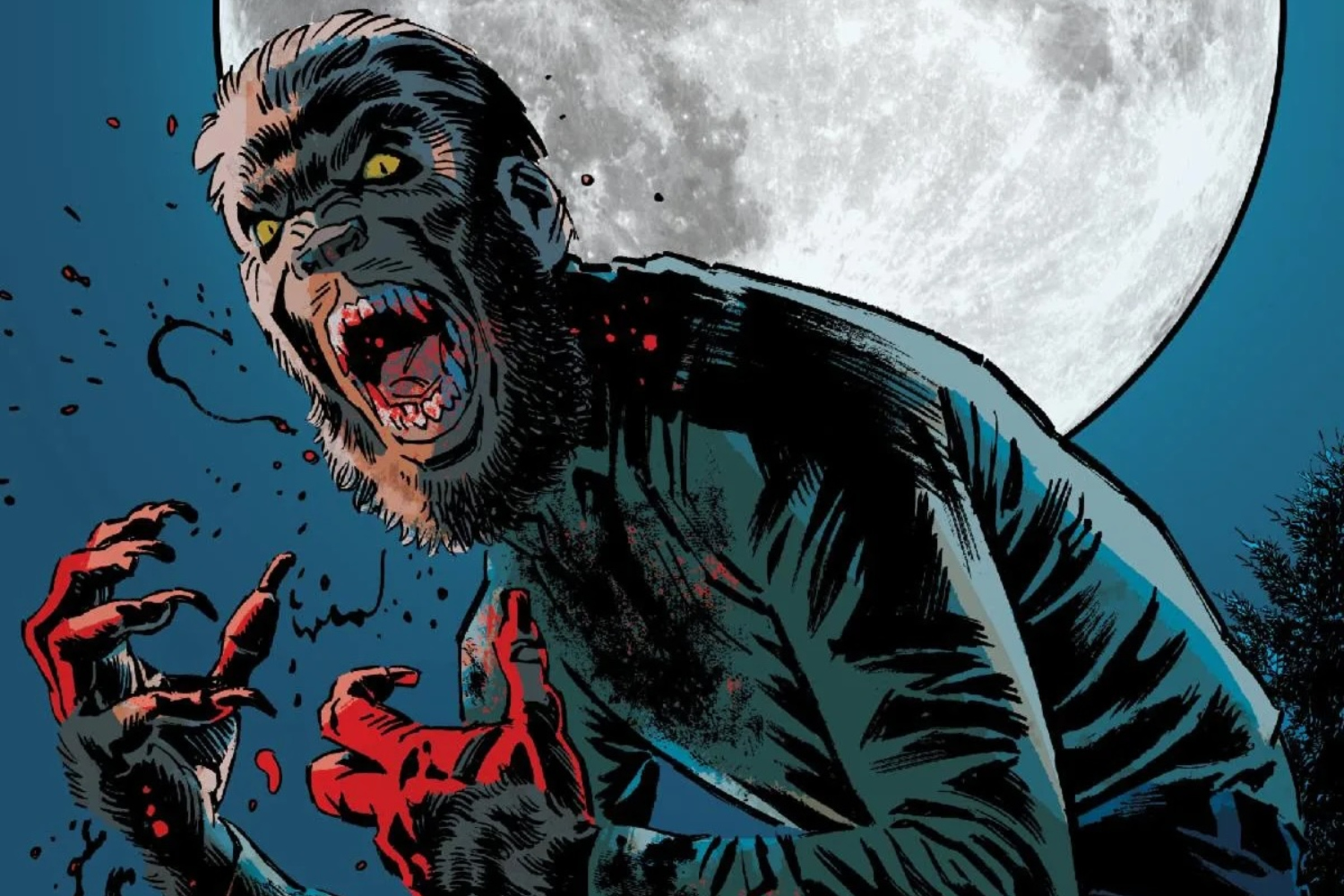

The Wolf Man has always been tragic; that pain is just part of the appeal. But for Joshua Williamson, the horror goes deeper than fangs and full moons.
With Universal Monsters: Blood of the Wolf Man (due out June 24), Williamson and artist Leomacs reintroduce the iconic monster through a story rooted in something far more grounded: what happens when someone you love does something truly unforgivable?
“It really came around to the real world,” Williamson said. “You see all these stories in the news…if you find out someone you love has done something horrible, how far do you go to protect that person?”
It’s a human element that almost all readers can connect with. The story itself follows college student Adam Jaeger after a brutal massacre leaves him questioning whether he’s truly responsible. As the monster within begins to surface in increasingly horrifying ways, the story shifts from a mystery into something far more intimate and unsettling.

Courtesy of Skybound/Image.
“For me, that’s what Wolf Man is about,” Williamson said. “The length you’re willing to go to protect someone that you know has done something wrong.”
It’s a theme that pushes the series into darker territory than readers might expect. Williamson describes the book as “one of the more darker books that I think I’ve written,” pointing to its emotional weight and moral tension.
That darkness is balanced by a long-standing love of the monster. Williamson’s connection to the Wolf Man goes back decades, shaped by both classic horror and unexpected entry points.
“I love the original movie,” he says. “It’s tragic…it’s always stuck with me.”
Like many fans Williamson’s age, his introduction came through The Monster Squad, which led him to explore the black-and-white Universal films. From there, the mythology stayed with him, evolving into a fascination with how the character could be reinterpreted.

Courtesy of Skybound/Image.
In fact, when Skybound approached Williams about the Universal Monsters line, his answer was immediate: “I was like, ‘Yeah, Wolf Man. I’ll be Wolf Man.’”
That robust enthusiasm carries into the DNA of the book, which draws inspiration from a wide range of werewolf stories, including the classic An American Werewolf in London to Wolf. Williamson ultimately pulled from different tones and structures to shape his approach.
Still, Blood of the Wolf Man is not interested in simply retreading familiar ground. Instead, Williamson leans into uncertainty. In the first issue, readers are left questioning what actually happened, placing them in the same position as Adam’s father, who is forced to confront an unthinkable possibility.
“If your kid came to you and said, ‘I’m a werewolf, and I’ve already done something awful,’ what do you do?” Williamson said. “Do you believe it? Do you trust it?”

Courtesy of Skybound/Image.
That tension is not one-sided, either. Williamson hints early on that the father is carrying his own baggage, complicating any sense of moral clarity. Added Williamson, “You’ll see his dad is not a great person.”
It’s yet another detail that adds another layer to the story’s central dilemma. This is not a simple case of a good parent protecting a troubled child. Both sides of the relationship are shaped by secrets, forcing readers to question not only what Adam may have done, but what his father might be hiding as well.
That ambiguity becomes part of the horror. Even as readers know they are in a Wolf Man story, the emotional reality of the situation complicates things. It is not just about monsters, but about doubt, denial, and responsibility.
The setting also plays a key role in shaping that tone. Taking place smack dab in the 1970s, the series taps into an era Williamson loves for both its filmmaking and its storytelling sensibilities.

Courtesy of Skybound/Image.
“Having it take place in the ’70s kind of helps,” Williamson said . “It’s a good decade for horror movies…so many good movies in the ’70s that I love and find influential.”
The lack of modern technology also allows the story to breathe, removing the constant surveillance of the present day and letting the mystery unfold more naturally. At the same time, Williamson hints that the time period is not just aesthetic. Added Williamson, “There’s a timeline reason it had to be the ’70s.”
Visually, the series is absolutely brought to life by Leomacs (and with colors by Pip Martin), creating a grounded, atmospheric look that complements the emotional stakes. Williamson had worked with Leomacs once before in 2022 on Rogues, and a second collaboration finally clicked here. Added Williamson, “He’s great… I love working with him on this book.”

Courtesy of Skybound/Image.
As part of Skybound’s growing Universal Monsters line, Blood of the Wolf Man joins a wave of reinterpretations that have been resonating with readers for some time. Williamson himself is a fan of the many comic series that have come out already, adding that “Frankenstein is probably my favorite” while praising creator Michael Walsh’s work.
But with Blood of the Wolf Man, Williamson is carving out his own space within that legacy. By grounding the horror in real-world dilemmas, he aims to deliver something that lingers beyond the page.
“The best kind of horror is when you tell a real story, but you hide it among the horror,” Williamson said.
For Adam Jaeger, that real story is only just beginning.
Comic shops have till May 25 to pre-order Universal Monsters: Blood of the Wolf Man #1.



You must be logged in to post a comment.