


Most comic book fans have a solid idea about what they’re going to buy every week as they descend upon their local comic shop. With that said, there’s still a lot of fun to be had just glancing at the week’s new releases and taking a chance on a book that looks promising, funny, scary, etc. That’s where covers come in. A fantastic image can make the difference between trying something new or saying, “Nah, not this week.”
In that spirit, here are the covers that captured our attention this week, with entries from comics editor Chris Coplan. This is Judging by the Cover.
Absolute Martian Manhunter #12
Variant cover by Sebastián Fiumara

It’s so odd and sort of painful to think we’re at the end of Absolute Martian Manhunter. While I can respect Deniz Camp and Javier Rodríguez for ending the story on their terms, I can’t help but look at other Absolute titles at issue #20 or higher and wonder what could’ve been for this extra inventive offering. But if we’re saying goodbye, I can’t think of a better way to do it than with this Sebastián Fiumara variant cover. On the one hand, it’s much more stark and gritty than Rodríguez’s work, and I appreciate that distinction in trying to honor this book’s impact by leaning into something that’s basically the diametric opposite. Even still, Fiumara has nailed a core visual of the book with an especially intense and inviting version of “John’s Psychedelic Alien Powers.” (Also, the tie is such a small but powerful gesture and bit of messaging.) I can’t tell if the power is flowing in or out at this point, and if our hero is somehow permanently broken or exhausted by the release of it all or just a sense of finality. It’s a different spin on a familiar aesthetic and visual feat, and exactly the kind of thoughtful but earnest way to honor this book, say goodbye, and get us thinking about its impact and value in a new way. In a story that’s been the most delightfully bizarre buddy cop tale ever put to paper, a little extra grit goes a long way to cementing why this book worked as efficiently and as potentially as it did. What’s the Martian phrase for “Bon voyage?”
Punisher #6
Cover by David Marquez and Guru-eFX

At this point, seeing Frank Castle bloodied and broken is as novel as Marvel’s obsession with blind bags. Heck, at this point, Castle ought to change his name to “Bleed Like A Stuck Pig But Never Die Man.” But, as with many other aspects of life, it’s not about a thing happening, but how it looks and feels and what it ultimately means. With Castle battling a new, extra brutal foe, and questions of his chances hanging in the air, it’s a wee bit disarming to see him look, well, so dang tranquil. Sure, he’s likely been beaten unconscious, but there’s something oddly peaceful to that face, as if he’s dreaming of something wonderful. (Which for Castle at this point could be his family or some fancy new shotgun that also shoots missiles or something.) Then you factor in all that blood: Not only is there a river’s worth of the stuff, but it’s sprayed like graffiti and expertly layered elsewhere, and both together feel especially deliberate. (The blood on Castle’s head is so well done; it’s like an ocean right there on his dome.) This is basically the closest Frank could get to being in a Renaissance portrait, a beguiling snapshot of his demise painted by 100-year-old monks with animal brushes and flower paint. If you want to sell me that this could truly be “The End,” this portrait already has me gripped in a tearful goodbye. And they said it was just more pointless gore.
Power Rangers Unlimited #1
Variant cover by Allessio Zonno

Let’s pretend you have no idea about the Power Rangers comics “universe.” (That’s not much of a stretch for me as my immersion is limited to some stuff from a few years ago.) You might gaze upon this Power Rangers Unlimited #1 cover and be confused about so many things. Like, when did they get that those dope helmet accessories, and why hasn’t that always been a thing? Or, just how many Power Ranger types are there exactly? But in all the ways that matter, even if you knew nothing, the cover tells you everything you need to know. Namely, there’s folks in weird power armor fighting giant monsters, and there’s so many organized together cause clearly there’s lots of cretins that need bashing. And that’s basically the appeal of Power Rangers dating back to when I watched the OG title in real-time: Colorful ninjas, gross monsters, and so much action it’ll light up your nervous system. The scope and intent of that may have changed as the comics universe has grown and expanded in new and intriguing ways, but I look at this cover and feel exactly the shiny impatience and rush of endorphins I did circa 1994. Now, it just feels even bigger than ever, and my nerd joy swells to meet the challenge. Seems like mission accomplished before even page one.
Nights #19
Cover by Luigi Formisano

Did you know it’s been something like 18 months since Nights #12? And while I enjoyed our immersion in the past for issues #13-18, I am so, so glad to be back in the present day. What do you need to know since we’ve been gone for so long? Well, too dang much not to turn this edition of Judging by the Cover into “Judging by the Nights” (and that title has way, way different connotations.) But based on the issue #19 cover from series artist Luigi Formisano, Gray and Vince should continue to be your focus. And what a place we left them both, with the former having kicked up earth and bounced and the latter dealing with new life as a vampire (and while adjusting after a three-month coma). On the upside, the love is still clearly there, and no amount of chaos or change can shake their bond. On the other hand, these two are in decidedly different places, and when these “new” souls come together, it inevitably means the scope of their relationship will be altered. (Vince’s face is extra unnerving as he balances his fear and uncertainty under a gentle guise, and Gray looks like she’s ready to rip the world in half.) Can love survive such drastic transformation? And what does either outcome mean for Santo Pedro and the rest of the crew? Moments like this prove that even if Nights does take its time, it’ll always sink its claws in and drag you back like nary a nano-second has passed. The more Nights changes, the more it retains this uncanny power over us mind, body, and soul.
Killer Influences #1
Variant cover by David Lapham

Before I ever spoke with Joey Esposito, I was pretty jazzed about Killer Influences. It’s got a great title, a better premise (a journalist works with a serial killer to bolster his profile), and the promise of more dope art from Valeria Burzo. But what really sealed the deal for me was when Esposito name-dropped both Lawrence Block and his excitement for the forthcoming Grand Theft Auto VI. It’s a multifaceted admiration of crime media you can see play out in this excellent David Lapham variant. Because if you’re gonna tell a story like this, something over-the-top but also a tad cheesy/hokey works so dang well. It’s like smearing blood on Norman Rockwell portrait: Your brain gets stuck between the humor, the viscera, and the down-home charm, pinballing back and forth in a way that is as exciting as it is disarming. Lapham’s whole approach and technique is tailor-made for this “cute meets creepy” slice of imagery, as he blends depravity, viscera, and something altogether quaint in a way where everything is balanced for maximum effect. If the book is 1/10th as effective in being gory and intentful, humorous but deadly serious, then we’re in a very good place for both a good story and a continued evolution of the IDW Crime line. Fore!
Cruel Universe #12
Cover by Miguel Mercado

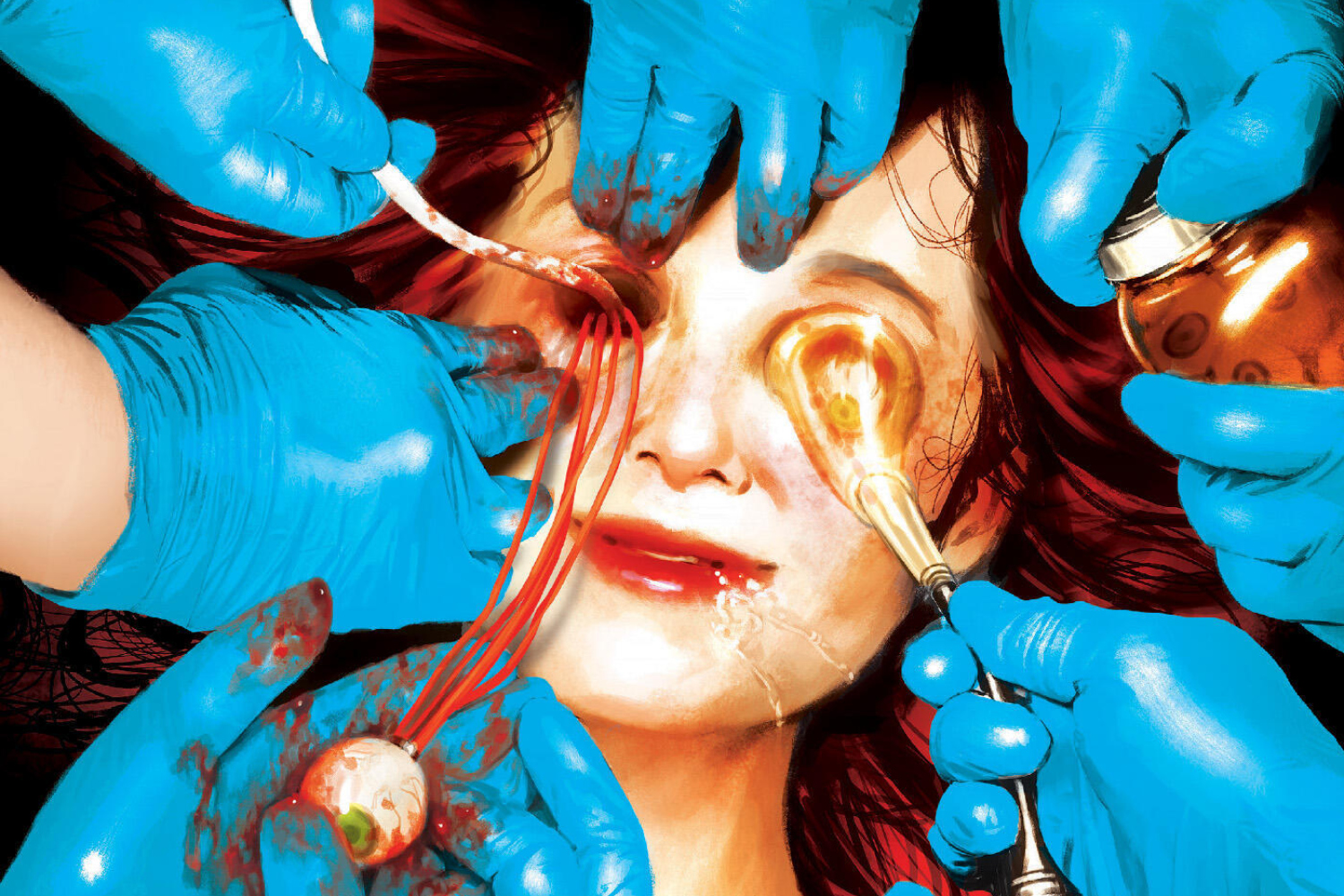
If I were a real animal, I’d get my body horror fix by looking up crime scene photos. (No shade to those folks; I’m married to a “true crime devotee.”) But I tend to rely on comics, including Cruel Universe, which is a regular enough source of Grade A gore. Take, for instance, this Miguel Mercado variant for issue #12 — its pretty much turned me off from ever wanting to go to the doctor or even have eyeballs ever again. From there, my mind goes to two thoughts: 1) Is this a robot/artificial person, and if so, is that better or worse somehow? and 2) Am I more disgusted by the eyeball being removed (and complex human biology being terrifyingly “simplified”) or whatever is going on with the other eye (that I wished they’d just plucked out by hand instead)? But in case it ever gets too weird, I can always just admire other areas, like the sheer technical prowess that went into coloring those gloves to within just .45 degrees of actual reality, or the sense of narrative expertly laid out in what this scene infers/doesn’t infer. (Seriously, those gloves give me flashback to gnarly dentist appointments circa age 9.) In comics, body horror is so much more; the medium manages to portray, position, and contextualize all this gore in a way that other mediums can’t achieve because of the lines comics skirt. In a way, I’m actually more sophisticated for liking body horror in comics because it connects to ideas, influences, energies, etc. that are the perfect balance of low- and high-brow. And that makes me a true sophisticated gentleman and absolutely nothing else.
Batgirl #21
Cover by David Talaski

Batgirl #21 features one of my favorite tropes that I call “The Memory Plunge.” That’s where, in order to solve a case/mystery, our lead has to experience old memories (via means either magical or mechanical) and hope they also don’t go crazy as a result. In the case of Cassandra Cain, this trope offers a veritable smorgasbord of possibilities, the least of which are this amazing David Talaski main cover. Visually, her whole costume is perfectly suited for this visual device; it’s distinctly human shaped but also the feature-less look makes me think “weird cliff structure worth spelunking” or something. And while the actual device here (of her climbing out of her actual eyes) is the right amount of freaky body horror, what really works is the emotional implication. For years, Cass was stuck, nigh literally, in her head without a way to communicate or engage with others (that wasn’t just violence). The desperation on her face now is, as you’d expect, doubly potent and affecting, and you can exactly feel why she’d want to exit her own brainpan right this very nano-second. The use of (what looks to be) forget-me-nots isn’t just story accurate — it’s a really great commentary of Cass’ own experience with memory and self-awareness (and just a neat visual to that also somehow makes me think of Seal’s “Kiss from a Rose” video). It should be quite the harrowing, informative plunge for us and Batgirl alike.
The Mortal Thor #12
Cover by Alex Ross

Now, did I pick yet another cover of “people climbing out of eyeballs” on purpose? Not at first, no; it took me a few seconds to realize I snagged ’em nearly back to back. But once I thought about it, it made sense to have what’s basically a complimentary piece to really suss out what this device says and means. Where Talaski’s piece makes this “process” feel beautiful and dream-like, Alex Ross’ work is decidedly unsettling. (Ross doesn’t do “horror” as often as he ought to, but when he does, we get stuff where the sheer technicality of the wrinkles makes it just as gross and uncomfortable as that dark green blood.) And where Talaski’s piece tries to balance an abstract feel with some real-world heft (to really interrogate the trope), Ross does away with such “fanciful” tendencies for something physically affective. And rightfully so: Whereas Batgirl is trying to let Cass address her memory “issues” in a healthy way, Mortal Thor is seemingly more focused on interrogating the character relationships and dynamics across this arc. The cover, then, can’t do anything but be as confrontational as all heck, relying on Ross’ unmatched skill to really get at the complicated, messy, and multifaceted efforts of Sigurd Jarlson, Donald Blake, etc. Whatever way you cut it, popped eyeballs are only the start of the existential horrors to come in this bad boy.
The Beast of Borikén #1
Variant cover by Naomi Franq

At a kind of “higher level,” I can appreciate The Beast of Borikén for, say, telling a story about Puerto Rico with Puerto Rican creators. Or even that it touches on both history and current affairs in a way that’s most effective and mission-oriented. But I just can’t get stop thinking about how writer Julio Anta positioned the Chupacabra, continually promoting him as the perfect balance of human capable of great empathy and intent and a monster of pure carnage and malice. It’s not an entirely novel concept, sure, but Anta framed it in such a way that it it feels rejuvenated in its efforts. And that echoes even across this excellent Naomi Franq variant cover to #1. I love the way the hair feels both human and monstrous and something else entirely; the small but important influence of his “clothes” and how that grounds our relationship and understanding; and even that Kubrick stare-esque glance that speaks to some deeper intellect/presence. I even really like that slightly unnatural angle the Chupcabra has chosen; it feels like something an animal could do, but also something a human would bust out be creepy, confrontational, etc. Heck, just that slightly off green color/hue does so much to throw off our sense of balance, and to get you thinking about the relationship between man and nature. This beast may be so much more than teeth and claws, but it’ll hunt ya down all the same.



You must be logged in to post a comment.