


On this week’s AIPT Comics Podcast, Dave Brooke and I joked about AI. Not about how it continues to be the artistic equivalent of extra runny eggs, or that so-called “champions” of it are doomed to be featured in the worst sections of history books. No, that given the increasing public outcry toward this “advancement,” now is the time for comics creators to tell their AI stories while the getting is good.
And with Minotaur, writer Si Spurrier (alongside artist Michael Dowling and colorist Sofie Dodgson) has entered the ring.
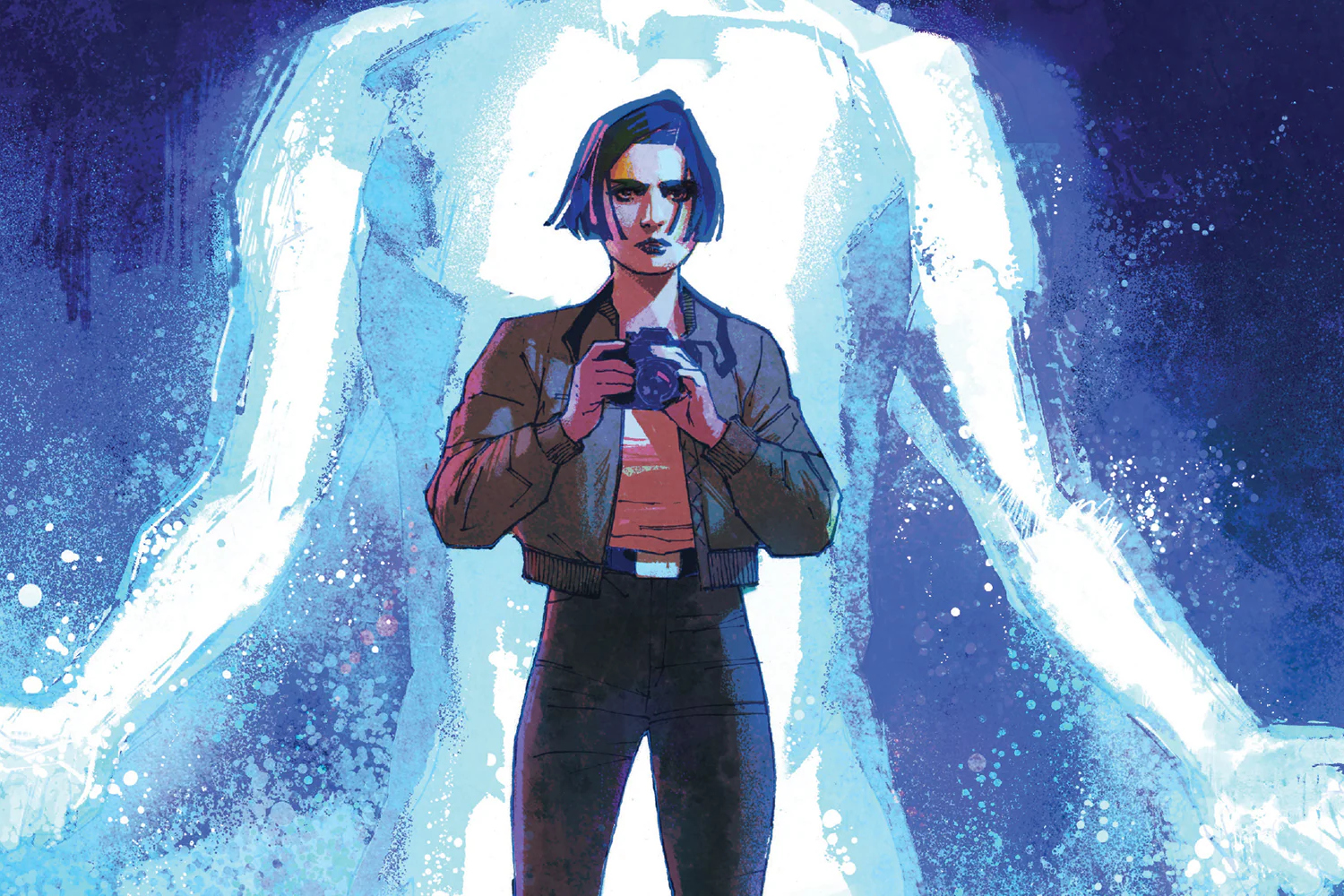
And, sure, if you only considered Minotaur as yet another AI book, you’d be mostly right (and mostly satisfied). Here, photojournalist Gloria Monday, her ornery bodyguard Sara, and a mysterious tech bro have joined forces to document the fallout of the failed Singularity, which represents a sudden and irreversible mega-evolution of computing/technology. The trio go around the world documenting “leaks,” strange apparitions and impossible creatures that have resulted from the scarily-named event. Think The X-Files meets Planetary, and you’re basically right there.
Only even that oh-so handy shorthand absolutely undercuts what Minotaur is really about, and the larger value of this story.

Courtesy of Ignition Press.
Visually, everything feels especially grounded and approachable, a slightly updated version of our own world (but never any less this absolutely stratified blend of leisure and suffering, filth and techno-sheen). And that’s not interesting in this “genre,” but makes perfect sense from a storytelling perspective: the Singularity technically didn’t happen (or did it?!), and this world (like our own) is very much trying to figure out how to react/respond. That distance and disconnect carries far more story heft and possibilities than simply blasting us into some techno-hellscape.
Similarly, the supernatural aspects also remain quite grounded — the Weretiger creature we encounter in this first issue (as well as a kind of pocket “dimension” related to the “seeds” left by the Singularity) never seem to go too overboard. It’s more about poking us in the brain that something clearly isn’t right, and that this is the beginning of changes of which we can only partially trace the full outline. They’re things that aren’t possible, yeah, but then they’re really not that far out of the realm of our understanding.

Courtesy of Ignition Press.
And that’s actually quite huge: we need to know what’s happening here so we can apply it to our own circumstances and understand our current moment in a really deliberate way. Look at it this way: The book operates entirely under that infamous ol’ Arthur C. Clarke quote/adage, “Any sufficiently advanced technology is indistinguishable from magic.” But in Minotaur, it’s not just a hella of a tagline — it’s a kind of warning. Because, yes, these kinds of stories work toward obfuscating the boundaries between magic and technology, and skirting those lines as to play with our sense of wonder and our general sensibilities.
But in Minotaur specifically, the phrase is also expertly positioned as a wake-up call — we cannot simply ignore the real-world foundations of these advancements, and we must understand them or be doomed to fall under their destructive spell. It’s this vital idea that now isn’t the time to buy into the fantasy of what this moment represents, but to really embrace what we do and don’t know, and try to live up to it in the name of actually furthering our core humanity.
Because that’s what Minotaur is really about — calling it another AI book is, at best, half of the story. AI is just the face of this latest existential threat/opportunity (see also capitalism, the Industrial Revolution, etc.) Spurrier expertly aligns himself with the careful, grounded look facilitated by his collaborators for a story that threads the between the very real and the very fantastical.

Courtesy of Ignition Press.
He’s never once afraid to be tap into our reality for inspiration — the story emphasizes a “version” of the genocide in Gaza in such a way that never once feels hacky or heavy-handed and instead uses it as shorthand for our current moment (and the hope and despair it best represents). Even the way our tech bro is regarded feels nuanced, and his depiction is limited (visually, narratively) to make this more than just another mostly half-cocked satire.
Because Minotaur (to me at least) is a decidedly hopeful book. It’s not one that’s ever blind to the moment, obviously, but based on the stuff with the Clarke quote, it believes that we’re in a moment of great possibilities as much as we’re perhaps irrevocably doomed. That if we do understand the confluence of history and culture and politics that lie before us, we can perhaps improve our lot in life by at least understanding what’s at stake.
Gloria herself even admits she’s here simply to bear witness, and that’s exactly what we’re here to do: grasp the mounds of context under our feet and decide the true path forward. A direction, mind you, born not out of sheer blindness but through a recognition of what we’re actually locking in for our species and whatever future it might get to call home.

Courtesy of Ignition Press.
Spurrier has always been a deeply human creator, and he’s worked with a dynamic team that gives us the specific magic we need to enter this story while very much leaving space for his presence to connect with and guide us. (In terms of his narration, mostly filtered via the tech bro, I’d wager that this is Spurrier at both his most Alan Moore-ian esoteric and also just downright talented and charming.) It’s that rich voice that gets us to confront these issues, and rather than provide real answers (other than for us to stop being so shitty, racist, and keen toward violence), he’s allowing us to determine what ought to happen.
Can the team stop the Singularity’s fallout, and should they even try? What happens if they don’t, and is this a net positive for mankind (a scary backflip into the future) or more fire on our inevitable doom? Like all great storytellers, Spurrier and company respect their readers enough to know that no one has answers, just plenty of questions that need to be asked pronto.
And in terms of important questions, I can add a couple more to the list (and maybe even some corresponding answers). Like, is Minotaur one of the more important of this “crop” of AI-centric comics? You betcha — it’s the most welcoming and intellectually challenging of the bunch, and it contextualizes this “debate” with personality and wit to spare. So, then, is it any good? You don’t need me or some computer program for that one — Minotaur is engaging, demanding comics sorcery for our weird and wild times.



You must be logged in to post a comment.