


Seasons four and five of Star Trek: Strange New Worlds were already in the works while audiences were suffering through the series’ disastrous season three. So the creative team had little to no time to learn any lessons about what went wrong in order to course correct before the lights dim for these series for the last time. Does this premiere I’ve dubbed “Star Trek vs. Dinosaurs” give me hope the writers figured out the problem on their own? Well…oh, boy!
“Valles Marineris” begins with something rarely seen on this series, a strange, new world. The gorgeously shot opening scene finds Pike and fellow away team members riding horses along a rocky terrain amidst floating land masses. But we’re not sticking around. Soon enough Enterprise finds itself answering a distress signal and being pulled into a vortex that leads to what is initially teased as a strange, new world but ultimately turns out to just be Earth in the past.
This is a classic Trek setup. Somehow Enterprise finds itself in Earth’s past or on a world that remarkably duplicates some era in Earth’s past. In this instance, the crew arrive in the Age of Dinosaurs during a time of both Tyrannosaurus and pterodactyls. Taking our characters back in time to the dinosaurs is not a terrible idea. Past Trek spinoffs might not have been able to afford the special effects needed to make passable dinosaurs, so there hasn’t been much dino Trek. Tragically, the dinosaurs are secondary to a flimsy premise that’s pretty slapdash and silly.
Once it’s revealed that the technologically advanced species taking over the ship are Martians from 65 million years ago that obviously left no record or trace, the plot twist — such that it is — becomes a foregone conclusion and predicable. Somehow Enterprise is going to witness the destruction of the Martian civilization and the extinction of the dinosaurs.
We’re told at the start our crew has completed fifteen missions in a row and are burnt out. The implication is signing up for every mission is Pike’s way of coping with Captain Marie Batel’s death from the previous finale. I can’t help but think how I’d so much rather be watching a character-driven drama centering the psychological toll on this overworked crew than this ill-conceived schlocky throwback about unspecific warring parties with no clear parallels to any real world conflicts.
There is some character business included in the margins of the episode, though most of it is recycled or problematic. Pike is offered a promotion to commodore. He considers it and eventually decides to pass. Not only have we seen this story beat with Commander Riker passing up the captaincy multiple times in The Next Generation, but since passing on it means nothing changes, it’s a plotline that might as well not exist.

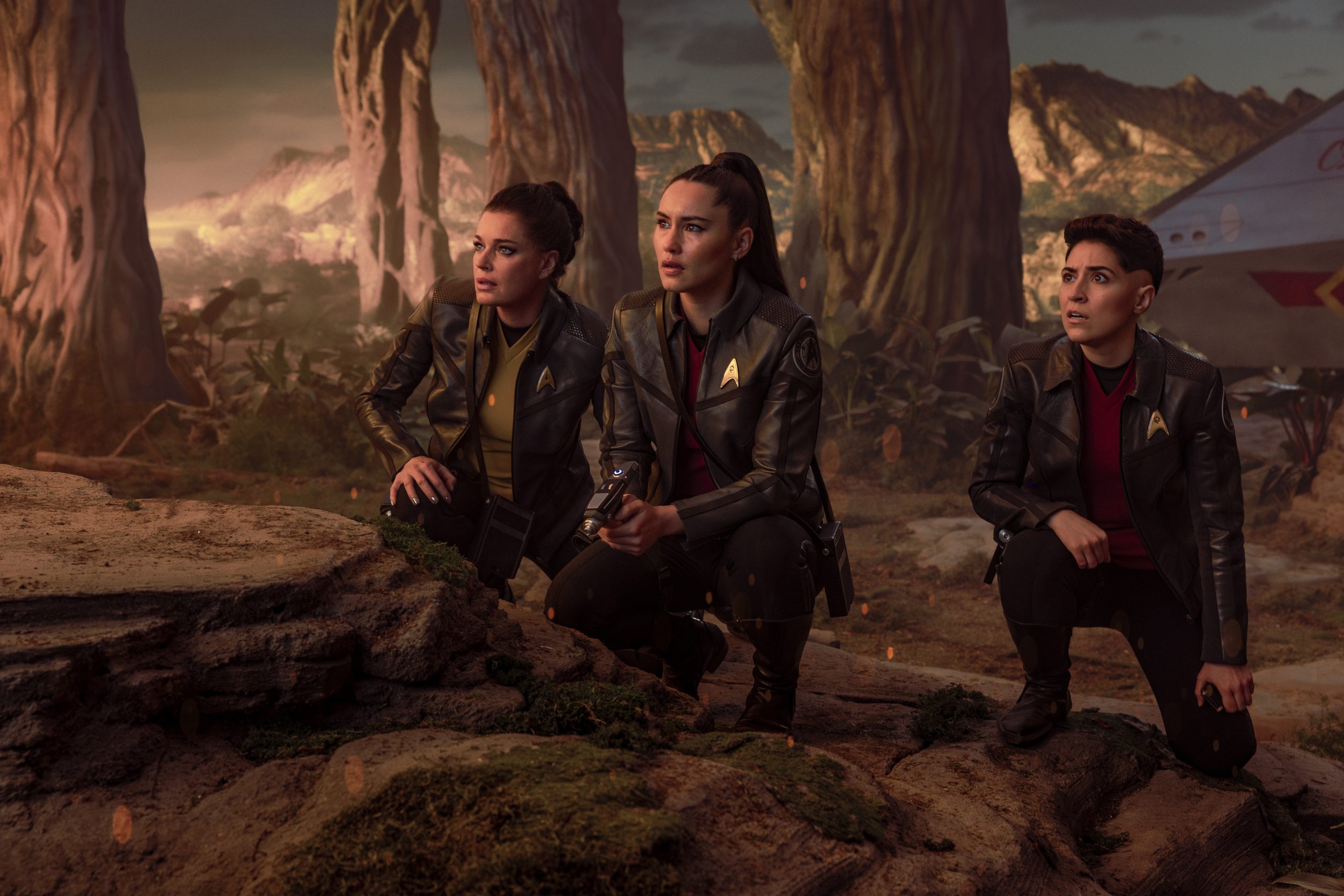
Photo: Jan Thijs/Paramount+
The writers also draw our attention to La’an’s concerns over “carrying enhanced warrior genes” and how those genes might one day turn her into a monster. This is clearly setting up a larger thread that will play out more this season if not both remaining seasons. It’s maybe the biggest issue Strange New Worlds faces specifically because production moved forward with the final two seasons before hearing the criticisms over season three.
This “warrior gene” plot is about as scientifically preposterous as when Janeway and Paris turned into lizards in the Voyager episode “Threshold” or when the crew “devolved” in The Next Generation episode “Genesis.”
Worse than that though is its disturbing implications of genetic determinism and its historical misuse of evolutionary biology to justify racism. Strange New Worlds has trod this genetic determinism path before with La’an as well as in a storyline in last season’s truly baffling misfire “Four-and-a-Half-Vulcans.” It’s clear the Strange New Worlds writers fundamentally don’t understand, for instance, why people were mad over that Sydney Sweeney “good genes” American Eagle commercial last year.
They don’t seem to understand how flirting with the reductive notion that the sum of all human behavior can be explained by “good genes” and “bad genes” hardwired in our DNA was the underlying theory behind the Eugenics Movement and Nazi race science — and that its scientific validity has been utterly discredited.
And yet maybe the craziest decision here is the choice to make La’an the vehicle for this genetic determinism storyline because she’s a descendent of Khan Noonien Singh, one of Star Trek‘s most iconic villains. The character’s debut in The Original Series episode “Space Seed” established him as a genetically enhanced ubermensch who was a major warlord during Earth’s “Eugenics Wars.” Khan was written as a refutation of genetic determinism. And yet here, his name is being laundered to reinforce it.
Now I do expect the show will ultimately vindicate La’an as not merely doomed by her genes to be a monster. American media — including Star Trek — pretty much always comes out on the side of free will and rugged individualism. But the writers have all but guaranteed this will be framed as La’an valiantly overcoming her nature, a dramatic moment where she’s about to do something potentially monstrous while a friend talks her down, finally summoning up extreme willpower to resist the violent urges of the cursed genes with which she was born. If that’s what happens, it’s not a proper refutation, and it’s kinda gross.
A far smaller nitpick concerns the introduction of a new Vulcan cadet on board. Season three also introduced a new, reoccurring rookie character, and completely wasted that character’s potential by killing him early and then having a demonic being possess his body. Hopefully, this time around the rookie will make a meaningful mark on the series.
The “time traveling heroes play a role in the extinction of the dinosaurs” conceit of “Valles Marineris” feels like a tired Sci-Fi trope within a story about nothing. The episode gestures towards generic antiwar messaging, but considering humanity’s very existence ultimately hinges on the warring parties destroying each other, that theme becomes quite muddled. It’s a throwback to the kind of storytelling we’d see in The Original Series, except The Original Series was actually concerned with contemporary issues of its day like the Vietnam War, the Cold War, racism, and totalitarianism. Strange New Worlds has only 15 more hours of show; is this really the story its writers were dying to tell before the end?
It was my hope the writers would take advantage of knowing they only had sixteen episodes left. If they were afraid taking on polarizing social commentary about the Trump Administration or some other third rail issue would get them cancelled, Paramount Skydance’s sixteen-episode commitment should’ve given them a certain degree of carte blanche, freedom to be uncompromising with nothing to lose. We’ve already seen South Park‘s Trey Parker and Matt Stone exploit a similar opportunity. If this episode proves representative of what these writers have to offer when they now longer need to hold back, what a squandered opportunity the Strange New Worlds will have been.
New episodes of Star Trek: Strange New Worlds release Thursdays on Paramount+.




You must be logged in to post a comment.