


There’s a whole genre of games called ‘pick up and deliver.’ These are games like Firefly, Star Wars: Outer Rim, Xia: Legends of a Drift System, and Merchants & Marauders. These are big, sprawling games. They’re big in a literal sense, at the least. Big maps, lots of cards and miniatures and whatnot, and will just take up a lot of space on your table. But they’re also big in a thematic sense. Pick up and deliver games throw you in head first into the game, and tend to let you do basically whatever you want.
In a pick up and deliver game, you tend to do just that. You pick up goods from one place, and drop them off somewhere else. In the meantime, you can upgrade your (space and/or sailing) ships, recruit new crews, fight off pirates/Reavers/Imperial Star Destroyers, or whatever you want. There’s a wide, broad decision space of choices there. When you sit down at Outer Rim – which is the one that I personally own, so, let’s use that as an example – you can decide to specialize as a smuggler, you can be a bounty hunter, you can work with the Rebel Alliance, the Empire, the Hutts, or the crime syndicates. The game doesn’t tell you that you have to do one or the other, and while there are some choices that are smarter to make, you don’t have to make those choices.
(And, actually, in Outer Rim, it’s always smartest to be a smuggler. As much as I love Outer Rim, it’s not necessarily a good game.)
But what if you can get the latter – the big design space and sense of choice – without being a physically big game?
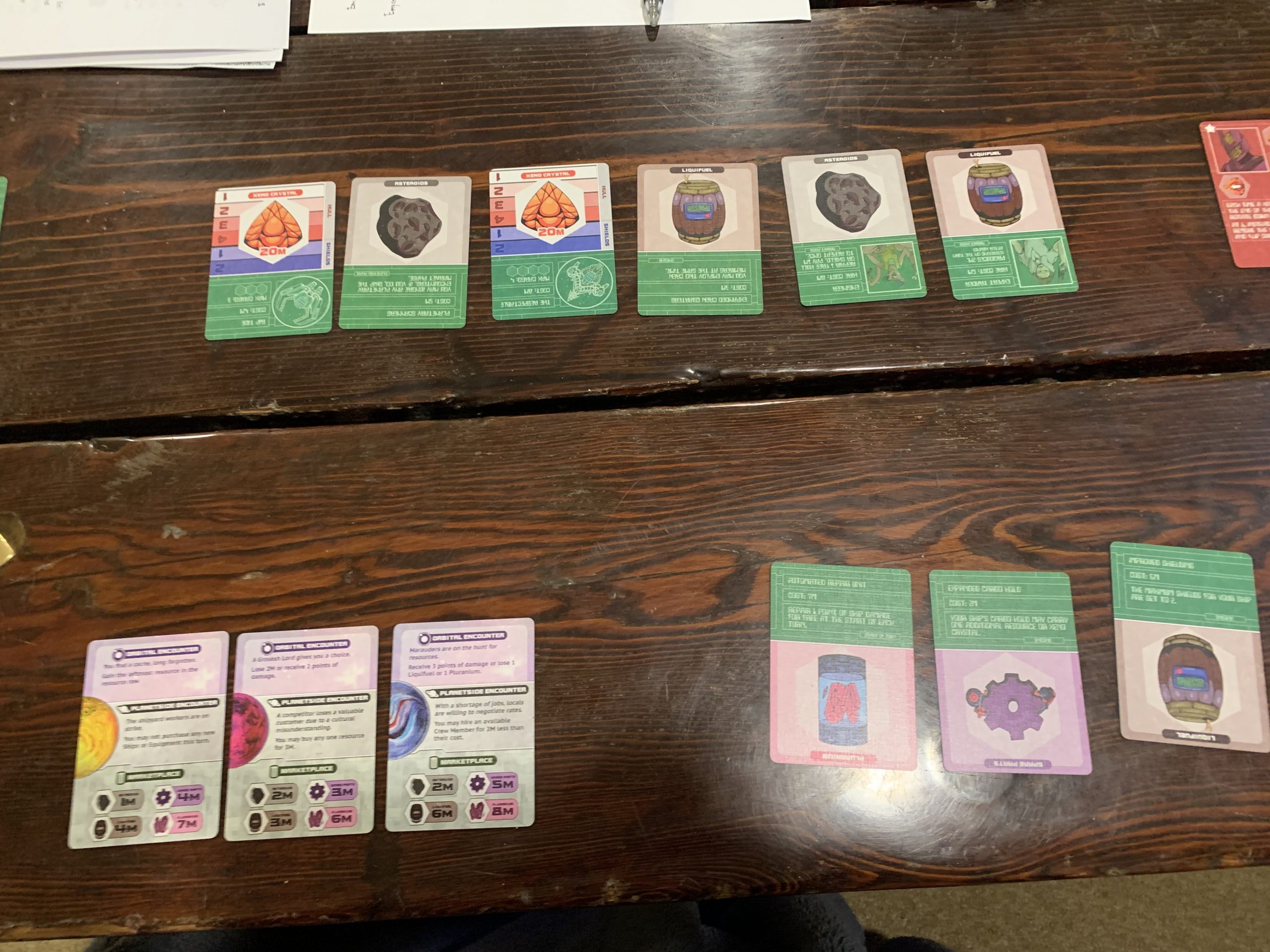
Button Shy Games’ Spaceshipped, designed by Lucas Gentry, does just that. It’s a fully fledged pick up and deliver board game, with a functioning economy, an entire crew recruitment and equipment system, narrative events, and a ticking clock that actively responds to how well you’re doing in the game. And it does that with just eighteen cards. There’s no miniatures, no dice, no big cardboard maps, no giant forty-page rulebook. Just eighteen cards.
But those cards are deceptively complex. Setting aside a scorecard and a card listing your enemy, the other cards are all double-sided. On one face is two possible events, and a list of prices for buying and selling the four possible resources. On the other is one of those resources, and either a ship, piece of equipment, or crewmember. Cards are then laid out in three tracks – three cards with ships/equipment/crew, three cards with events and prices, and the remaining displayed with their resources showing. Each turn, you complete two events, buy or sell any items you want, and slide a card from one track to the next. You win by purchasing two of the very expensive xeno crystal Maguffins; you lose if either a xeno crystal slides off a track six times, your spaceship runs out of hull and explodes, or if you run out of money.
Which, you know, not letting your spaceship explode or falling into debt may be self-explanatory, but it’s probably worth noting, anyway.
It’s hard! You lose many more of these games then you win. The game is unforgiving, and you’re likely to have your spaceship destroyed, or the crystals slide off the track, pretty often. But it’s just eighteen cards. If you lose after six minutes or so, you can just take the eighteen cards, shuffle them up, and deal them out again. Setting the game up again takes all of fifteen seconds.
The game isn’t great. There isn’t that much variety in the cards – because, again, there is only eighteen of them – and the cards themselves lack a sense of narrative. Which, incidentally, is strange, because it references some fake names and such, and could easily create such a narrative. Button Shy’s other game Liberation is arguably a good point of comparison. As well, once you beat the game the first time, well, one game is much like the next. Again – just eighteen cards.
And that’s really the rub of it, I think. When you compare Spaceshipped to the other Button Shy game I reviewed on the site, Sprawlopolis, I think that Spaceshipped comes off the worst. A game that is about creating a sense of narrative simply can’t work that well with just eighteen cards.
That’s not to say that I wouldn’t ultimately recommend Spaceshipped. I do. It’s fun, and for twelve bucks – or three dollars, as a print-and-play – well, ‘fun’ is enough to recommend it. But it’s almost more interesting as an experiment in, and an example of, innovative game design, then it is as a game itself.




You must be logged in to post a comment Login