

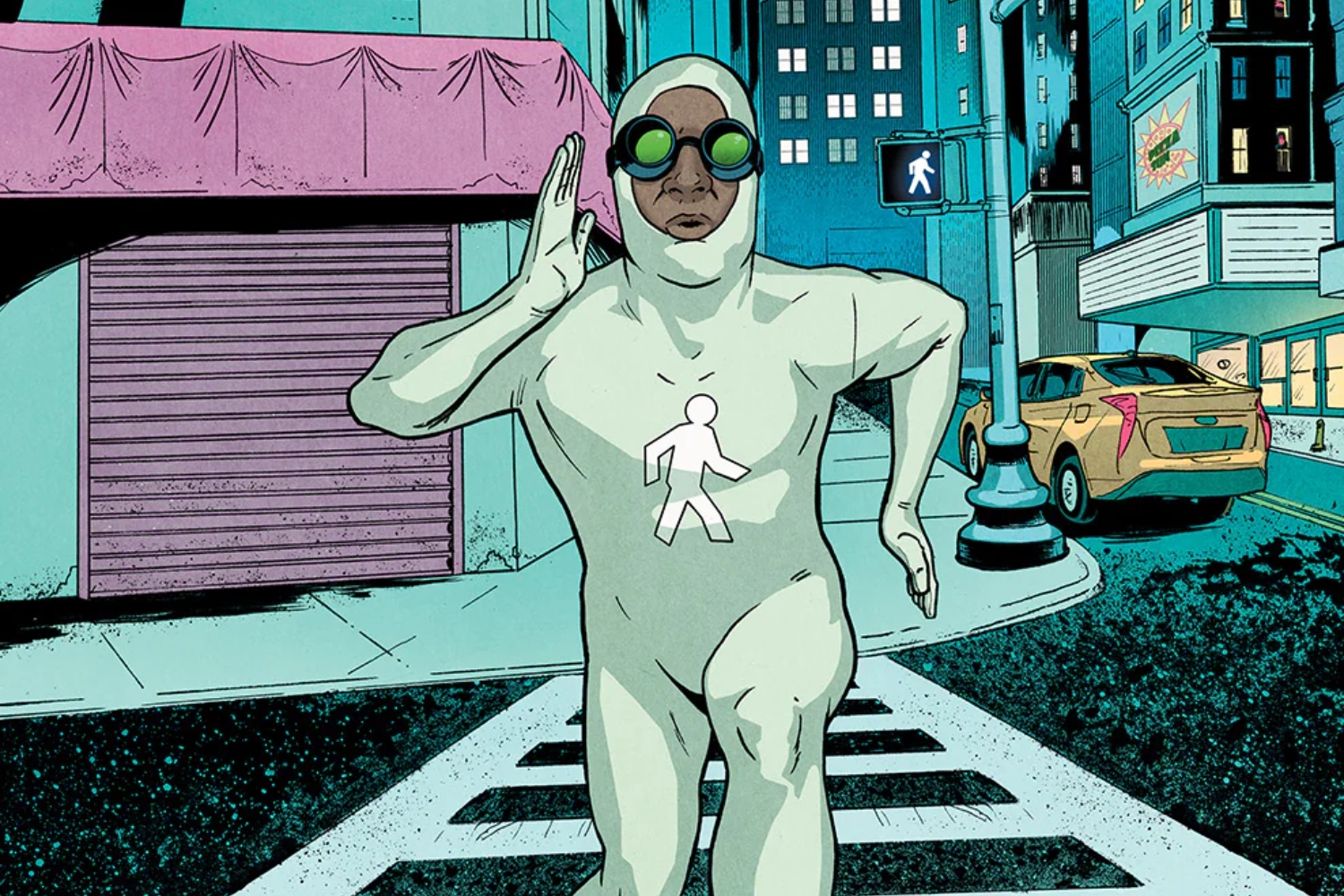

When I read issue #1, I was taken aback by The Pedestrian. Because based on the solicitation — ” A strange visitor speedwalks into Summer City and silently changes the lives of its residents” — and the cover art, you’d expect a kind of Madman-ian jaunt into the weird and wild. But man oh man, does it walk all over your heart, just as creators Joey Esposito and Sean Von Gorman intended.
“I think that’s probably just what you get when you get Von Gorman and Esposito; you’re going to get some feels,” said Von Gorman in a recent Zoom call. “We deal in the feels. Write that down.”
For his part, Esposito wants people to be struck by the sort of strangeness of it all (and not just the fact that our lead is in a giant bodysuit).
“I do think you’re right that it presents as maybe something a little bit different than what it is,” said Esposito in the same Zoom chat. “And I would say that that is on purpose. Not only to hook people, but also hopefully surprise them and just to get them to challenge their expectations a little bit. And I think we’ll do that also issue to issue. Based on reactions from issue #1, I’m very pleased with people’s response to it so far. And I think that, hopefully, that means issue #2 will also be a little bit surprising in terms of the directions that things go and the scope the story takes on, which feels pretty contained now. But I think by the end of this arc, it’s maybe a little bit different than what people are anticipating. That’s very exciting to me.”
It’s a penchant the duo have developed in the several years of working together, including another similar, multi-character series.
“Our first collaboration was on a project called Pawn Shop, which was a story of a day in the life of New York City from four different angles,” said Von Gorman. “Each chapter followed the perspective of one character and saw an interesting build up of timelines and different perspectives, but very much at the root of that is a very emotional story. This was a pure slice of life adventure in New York. Emotion was rampant in that book. There is not anyone that I’ve come across who has read that book has not gotten really bummed out or sad or leaving with a sense of poignancy at the end of it. So that was definitely something that was important to us in terms of building worlds and building some attachment between the reader and the characters.”
When it comes to worldbuilding and character development, the story of The Pedestrian began not with something poignant but a silly little joke.
“I think at the beginning, it really started from a very ridiculous place,” said Von Gorman. “I had had this image of this costumed character without any powers who just speedwalks around the town because I thought it’d be really funny to have something maybe like The Flash without any powers. And wouldn’t it be funny to just see someone just walking around in real-time on adventures? And I didn’t have much more than that. So that’s why I tapped Joey after remembering how great he was at writing these really rich characters to help populate this world.”
Esposito, meanwhile, had a very specific question or concept he wanted to address with The Pedestrian.
“I think you hear people say all the time that everyone’s the hero of their own story, and that’s true, and that everyone has their own hopes and dreams and needs and wants,” said Esposito. “We don’t always get to explore that particularly in superhero comics.”
So, to help answer that query, the duo leaned into a similarly-structured story where humanity shines above all displays of superheroism.
“I’ve said this before, but Sean and I talk a lot about the triangle era of Superman books at DC from the early ’90s and how he had such a great supporting cast and they all had their own stories, but it was still ultimately a Superman story,” said Esposito. “Whereas I think in The Pedestrian, he’s important, but he’s just really the connective tissue between these other characters who are all dealing with this very weird thing that’s happening in the middle of their regular, mundane lives. It’s just this additional thing they have to deal with, and for some, maybe it’s a good wake up call or something to brighten up their existence in Summer City. For others, maybe it’s the worst thing they could possibly imagine.”
Similarly, Von Gorman referenced the Man of Steel in getting to the heart of The Pedestrian.
“Let’s look at Superman for a moment,” said Von Gorman. “Take away all the powers of Superman and what we have is someone who is just trying to do the right thing, and that’s kind of what we have here. Are there bigger cosmic elements to what’s going on here? Sure. We’re going to get into that. But he’s kind of a blank slate where people can kind of see [The Pedestrian] and pin their hopes and dreams.”
And in crafting this deeply human world, the two creators certainly developed connections with the various denizens of Summer City. Esposito, for instance, talked fondly about a young man named James, whose bad habits bring him face-to-face with The Pedestrian himself.
“I also think James is very interesting. I mean, he’s a dirtbag, but dirtbags are people, too,” said Esposito. “And dirtbags aren’t necessarily born dirtbags. There’s circumstances leading up to them. There’s reasons he does what he does and they’re not necessarily his fault. That’s a very real thing, even though we don’t often consider that when someone makes a choice. But consider the circumstances he’s raised in and all these things that led to that point.”
Von Gorman, meanwhile, likes a couple young twins boys named Jeremy and Sydney, who serve as a specific kind of catalyst in The Pedestrian.
“They have some of my favorite moments and their positivity really drives the story in a big way,” said Von Gorman. “Whereas a lot of stuff that’s going to be happening is stuff that only a kid would be ready to embrace and understand like, ‘Oh, someone’s in a costume, let’s go.’ Any other adult would be like, ‘Who is this guy? He’s not talking to me, he’s not telling me he’s not crazy, so he must be crazy.'”
The book’s so personable and life-like, in fact, that it’s actually based on a real-life person. Some strange but well-meaning character who helps facilitate the larger messaging of this story beyond just how deeply engaging it may feel.
“He’s [The Pedestrian] based on a guy I used to work with way back,” said Von Gorman. “He was the guy at the bar who goes, ‘I don’t drink, but you can,’ and he would just stand at the corner of the bar watching everyone doing what they do. Not necessarily judging what they’re doing, but leading by example. I thought that was a comical aspect to this, of the thing that you’re trying to do is not necessarily working out the way you are expecting it to. But this is how I’m going to change the world. I’m not going to try and scream at someone into doing what I think they should do. I’m just going to do what I think is best and try and hopefully others will follow my example of what’s happening.”
And that’s it right there — The Pedestrian isn’t just about communities and people coming together, but what these ideas mean right now. Esposito and Von Gorman spent a sizable chunk of COVID lockdown putting together The Pedestrian, and that very much influenced their efforts.

Main cover by Sean Von Gorman. Courtesy of Magma Comix.
“All of the characters bring something to the table, and we’ll start seeing that as the story progresses in the unexpected ways when you form a community,” said Von Gorman. “And that’s a lot of what this story is about when we were working on this. The first year [of working] was in secret during lockdown, where a lot of 2020 seeped into the mix. What we saw on television and these social justice issues, a sense of isolation, and communities being dismantled by corporations. I think what we’re doing here is that we have a hero here, especially a hero of color, who doesn’t use violence to solve problems. And we thought that was a very powerful image to show these days — he’s not beating up a bunch of people.”
All of that isolation and separation really informed why this book has so many leads, why it speaks to making communities more aligned and fruitful, and even the need for everyday citizens to stand up. As such, the pair fully leaned into their own hometowns in crafting the very look and feel of The Pedestrian‘s own Summer City.
“There are key visual elements that incorporate where I grew up and where Joey grew up,” said Von Gorman. “Joey grew up in a small town in Massachusetts. I grew up in the outskirts of South Brooklyn. So there’s urban aspects to this. There’s definitely small town aspects of this. It’s not necessarily a set place, but it’s probably a place you’ve been to before.”
But in keeping with the whole “COVID-tinged loss of innocence,” this city is quite different from comics havens like Metropolis or Star City (maybe even Gotham City to an extent).
“This is a place that is in a state of flux and in a state of change, and that change is not a positive change,” said Von Gorman. “This is a place that’s slowly dying and there’s not really much there for anyone. If people are just moving away for better jobs, and there’s not really anyone speaking up or taking a stand on anything, then a neighborhood just becomes a place, and then that place can just become something that people can buy and change into something that they envision as, ‘Oh, this should be high rises’ or ‘This can be a spa with the high rises’ and not really necessarily considering the ramifications of the people who live there.”
For Esposito especially, the concept rings even truer still.
“Something that was really in the front of my mind while working on The Pedestrian was where I grew up,” said Esposito. “GE was a major employer in my town when I was growing up, and they started shutting down all these factories and laid off, like, 15,000 people or something crazy that devastated the town, and it just a wasteland around that area. They polluted the lakes. They had to dig up one of the elementary schools because there was cancer-causing PCBS in the playground. As a result, my generation has grown up in a place like this while all the adults are telling you, ‘You’ve got to get out — there’s nothing for you here. You’ve got to work really hard and make sure you move somewhere where there’s opportunities and stuff.’ They weren’t wrong, but as a result, my sense of community or connection to that place is damaged because it was never a place I felt strongly connected to because I knew that I was going to be leaving.”
It’s made even all the more clear (and maybe painful) now that Esposito’s a homeowner himself.
“Even in my adult life, until I moved to where I am now in Maine, I struggled to really find connection or like comfort in my community because it just wasn’t something that I valued as much as I should have because of the way that my hometown was treated when I was a kid,” said Esposito. “So a lot of that seeped into this book. and particularly the young adult characters that we meet who have recently left high school and are kind of rudderless for various reasons and trying to figure out a way to get the hell out of there. but who have now found themselves in the orbit of The Pedestrian and are going to have to stick around a little bit longer.”
Even Von Gorman sees a kind of fickle tendency that’s evolved in cities, and people seem to be disconnected from these hubs.
“I think high rises are a great example of what we’re talking about here,” said Von Gorman. “These [previous] buildings existed for 100 years because someone put great care into putting together these houses — people were building their homes, and then this generation passes it off to a new generation. That generation sells it and then someone comes in and builds something artificial and quick to make for a quick buck to sell. Cut five years into the future, and they look like crap because no thought was put into them. You just have a whole neighborhood of LEGO buildings that are falling apart that they’re also not fixing and that people own these and they’re just kind of stuck with.”
It’s all a reminder that some things are meant to last.
“This is related but kind of a tangent,” said Esposito. “When we bought our home in Maine, it was built in 1880. All the [neighbor’s] houses are that or older. I told the home inspector that I had an issue that I was concerned about up in the attic. The home inspector was like, ‘This wood is so solid and so good. Your house has been here for 200 years. It’s going to be here for 200 more.’ I think that’s exactly what we’re talking about: prioritizing profit over people, or artificial property and profit over any sort of long-term community building.”

Variant cover by Dean Haspiel. Courtesy of Magma Comix.
This dissection of cities opens up another important thread in The Pedestrian: superheroes themselves. More specifically, is this book’s end goal to explore heroes as a satire, celebration, or some nebulous hybrid?
“It’s an interesting question. I definitely don’t see it as a satire of superhero stories,” said Esposito. “I think if anything, it’s picking it apart a little bit but not in a critical way. I would never compare anything I did to Watchmen, but Watchmen is very much a criticism of superhero tropes. And I don’t think that that’s what this is.”
Von Gorman, on the other hands, is a little more sure of The Pedestrian‘s scope and intentions.
“It’s definitely a deconstruction for sure,” said Von Gorman. “We’re taking the base elements of a superhero story — even the way we started with a foiled mugging as have many comics. But what happens after that hero reveal? We have these moments but we don’t step on them. Maybe it’s like Thor: Ragnarok, where they’re making fun of superheroes. We have great respect for the genre. And I think part of what we’re coming from this with is what if there was an actual superhero? What if someone in a costume in the world was trying to help people? We’ve seen some examples, like groups that put costumes in Florida and walk around doing community service stuff. There’s people who cosplay for charity.”
Maybe it’s a question of specific influences. Think less Batman or Captain America, and instead a very specific kind of ’80s hero.
“A lot of our inspiration comes for things like Ghostbusters, [which] builds a very believable world,” said Von Gorman. “We believe this world exists except for this one weird thing where these guys who are probably not our first choice for the people are going to save us. And that’s very similar to what’s happening here.”
Or, maybe a hero who is even stranger and more bizarre than Dr. Peter Venkman.
“We’ve talked a lot about the David Lynch influence on The Pedestrian, specifically Twin Peaks,” said Esposito. “I don’t think our series is as abstract as Twin Peaks, particularly Twin Peaks: The Return. But I think what’s interesting for me with that stuff, and what I hope people can take from The Pedestrian, is once you read it, going back to read it again and seeing what you missed. Sean and I talk a lot about, ‘Oh, on a reread, this will be really cool.’ Once you have some more information you go back to issue #1, you can see little details or little things that are mentioned or seen in the background or whatever it might be that will have additional context.”
Perhaps above almost anything else, Twin Peaks made some important but difficult creative decisions that proved especially inspiring.
“The thing I really love about Twin Peaks is that it really, really challenged you in a way that television, to a point, really never had before,” said Von Gorman. “Especially leaving off on a cliffhanger that was going to be forever. It’s just frustrating and it just made you feel so upset. Like, the hero went into hell, he saved the innocent girl, but he’s forever damned now. And we’re never going to get a satisfying resolution to this. Even when we did get some sort of resolution to that, it took 24 episodes to get to that.”
In fact, there’s a hugely Lynch-ian thread beating at the very heart of The Pedestrian.
“There’s significant lore happening here that we’re going to dive into a little bit,” said Von Gorman. “You see street signs and you wonder why do I stop at a stop sign? Is that something that I’ve been trained to do, or is there something inherent in my DNA that tells me that I need to stop for three seconds before moving on? I think that’s something we have fun with in here, and there’s bigger answers to that cosmically that if we get to go where we want to go with the story, It’s going to be the weirdest, wildest payoff we’ve seen in a comic in a generation. Like, Grant Morrison would just throw it away in a single panel and we’re going to milk this as much as we can.”
To an extent, some of that is very much a reaction to the nature of comics. Esposito understands that it’s a “traditionally disposable medium,” and that “anything you can do to not only get people to read it but to not just file it away in their boxes or whatever and maybe keep it out, that’s a win.” So, it becomes an issue of exploring all these massive ideas in a way that shows without telling, or engaging readers in a way that demands their utmost attention.

Variant cover by Michael Allred. Courtesy of Magma Comix.
“But we would much rather err on the side of telling the story that the way that we think it should be told and the way that we’re most interested in rather than making sure people get every question answered,” said Esposito. “Because I just think art is more interesting when you can leave the reader or the viewer or whatever with questions about what they’ve read and theories and participating about what it means.”
Esposito added, “The reader should be an active participant in the story. That’s part of the beauty of comics — the reader controls a lot of the experience, they control the pace, they control how they consume the book. And I think acknowledging that and not trying to be like, ‘Here’s my vision.’ It’s inviting a reader to share the vision and to be part of the story.”
Not only does Von Gorman agree, but he explains that this tendency within The Pedestrian has everything to do with its larger goals and messaging.
“You never get a straight, concise answer,” said Von Gorman. “You get some more information that expands your question a bit. But there’s no specific detail that is going to have a flip switched and have all the answers not going to be revealed, especially at the end of this volume. We do have three significant arcs here based on Greek dramas: there’s a man versus man, a man versus nature, and a man versus God type of thing. Once we see the bigger picture of, yes, it’s a quirky superhero slice of life story, but beneath the surface, there’s the secret history of street signs that’s linked to this ancient conflict that we’re going to see start to boil over into the real world.”
Esposito even made the comparison to horror movies, explaining that there’s a long-term future in knowing when to simply shut up.
“I’m a huge, huge horror fan,” said Esposito. “But there’s franchises with diminishing returns — where you learn more and more about Michael Myers or whatever, and at a certain point, it becomes lore and not terror. And I think that can also apply to mystery elements. We have those answers and we know what the story is. I would say our intention is to have it be kind of a slow drip of revealing certain information. You know, we have four issues for this arc, and you will get some further info about what’s going on, but you definitely won’t get everything because while potentially these four issues are all we get, we hope that’s not the case.”
And the duo don’t just talk about being careful storytellers — they practice it with the utmost ability.
“There is a panel that Joey pointed out to me the other day on a reread after we got the letters back for issue #2 that he didn’t know that changed the whole mood of the page,” said Von Gorman. “It’d been in there for years, and he’s finally seen it.”
And while issue #1 of The Pedestrian won’t be out till August 7, there’s no denying that they’ve already had some success with the book.
“When we first started showing The Pedestrian to people, we made up a six-page ashcan,” said Von Gorman. “People would come over and just be intrigued, and they would either pick up the ashcan for $10 or they would sign up on our mailing list. We sold probably 300 to 400 copies over the years. The reaction to this has been the strongest we’ve ever had of anything we’ve worked on ever.”
But sales are one thing, and the duo have even started building a community within and around The Pedestrian. That begins with Magma Comix, the upstart label who took a chance on The Pedestrian. I truly does feel like a relationship forged from pure magic.
“But we got to all the major publishers that create their own books and we got to a point where I had to say to Joey, ‘I don’t think the publisher we need exists yet,'” said Von Gorman. But they eventually made contact with Magma, whose team includes several industry vets, and they told Von Gorman that “we’re getting ready for a second slate and we keep coming back to the pitch. It’s something that they couldn’t forget.”
Added Esposito, “We talked to everybody and got some offers, and we walked away from a few that were just like, ‘No, we don’t need to do that.’ That’s something I’m really proud of us…we believed in The Pedestrian and our vision and knew that certain things had to be a certain way. Had we not found Magma, we would have just found a way to do it ourselves.”
They’ve even been able to build a rather robust community of guest artists, including Michael Allred, who contributed an extra snazzy variant for The Pedestrian #1. It was a connection Von Gorman made some years ago with Allred, whom he described as a personal inspiration.
“I finally met Mike years later after starting my own comic, an action-adventure series called The Secret Adventures of Houdini. And part of what I was doing at that time was I would go to shows with a straitjacket. I would find someone I either knew or admired and I would ask them to put me in a straitjacket and I would perform straitjacket escapes at comic shows.”
So, when he finally pitched Allred for The Pedestrian, did the comics legend even remember the younger creator?
‘Of course, I remember you,” Von Gorman recalls of Allred’s message. He goes, ‘I have never put anyone else in a straitjacket.’
That last story isn’t just ridiculous but it also speaks to just how much Esposito and Von Gorman have put into making The Pedestrian a reality. One of the perks in working with Magma, for instance, was that “they aren’t interested in IP farming,” and that allows the pair to “make the best books that are possible.”
Not that they wouldn’t mind if The Pedestrian wasn’t a hit that eventually branched out into subsequent forms of media. The pair already have an action figure prototyped, as well as a Saturday Morning cartoon-style trailer complete with The Pedestrian’s own theme song. (Editor’s Note: Check out the song above.) But at the end of the day, The Pedestrian may already have achieved the only metric necessary for true success. A reader who, much like with my own initial reaction, felt drawn to The Pedestrian for its oddness, core messaging, and generally novel ideas about community and the roles we all play within it.
“There was a lady who had walked over [at a con], and she had a cane and she was looking at [the ashcan],” said Von Gorman. “She goes, ‘Excuse me, can I ask you a question? Is he jaywalking?’ And I said, ‘No, actually, he’s not jaywalking. He’s The Pedestrian. He doesn’t break the law ever to fight crime.’ And she goes, ‘Oh, that’s really interesting because I jaywalked once and I got hit by a car and that’s why I have this cane. I would like to buy a copy of this, please.'”
The Pedestrian #1 is due out August 7 from Magma Comix.



You must be logged in to post a comment Login