

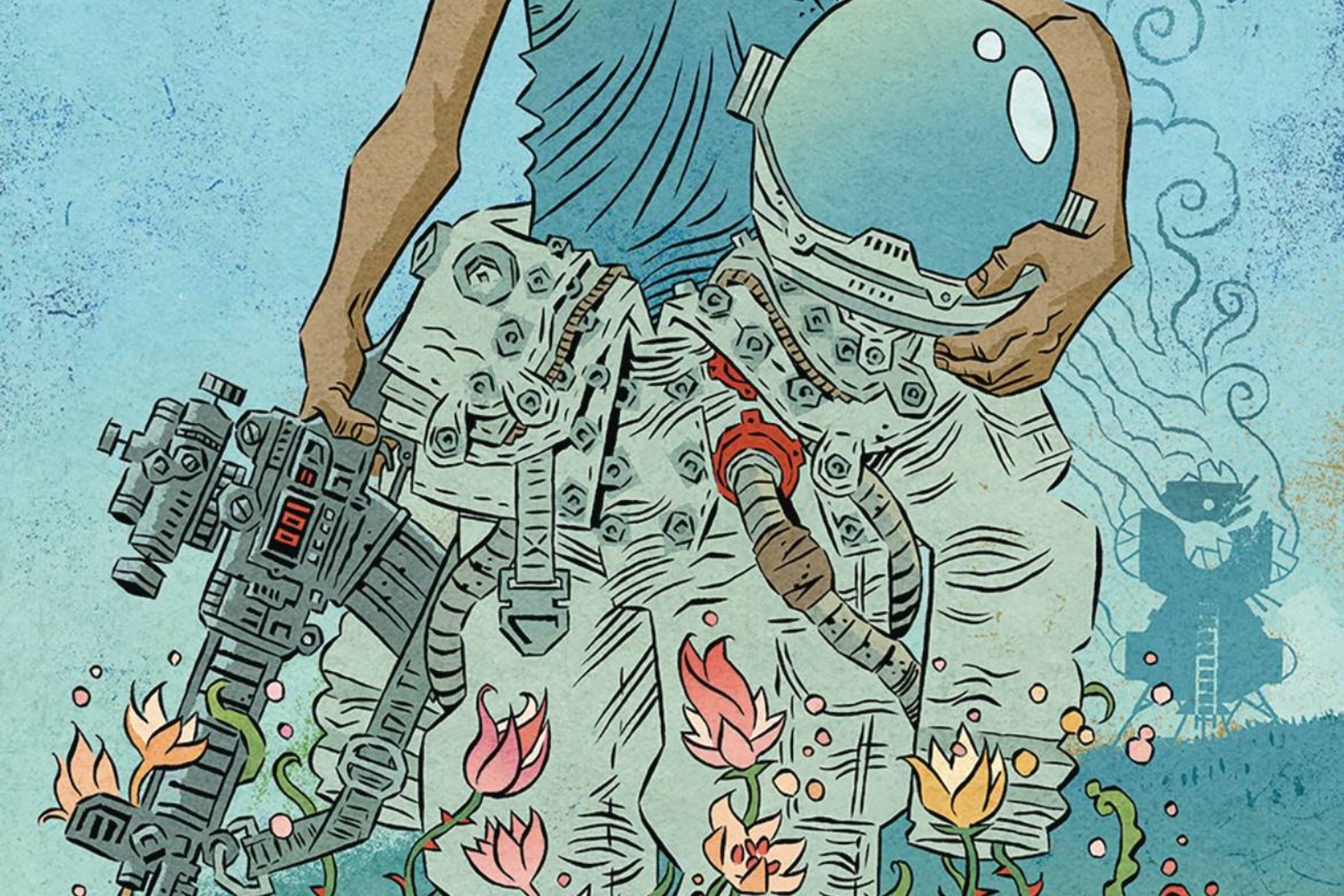

Stop me if you’ve heard this one before: there’s an adventurer/captain/science officer and they’ve uncovered a new island/dimension/planet, only to be stranded and have to fight for their very life against strange fauna and elements.
So, no, Convert isn’t exactly operating in the most novel of territories. But there’s a few key decisions that could make Convert an interesting addition to this “survival” genre — if it can make it through the journey, of course.
The first thing setting Convert apart is the overarching approach from writer John Arcudi (of the super great Rumble). Here, we meet science officer Orrin Kutela, the sole survivor of a mission to some alien world. Sure, the story of someone surviving a great tragedy only to have to keep surviving is a tale as old as time, there’s a kind of robust efficiency here. Arcudi’s storyline means Convert gets right to the harrowing parts of Kutela’s struggle, and we see him grappling with the grief as much as the actual nasty alien creatures and a sheer lack of food. In that way, all of Kutela’s struggles are tied together, and that feels important as we try to get into his head and engage in his experiences in a way that feels especially meaningful.
Of course, you can’t do that without a properly organic, well-rounded hero, and even this early on Kutela feels fully and wonderfully realized. Arcudi made him an artist, and that kind of thoughtfulness and ease of spirit already comes off in Convert‘s debut. His monologues, expressed as a journal scratched out in his former drawing pad, is full of a kind of unassuming poetry, as Kutela makes scientific observations sing with deep emotion as much as there’s this unwavering honesty and intellectual heft to his basic expressions of fear, desperation, and grief.

Courtesy of Image Comics.
If Convert is really going to continue to buck its very familiar story frame and all of those corresponding tropes, then Kutela will need to continue to shine as this poignant wanderer with whom we can relate to and fill with our own musings about loss and grief.
But, of course, so early on, the real draw is the visuals (from artist Savannah Finley, colorist Miguel Co, and letterer Michael Heisler). In some vital ways, this book feels similar to the excellent Scavengers Reign. I’m thinking mostly in the ease and tranquility (that’s undercut by this tinge of visual tension); the sort of biopunk-esque choices for the animals and world at-large (even as it’s way more subtle in Convert); and the stark way humanity is depicted in all its power and beauty as well as more harrowing, unsettling lows. It’s an imperfect comparison, yeah, but it helps to understand the visual niche that Convert has aligned into, and how that helps further contextualize its worth.

Courtesy of Image Comics.
But even more than some of the narrative decisions to make Convert shine amid those similar offerings, it’s the art where we see how truly novel and alive this series is thus far. Finley’s whole style balances realism and a more abstract or free-form approach to everything from people and technology to alien fish. It results in people that we can engage with when, as Kutela’s situation becomes more dire toward the issue’s end, they also take shapes and hues that play around and comment on their own form and humanity. Or, terrains and wildlife that are familiar to our own terrestrial experiences and yet with tinges that aren’t quite as alien (like Scavengers Reign) but exude enough “newness” to draw out our uncertainty and curiosity. Even Kutela’s bodily transformation, as weight loss and nature begin shaping his form, feel really powerful in manifesting the suffering and struggle he deals with psychically.
Then, of course, you consider the rest of the team. How Co’s colors manage to extend the balance between the familiar and the strange, and also capture certain ideas and moods in such a vivid snapshot. And Heisler’s lettering, which fosters the whole “journal device” in such a way that we can connect with Kutela to another level or degree. Together, the art team don’t just make Convert more than the sum of its genre parts, but make it hum with its own unique heartbeat.

Courtesy of Image Comics.
The narrative facilitates some of this, but it’s really the art where a lot of those connections and disconnects sort of blur, and what we’re left with is this purer chance to engage with a world and a person that’s unfolding in front of our very eyes. It’s also a style that means when there is some added “strangeness,” as occurs in the final pages, that “uptick” is made to seem all the more powerful and important to the story at-large.
It dawned on me, early enough in the story, that the creators maybe know what they’re doing with Convert. That they’re working in this same grand tradition not because it’s new or novel but that it’s an especially vital narrative we keep telling ourselves again and again. We seem damn interested in pushing ourselves to the brink (even in story form) and how we can more meaningfully maintain and engage with our own humanity.
It’s less about doing something exciting and more about exploring that very human “tradition,” and so far Convert has embraced that with gusto, heart, and pure passion. Time will tell if this story can further distinguish itself, but for now, Convert is a survival story worth tackling with teeth and mitts alike.




You must be logged in to post a comment Login