

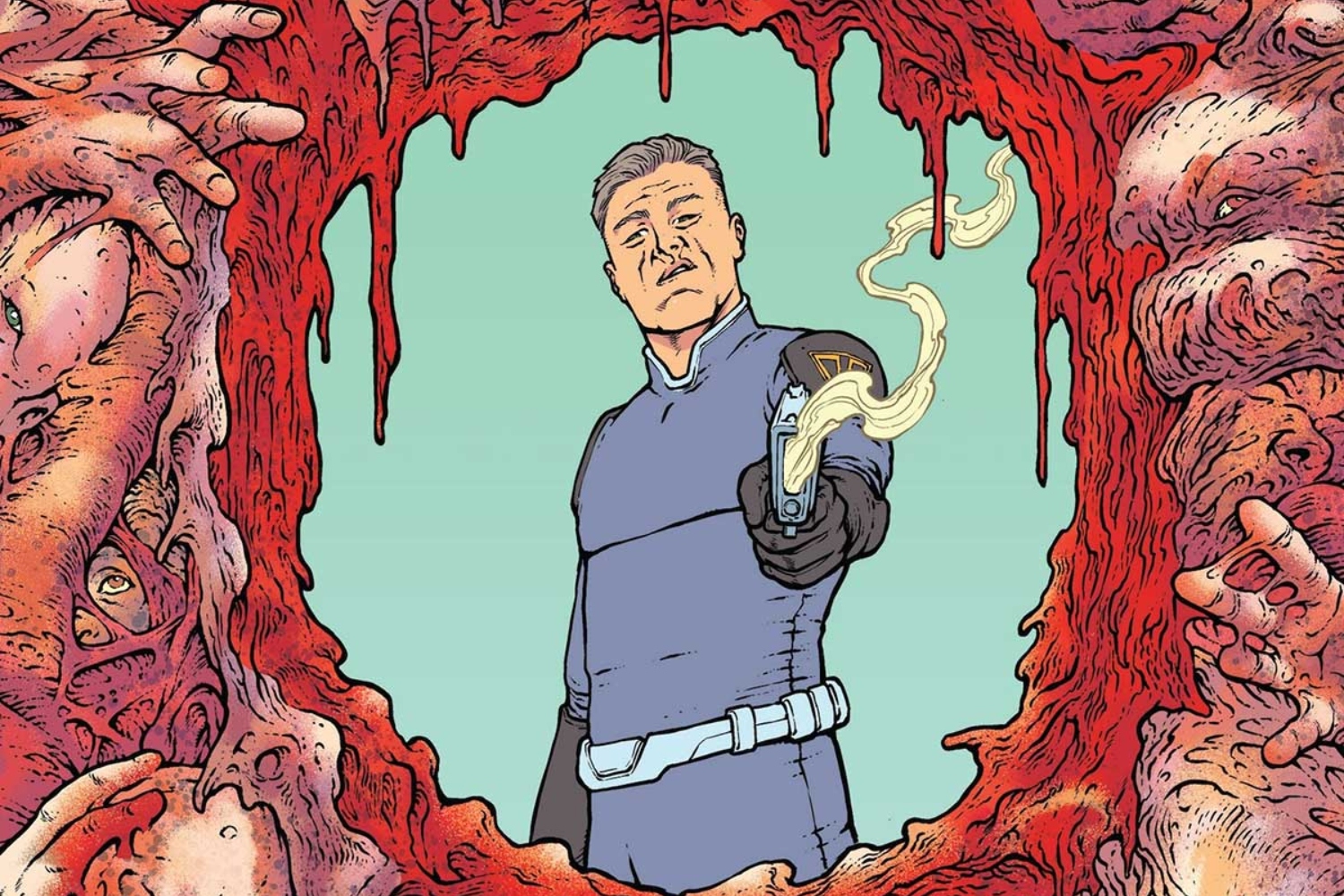

Perhaps you’re like me and thought the mark of the future would be robot butlers and teleportation. As it turns out, the true mark of the 21st century and beyond might actually be a dazzling level of mistrust. It certainly stings a little, but given the proliferation of AI and deepfake technologies, it certainly does make sense that we’d struggle with the basic premise of trust. If there’s a single, glimmering upside to this sustained degradation of trust, it’s that the “subject matter” is ripe for exploration in comics and other media. Case in point: Skin Police.
Written by Jordan Thomas, and with art by Daniel Gete (Über), Skin Police is “a sci-fi/action spectacle that will force you to trust no one.” After global fertility levels dropped circa 2141, a black market for “illegal clone babies” emerged to meet that need. But the day wasn’t exactly saved, as we quickly discovered that 75% of these “Dupes” will eventually turn into into “psychologically unstable killing machines.” As such, it’s up to the Duplicate Identification and Capture Division (aka the titular Skin Police) to hunt these Dupes and maintain law and order.
What follows, then, is a sci-fi series that may seem familiar enough (it rhymes with “Glade Sunner”). But from that basic enough premise, Skin Police develops into something altogether more potent, a tale that balances Gete’s bold and stylized vision of the future with Thomas’ layered narrative to really delve into these multifaceted social issues. It is, at its very core, a story about our relationship to the world and one another, and how that evolves in ways both uplifting and unsettling. It’s damn good comics — just trust me on that.
Skin Police #1 is out this week (October 2) via Oni Press. To get a better idea of the story at-large, we recently fielded Thomas some essential questions. That includes Skin Police‘s premise and connection to Thomas’ other works, the story’s messaging and conceptual interests, key ideas of heroes and relatability, and some teasers/tidbits from the rest of the series.

Variant cover by Adam Pollina and Ulises Arreola. Courtesy of Oni Press.
AIPT: Is there anything tonally, thematically, emotionally, contextually, etc. in common with the excellent Man from Maybe?
Jordan Thomas: Skin Police is a very different story to The Man From Maybe. Where Maybe was a high adventure quite classic story with very clear heroes and villains, Skin Police operates much more in the grey areas where picking out the goodies and baddies is a lot tougher. However, I’d say that I have a certain sense of humor that you’ll see in both series and we have that fun back and forth between an odd pairing in our two clone-hunting agents Eckis and Corfer, and well, there’s also the fact that ultimately the worst evil is done by the power hungry ultra-wealthy whilst the average person is just trying to survive in a world that doesn’t care much about them. To grab a pair of Harrison Ford movies, Maybe was much more Indiana Jones, whereas Skin Police is playing in the same schoolyard as Blade Runner.
AIPT: How much of this story is about the surprising lack of control we don’t have even as we seem to further evolve/elevate as a species?
JT: Yes, I suppose that plays into the ultra-wealthy and politicians being the real villains behind the scenes of a lot of the story. The world we’re in is a dictatorship in all but name as a ruling party took control through a coup and then holds sham elections where no one can challenge them. This places all our characters, no matter what side they are on, in the position of existing within a structure they have no real control over, and it’s the attempt to wrestle back some control that is at the heart of the story. This is played out in metaphor as well in the fate our duplicates suffer when they pop, losing their minds and becoming terrified creatures acting more on instinct, which is probably how all of us would feel if we were truly aware of what is going on anyway!
AIPT: Is there anything else you think this story is about at its core?
JT: I think the true core of the story plays out between our protagonist and antagonist, DIC Lead Agent Brisson Eckis and Dupe Rebel Underground Leader Heath Noxxon. The reality is that each of them fulfill both protagonist and antagonist roles as the story progresses. Both are on a journey to free their minds but in different ways. Eckis from the propaganda he has built his life upon and Noxxon from the literal danger his mind is always in because of the degenerating genetics he was created with.

Courtesy of Oni Press.
AIPT: The Skin Police aren’t exactly regarded as heroes here. Why that dynamic specifically, and do you think there’s some obvious real-world parallel?
JT: The story is set in a united future Europe and unfortunately the history of Europe really only points to that happening under some kind of conquering dictatorship. Skin Police is the less-than-flattering nickname for the DIC, the Duplicate Identification and Capture department of the government who are tasked with hunting down the illegal clones that flooded into society during a recent fertility pandemic. Like today when you look at things like immigration people with kinder hearts tend to think about the suffering of the people forced into extremely tough situations whilst governments use those same people as a way to win votes and create things for the world to be afraid of rather than choosing to help the people in terrible situations. This same attitude is what creates the tension in the world of our series with people believing that rather than just exterminating the clones the government should be doing something to help them. Plus, the DIC are monitoring everything everyone does and have all access keys to enter any and every home or building whenever they like and that’s not something people tend to be big fans of.
AIPT: What was it like working with Daniel Gete? I see some aesthetic similarities with past collaborators like Shaky Kane and Clark Bint — do you have a “type” artistically/creatively?
JT: Working with Daniel is an absolute joy. Getting the right artist for this series took a long time as I was pushing for someone with a European/Moebius-inspired style and those types of artists aren’t easy to find but Daniel is everything I wanted and more. I gave some general pointers on the kind of world we were going for visually with a combination of historical architecture and futurism as Europe has so much history I didn’t want to wipe that all out and build giant gleaming skyscrapers on the rubble, but besides that Daniel has really been the one to create the look and flesh out the visual tone of the series. The amount of work he puts into the design of each and every location is insane and I really feel the book is an artistic tour de force where you can just study every panel for the unusual patterns and creative choices Daniel has made. Then, once it gets to the action, Daniel has also been able to bring the visceral intensity I dreamt of when writing the issues. I’m a huge fan of his and love working with him.
In terms of comparing Daniel to previous artists I’ve worked with he is certainly more on Clark’s side in terms of being comfortable with a lot of detail and pages with a large amount of panels on them but they are also quite different artists with Clark being a bit more exaggerated and cartoony. When it comes to picking artists I tend to either love the school that came from the like of Moebius, the tree that branched off into Frank Quitely and Geof Darrow, with loads of little lines and detail, or I go the complete other way with the branch that followed the likes of Alex Toth, very simplified and classic looking, like the work of Chris Matthews my co-creator on Mugshots. Shaky is then his complete own thing! When I work with Shaky, I write very specifically for him.

Courtesy of Oni Press.
AIPT: Speaking of types, I think that Agent Brisson Eckis is another stoic, morally complicated hero type. How would you compare him to the heroes of Frank At Home On The Farm or The Man from Maybe — is he someone you like and trust?
JT: I think that may be the first time Frank has been considered a hero! The poor guy. The Man from Maybe is definitely the closest I’ve come to writing a classic hero. Maybe will always ultimately do the right thing and protect those weaker than himself. Eckis may be the most interesting character I’ve ever come up with in that on the outside he seems very straightforward, almost like a toned down Judge Dredd, but internally he has so many doubts and concerns about the world, which is something that has been brought on by him recently becoming a father and his partner having been almost killed and left in a coma.
Eckis is definitely someone I like as in a way you have to like all the characters you write to give them a fair shake, and he is a good loyal person, but he also has no qualms about the dirty side of what he does, especially at the start of the story, and you wouldn’t want to cross him. I suppose he is one of those people that fits into the “a great friend, a terrible enemy” category.
AIPT: Do you have a favorite moment in issue #1? Maybe something that defines or sets up the story for you?
JT: I suppose the full reveal of Brisson Eckis is the coolest moment, him standing over a dupe he’s just taken out emanating confidence and danger. Although I just love pouring over the world design that Daniel has brought to book and finding all the little touches he’s snuck in – I think we have a lot to appeal to different types of readers, whether they’re here for action, the mystery or just seeing an amazing new world.
AIPT: You’ve done crime/noir (Mugshots) and sci-fi (Xino), and you combine them here. Do these genres have more in common or less in common?
JT: I suppose they’re just both very malleable genres, you can combine them with anything. Weird Work, the series Shaky Kane and I did at Image, is a total sci-fi noir story, whereas I think readers will find that Skin Police is something bigger than that. It’s a very human story and ultimately breaks out of the more traditional genre conceptions of a noir tale as it gets bigger and bigger visually whilst becoming more personal on a character level as our characters are presented with tougher and tougher choices as the stakes escalate.
AIPT: How much worldbuilding do you do here, like with the United Nations of Europe? Do you need that fully realized world to properly tell the story?
JT: Worldbuilding in comics is something I could probably do a whole talk on. As the number of issues in a series has come down from the days of 50-issue Vertigo runs, I believe being able to world build whilst also delivering the story and building the characters all at the same time is hugely important. I’d love to have four double page spreads in the issue to let Daniel go wild and show the whole world but ultimately I think that less pages to work in does lead to very trim, impactful stories to a point, where you need to be getting the flavor of the world across as you tell the story.
A line of dialogue where a character gives you an important piece of information about what is happening now, whilst also giving a glimpse of insight into them as a person and adding another brick to the world you’re creating is the most satisfied I can feel as writer. I’m very anti the information dump/exposition style of dialogue and I make a huge effort to never have my characters say anything unnatural just for the sake of giving a piece of information or to move the plot along. To me they’re real people and they won’t just do whatever I want.

Courtesy of Oni Press.
AIPT: Is this your version of Judge Dredd or Blade Runner at all? Do you see yourself working out/exploring the same themes or ideas somehow?
JT: The start point for me was definitely, “Imagine Blade Runner…but on a global scale!” But the story goes in very different directions to either the book or the movie, it was just a starting point to get my gears in motion. I think that the Judge Dredd similarities are much more superficial. The tone of our story is very different to what goes down in Mega City 1, which is way more on the nose satirically and far more over the top. I love Dredd but what we’re doing here is in a sense the opposite. Dredd is a character that never changes, whilst Skin Police is really about the changes our characters go through.
AIPT: What can you tease from the other three issues to come?
JT: Illegal dupe UFC style fight clubs. Assassination attempts. Shootouts. Ambushes. World-changing conspiracies being uncovered. And a whole lot of action and intrigue. Each issue has a main story, something that Eckis and his team are dealing with at the same time the bigger events are taking shape in the background. So, hopefully each issue is satisfying individually and as part of a wider context that ramps up as we go.
AIPT: Is there anything else we should know about Skin Police, your career, comics, life, etc.?
JT: That we’re incredibly proud of the book and I think it is something a little different to everything else on the stands right now, so I hope people give it a try. I’d written the whole thing before Daniel started, so I had a chance to really work the scripts to make the whole story fit together and have small moments in earlier issues have big consequences later on, so readers will be getting a very complete, consistent story.
Besides Skin Police, I have Mugshots with Chris Matthews just wrapping up, which is a UK crime story full of twists and turns, big characters and gut-punch moments. I also wrote a story for the first issue of the new Flash Gordon Quarterly anthology, which was a heap of fun to do.

Courtesy of Oni Press.



You must be logged in to post a comment.