

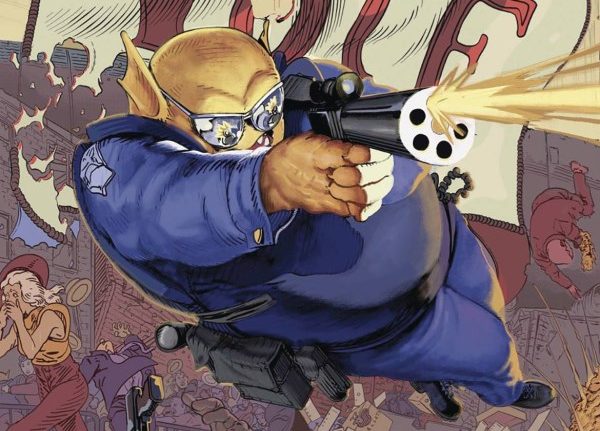

When Justice Warriors: Vote Harder crossed my desk directly following the election, it might not have been the right time for me to read it. The blow of the election’s outcome had hit me in such a way that I wanted, desperately, to burrow into a hole and disengage from the oncoming barrage of discourse; I knew the windbags were going to start blowing, and the whole thing had left me disparaged and exhausted.
Satire about a troubling election – however hyper-absurdist and outre as Justice Warriors is – felt counter-productive to my urge to bury my head in the sand.
At its best, satire isn’t meant to be a balm on social burns or even to mirror the political thinking of a spurned community – it’s meant to speak to power, highlight grievances, and pinpoint (and elevate) the troubles of a cultural time and place.

AHOY
Vote Harder might not speak exactly to this time and space. Released this September, the book was created in a time that doesn’t quite look like the one we’re in now – it was created, presumably, back when the Democratic candidate was Joe Biden and not Kamala Harris. A time when even the most gung-ho of progressive optimists were undermined by a gnawing pessimism.

AHOY Comics
This likely shaped Vote Harder’s central narrative, which revolves around an unheard-of mayoral election taking place in the sci-fi supercity, Bubble City, which has been under the rule of a vainglorious and oblivious pop star who is undermined when his sister kicks the long-unused electoral gears into motion. The real-world resonance is this: it’s either more of the same or more of the same. Keep the ineffectual candidate we have or switch to someone virtually interchangeable. Sure, the Biden/Trump race wasn’t “one for the other,” but it was two candidates we have already experienced and knew to be both lackluster and potentially dangerous.
The book proposes, deep under its walking shit-men and person/tank hybrids, a more radical approach to usurping that indecipherable change of power: revolution. That tank person opts to become a third party in the election and gathers behind her the political dissidents and financially barren dissidents. There’s an air of violence, both potential and literal – this is a world, like ours, of casual and rampant police violence, after all. Why not add to that the very real-world threat of assassination attempts? After all, that very reality had occurred not two months before the release of Justice Warriors: Vote Harder.

AHOY
Whether the book succeeds in ‘speaking to power’ or not is questionable (the characters in power are, like our own, unattainable and untouchable), but it does highlight real grievances and troubles that state-enforced violence on citizens reaches its obvious militarized conclusion, here. Basic human needs aren’t being met, and the poor are getting poorer; worse, these characters seem to feel that they somehow deserve this treatment. The system has been so heavily set against them – so long have they struggled under it – that it simply feels like the inescapable fact of reality.
Vote Harder speaks to a world like ours, and rather than attempting to foresee the end results of the 2024 election, it hedges its bets and remains moveless. The antics of our main players have little effect on those oppressive systems, and so the book resolves that it doesn’t matter in the end – Biden, Harris, or Trump, the machinations of our democracy won’t stand revolt or change, no matter how violent that revolution attempts to be.
It’s a bleak final outcome and almost aggressively pessimistic (or even nihilistic). That that pessimism ended up being deserved means that, no, Justice Warriors: Vote Harder is not a book with which to comfort yourself after a major political blow. Again, that isn’t the purpose of satire. This is a book to wake you up from that impulse to hide and to make you think a little bit about how the machinery of change needs to be addressed so this sort of thing doesn’t continue to happen election season after election season.



You must be logged in to post a comment.