

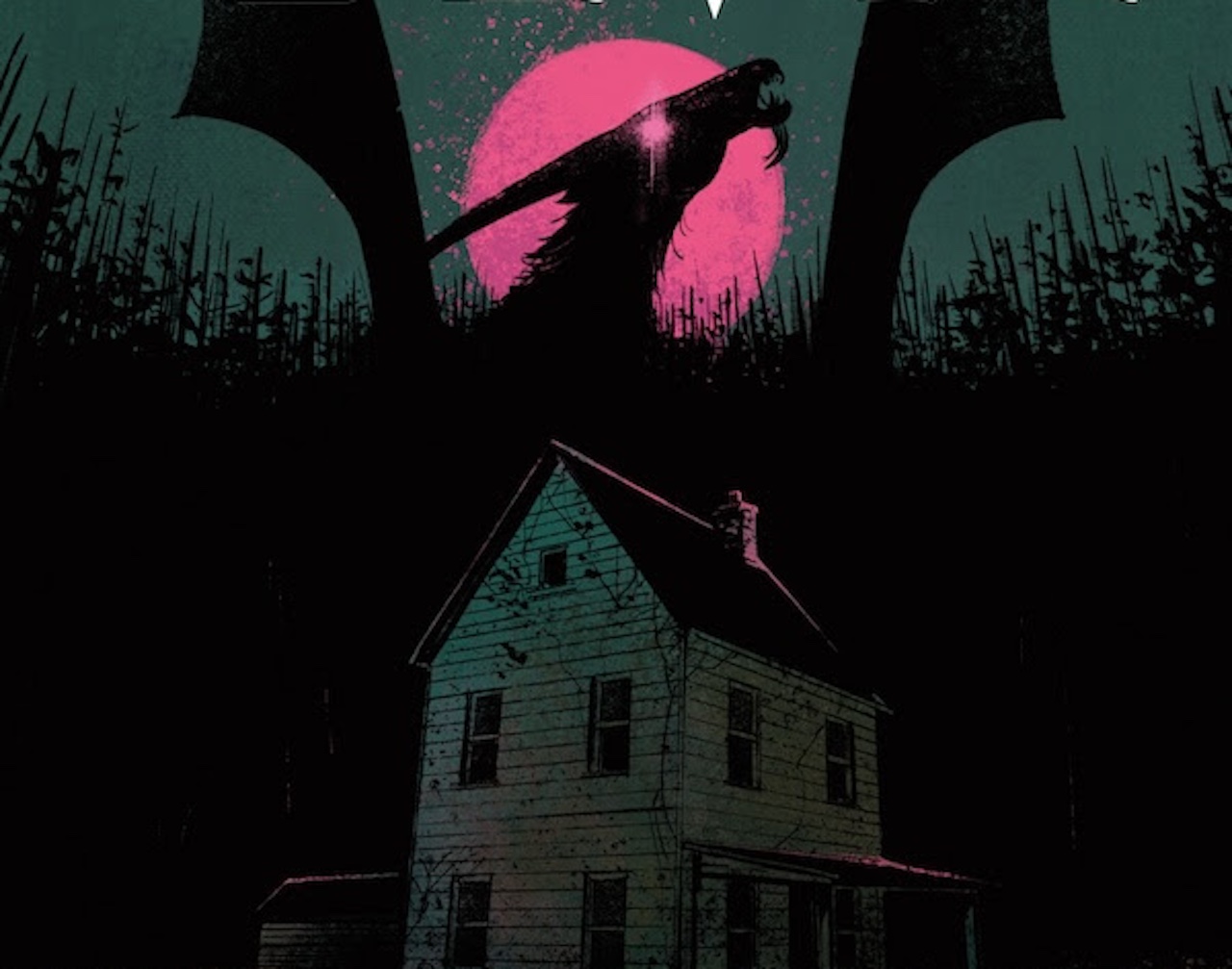

We love James Tynion IV’s Image Comics conspiracy theory series The Department of Truth here at AIPT, but what might be even better is his work with cryptids. To celebrate today’s release of Dark Horse’s Let This One Be a Devil, we asked historian Brian Regal, who literally wrote the book on the Jersey Devil, to tell us more about this fascinating folklore.
Everything you think you know about the Jersey Devil is wrong. The common view of a kind of emaciated horse or deer with wings was concocted in the early 20th century by hucksters trying to draw people into their Philadelphia dime museum. The actual history is much more interesting, and more important, than that.
In the late 1670s, a young Quaker from England named Daniel Leeds (1652-1720) came to what had only recently started being called East Jersey. He arrived in the company of his father and brother (their mother died from smallpox just before they left, and was buried in London). While their father settled in Shrewsbury, the Leeds brothers headed inland to the banks of the Delaware River to the new town of Burlington. There, Daniel began to build a life. He prospered, but financial and social success was not enough. He longed to be a philosopher.
Leeds was a voracious reader and thinker, and by this time he’d developed a cosmology involving not just Christianity, but other disciplines as well. He felt the only way to really understand the divine was to understand the universe, and the only way to do that was through the ideas of alchemy, astrology, and astronomy. It must be made clear; Leeds was no traditional occultist. He was indeed a deeply devout Christian.

Dark Horse
To bring the philosophies of the Enlightenment and the Scientific Revolution to what was then the outer reaches of the British Empire, Leeds decided to publish an almanac. He did this in 1686 with the help of newly arrived Quaker printer William Bradford. Leeds and Bradford published the almanac as a broadsheet — a single piece of paper printed on only one side. It contained information on the changes of seasons, eclipses, sunrises and sunsets, and other information useful to a highly agrarian population.
While Leeds thought his neighbors would welcome such a thing, they reacted badly and called the almanac “occult.” Quaker fathers confiscated most of the copies and burned them. Undaunted, Leeds then published the first book south of New York: The Temple of Wisdom (1693). In it, Leeds laid out his view of the universe in detail, but sadly, only one original copy survives today. With both his heartfelt works destroyed by its adherents, Leeds rejected Quakerism and converted to the Anglican Church. The Quaker fathers now called him “evil” and “Satan’s Harbinger.” Leeds retaliated by publishing a series of anti-Quaker books calling them liars and business cheats.
As the decades went by, the Leeds-Quaker feud went up and own. When the British colonies began thinking about independence, they saw Leeds as suspect, as he’d worked for the hated Royal Governor of New Jersey, the infamous Lord Cornbury. Eventually “Leeds Devil” became a term of political opprobrium. However, after the Revolution, and his passing in 1720, the distaste for Leeds faded.
By the middle of the 19th century, the story of the Leeds Devil had gone all but extinct. It seems to have survived only in isolated rural communities in southern New Jersey in a heavily forested region known as the Pine Barrens. It’s there that the legend seems to have evolved from a political story to one of an actual monster, as less and less was remembered of the original factual aspects.
By the late 19th and especially the early 20th century, the story came creeping back, in part because reports of strange, monstrous footprints found in the snow around Mount Holly, New Jersey, and other places. In 1905, these reports became more widespread. At the time, in Philadelphia, the once-popular but now struggling Ninth and Arch Street Dime Museum was looking for a new attraction. They decided to take the legend of the Leeds Devil and claim it was a real creature, called it the “Jersey Devil,” and that they’d caught it and had it on display! They may have even been the ones to invent the tale of Mother Leeds and the infamous birth scene, in which she calls out, “Oh, let this one be a devil!”

Dark Horse
Since the museum didn’t actually have a Jersey Devil, as no such creature exists, they rented a kangaroo from a dealer in Albany, New York. They painted it green, attached cardboard wings to it, set it up on stage, and charged people to see it. In its cage, the forlorn creature would be poked by a boy just offstage, with a stick with a nail in it. This of course caused the kangaroo to jump and scream, causing the crowd to also jump, scream, and sometimes even run out of the auditorium. When the novelty wore off after many weeks, and the crowds disappeared, the owners of the Ninth and Arch Street Dime Museum washed the kangaroo off and shipped it back to Albany.
Despite knowing the entire exhibition of the Jersey Devil was a wheeze, people began to accept that the Jersey Devil was an actual flesh and blood monster that had been lurking in the Pine Barrens since the 1730s. Because the dime museum used a kangaroo as a stand-in for the “monster,” that became the basic appearance claimed by almost all sightings since. The story is a message to us all about folklore, mythology, and the creation of fake news, and how easily people can be duped into believing the most outrageous claims.
Every February, to help celebrate Darwin Day, the Science section of AIPT cranks up the critical thinking for SKEPTICISM MONTH! Skepticism is an approach to evaluating claims that emphasizes evidence and applies the tools of science. All month we’ll be highlighting skepticism in pop culture, and skepticism *OF* pop culture.
AIPT Science is co-presented by AIPT and the New York City Skeptics.



You must be logged in to post a comment.