

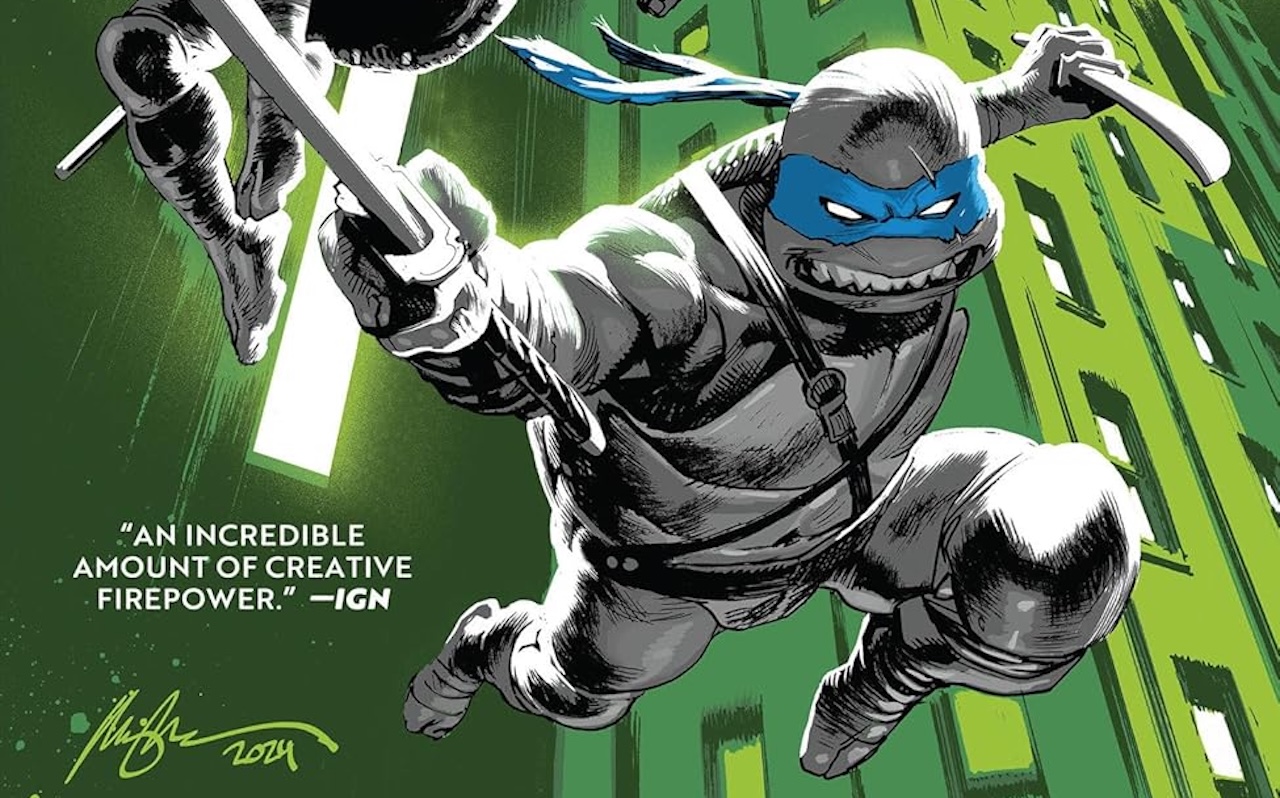

IDW is known for its licensed comic book adaptations of films, television shows, video games, and cartoons, but none bigger than Teenage Mutant Ninja Turtles. There has been some great stuff to come out of IDW’s TMNT comics over 14 years, fans were especially excited when it was announced last year that Jason Aaron would be writing the main series.
While this isn’t a full-blown reboot, as there are a few references to the previous run by Sophie Campbell, this is meant to be a fresh start for new readers to get into. But instead of opening with the Heroes in a Half-Shell together as a family, each of the first four issues showcase what the Turtles have been doing individually following their departure. No doubt the involvement of Aaron attracted the attention of big-name artists, each of whom get their own issue to draw.
Starting with Joëlle Jones drawing the first issue, we see Raphael is in prison. The second issue, drawn by Rafael Albuquerque, shows Michelangelo living in Tokyo, where he’s become a TV star. Cliff Chiang draws the third issue where Leonardo travels the world in search of peace. As for Donatello, he is trapped in a mutant zoo and forced to fight rich men looking for a thrill, as seen in the Chris Burnham-drawn fourth issue. From an artistic standpoint, all these artists lean hard into their sensibilities, proving that any one of them could have their own TMNT run, which makes it a little frustrating that these issues may be the only times they will be involved in the book.

IDW
This is not the first time we have seen the Turtles off living their separate lives and eventually get back together, as that was the premise of Kevin Munroe’s animated TMNT movie from 2007. However, Aaron nails the individual voices of the Turtles with each issue having a great deal of narration. Whilst we all know that Raph is driven by anger and even he knows this, there is some surprising characterization from the likes of Michelangelo, who felt abandoned and thus harbors resentment towards his older brothers.
While the issues showcase a situation that you can see each of the Turtles being in, based on their personalities, even with the realization that they are truly alone, the most shocking character arc goes to Donatello. Donnie is put through the wringer in his issue, from wandering through the woods like a homeless person, to becoming a combatant in an illegal ring where mutants are being forced to play. As his body gets banged up and his mind becomes more disheveled, the only solace Donnie can find is a rat he takes care for, who thinks is their late father Splinter.
With each issue having an action sequence that feature Foot ninjas, it isn’t until the fifth issue where we find out what is really going on with the Foot Clan, which has a change in management. Under the influence of Oroku Karai, we see Hieronymus Hale’s rise of power as a corrupt politician who uses his connections with the Foot Clan to rule New York after living a dark past that is defined by ignorance, tragedy and eventual hatred towards mutants. With Darick Robertson bringing his signature style of grit, you get a gritty, fight sequence involving everyone’s favorite hockey mask-wearing vigilante Casey Jones.
Aaron’s back-to-basics approach is most apparent is the final issue, which sees the four brothers returning to the sewers of the city they grew up in. While that familiarity of seeing them together is delightful for longtime fans, it is very clear that they are not all in sync as there are problems that need to resolve if they are going to stop this new villain hellbent on destroying the Hamato Clan.
It is also here where we see the TMNT debut of Juan Ferreyra, who will be the main artist for subsequent issues of Aaron’s run, and instantly he makes a great first impression. Bringing a lot of detail in his art, he makes each of the Turtles visually distinct from them being all different shades of green, to having different physical details, not just the multi-colored bandanas. What makes his art much more impressive is when he draws the Turtles in action sequences that not only makes great use of ninjas, but also New York as a fun if deadly playground.




You must be logged in to post a comment.