

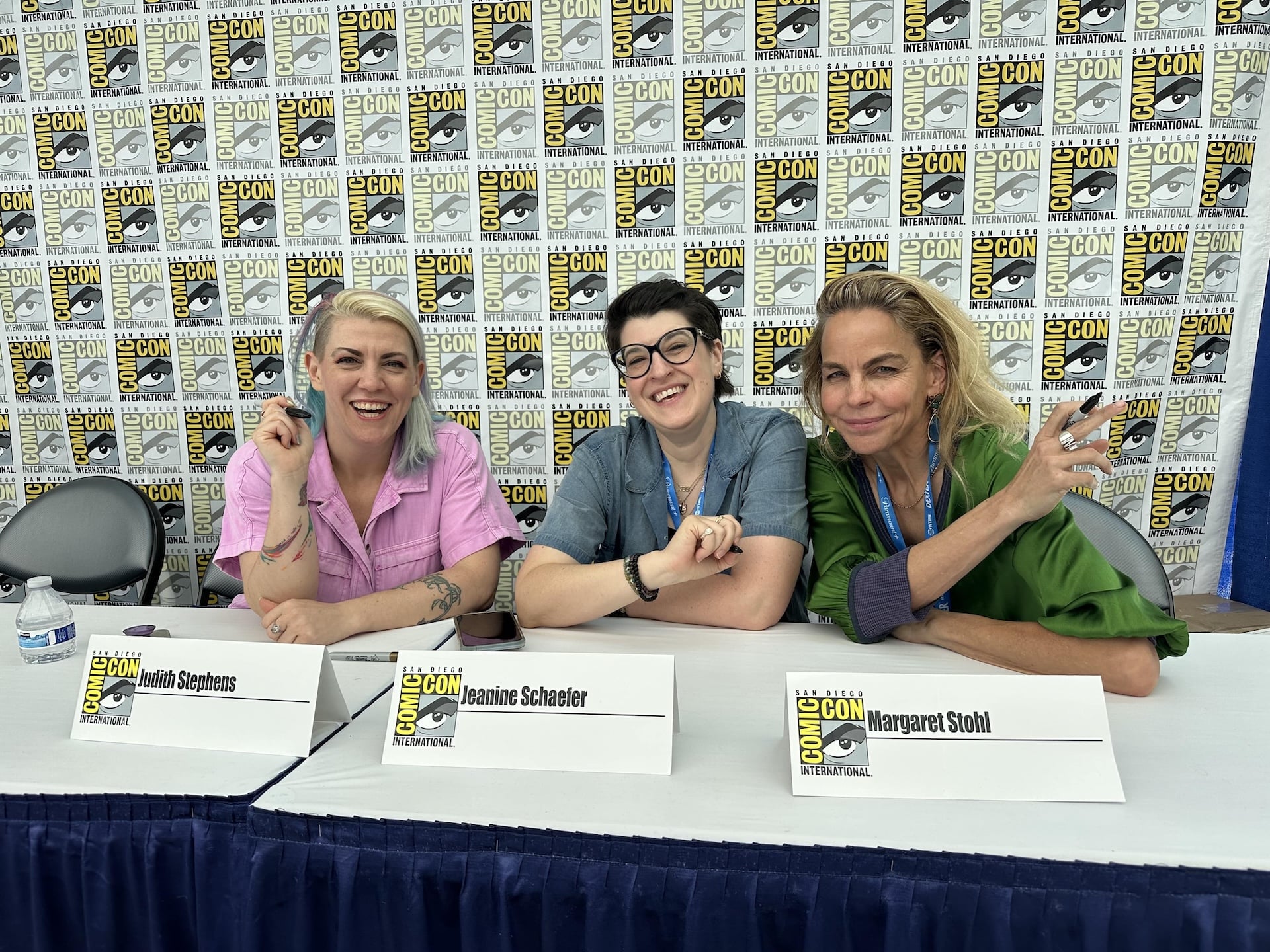

This year, I had the honor of speaking with three outstanding women in the comic book industry: Margaret Stohl, Jeanine Schaefer, and Judith Stephens. We discussed their new book, Super Visible: The Story of the Women of Marvel Comics, and so much more.
After I got home and transcribed the interview, I found myself staring at my computer screen. “Do I have writer’s block? Am I just tired? Or am I distracted by my three-year-old screaming for a snack because she no longer wanted the one I gave her 30 seconds ago (one that she specifically requested, mind you)?”
Then, I realized it was none of the above. This conversation I had with these women was so eye-opening and inspiring that I couldn’t just publish it as an interview. There were so many stories that needed to be told that I would be doing it a disservice to limit it to a single interview. So, I went to my local Barnes & Noble, picked up a copy of Super Visible: The Story of the Women of Marvel Comics, and got to work.

Flo Steinberg, Virginia Romita, and Dawn Geiger
Super Visible isn’t just about the history of women in comics. It’s an exploration of what it’s like to be a woman in such a male-dominated industry. It’s about how women support each other instead of competing against each other. Most importantly, it’s about the difference we can and have made.
What better way to begin an interview than to discuss one of the most sacred places at San Diego Comic-Con, the women’s bathroom?
“There, everyone is supporting each other. Helping each other with their costumes and chatting about panels. And, you know, sometimes you just need 15 seconds to collect yourself,” Stohl explained. Schaefer added, “It’s where we go to cry.”
The women revealed that the bathroom was brought up so much while writing the book that they had to dedicate a chapter to it. It did not disappoint. At its core, Super Visible’s chapter, Meet Me in the Bathroom, stressed the importance of camaraderie among women in the workplace. In an “industry that prioritizes male spaces”, it is important for female employees to have a place that was created just for them where they could bond and support one another.
Super Visible was always a top priority. Stohls stressed the importance of getting all these incredible women’s stories out there. She stated that a lot of their stories were at risk of being lost to time — because they almost were.
“Their stories don’t show up in history books. I know because we read them all. We were like, where are all the women? We’ve been talking to over one hundred, and they get one mention.” And, the urgency to publish the book escalated after the passing of two Marvel Comics icons, Ramona Fradon and Trina Robbins.

Super Visible honors the legacy of the women of Marvel
Stephens explained, “Two women passed away while we were writing the book, Trina and Ramona. And Margie said, ‘We need to get these women’s stories out there, out of our own heads. Out of their own heads.’” She further elaborated, “We were redoing the dedication page and writing their names so they would be on the first page. These women who were there from the very beginning.”
Robbins and Fradon weren’t just Marvel icons; they both played huge roles in the comic book industry as a whole. Robbins was a cartoonist, writer, and one of the first women to join the underground comix movement. She was also one of the producers of It Ain’t Me, Babe, the first all-female comic.
Fradon’s career as an artist spanned from 1959 to 2024. She was prolific at both Marvel Comics and DC Comics. She was one of the first women to consistently work on superhero comics, paving the way for others to follow in her footsteps. Fradon earned her spots in the Women’s Cartoonists Hall of Fame in 1999 and the Will Eisner Comic Book Hall of Fame in 2006.

Credit: Super Visible and Marvel
Marvel’s female characters take center stage
When the conversation shifted to female comic book characters, the creators discussed which heroes they would like to see more of. For Stephens, it’s Squirrel Girl.
“I want more Squirrel Girl. I mean, at one point, she’s, like, the strongest. She beat Dr. Doom. She’s just a fun, incredible woman who looks different than everyone else on the page. I think that’s really important, especially for young people growing up to see a hero who doesn’t look what the beauty standard of perfect is.”
Schaefer is excited to watch Sue Storm grow as a character. “I’m pretty excited about the Sue Storm sort of moment that hopefully we are entering into. I don’t think I really connected with her before, but I’m suddenly very excited. Like, I feel like I suddenly can see it now that I’m a little bit older. I’m really excited to see her maybe get a little bit of a bigger pudding outside of the tea.”
Stohls hopes to see creators focus more on the solo journeys of Ms. Marvel and Captain Marvel. “I think as someone who worked on Captain Marvel, I mean, I really would love to see them, Kamala Khan and Carol Danvers, basically have individual female stories that you can’t collapse into sort of one. girl bucket. Go back to playing them out in terms of human stories.”

Flo Steinberg, Steve Leialoha, and Trina Robbins
Our conversation concluded with words of encouragement for women who want to join the comic book industry but may feel discouraged. Schaefer offers some words of advice:
“The community’s still there. It really is there. I find them online, find them at conventions. I mean, I think even more today. Reddit, Discord, there are so many places for you to meet people in your space and your community. And I think if we are a community together, then we can fight back against society.”
She also encouraged up-and-coming creators to look outside of Marvel and DC. “Although, obviously, it’s everyone’s dream to work for the Big Two. But sometimes the characters in the smaller publishers, the independent publishers, or that writer that you’re going to meet tomorrow, is going to be the story that truly opens you as a writer, as a creator, as an editor. Like, don’t just see, okay, I have to work for Marvel or DC. There’s so many other spaces for you to write and work and edit and draw.”
Stohl wanted to reassure everyone that women in comics are not going anywhere and that young women shouldn’t doubt themselves. “There are women in comics. There always were. We have always been there and remain so. And let’s just own that. Like own that that were part of that story. People who, you know, don’t look like Stan Lee can find their way because there is a place for them.”
Super Visible: The Story of the Women of Marvel Comics is an incredible piece of art that is worth reading. It showcases the true value of women in comics and how we deserve a seat at the table in a male-dominated industry. I commend Margaret Stohl, Jeanine Schaefer, and Judith Stephens for pouring their blood, sweat, and tears into this book and giving women their voices back.
Super Visible: The Story of the Women of Marvel Comics is available in bookstores now.



You must be logged in to post a comment.