

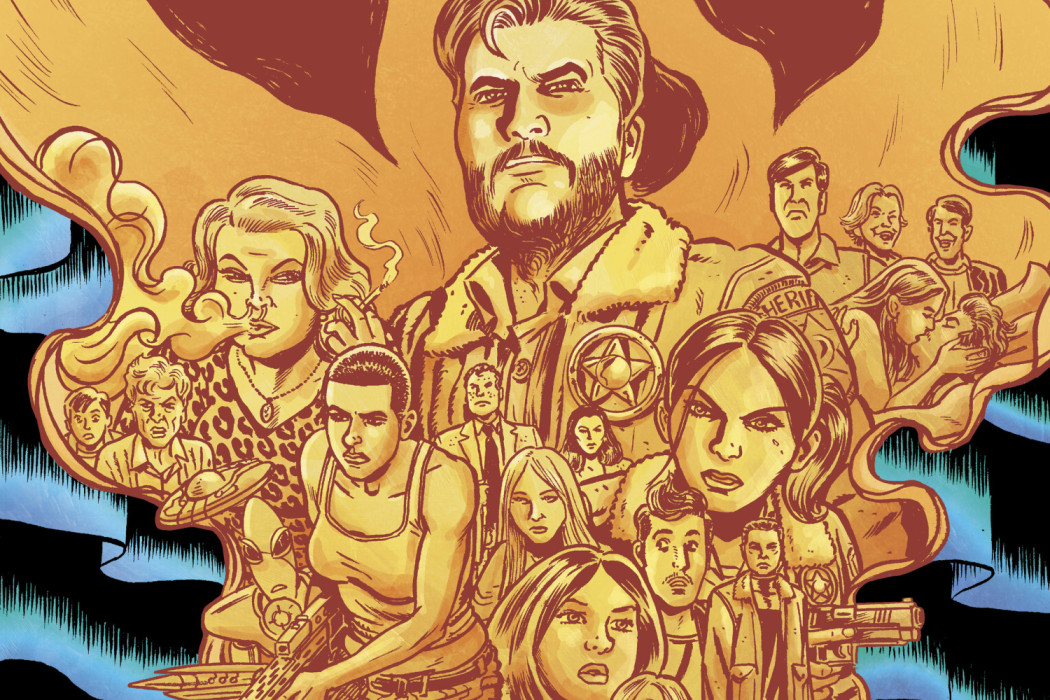

With Stray Bullets, David and Maria Lapham made perhaps the most perfect crime comic I’ve seen so far. There’s grounded, relatable characters; a proper mix of humor and the macabre; and this unflinching take on how suddenly and randomly our lives can forever change. It’d put it up against anything from Parker to Sin City as a singular model for the genre, truly.
But with Good As Dead, the duo (alongside colorist Dee Cunniffe) stray from their “standard” storytelling territory, and the end result is as promising as it is imperfect (but never any less vital).

Courtesy of Image Comics/Skybound.
Good As Dead takes place in the town of Port Linden, where two families (the Valades and the Calhouns) have been feuding since day one. The Calhouns have some power — David Calhoun is the sheriff — but the Valade clan hold the upper hand as they control Emissary Bridge, the dominant feature of the town’s economic makeup. But when one man travels to the bridge to set himself ablaze, the secrets of Port Linden come pouring out, and no bridge can keep it all together.
But this ain’t no ordinary small town thriller. In interviews/press material for the series, David Lapham has said Good As Dead (which was co-developed by Chris Black and David Alpert) was meant to be different still, with bits of sci-fi, horror, and general surrealness infused to push this crime story in new and strange directions. I can certainly applaud the team for their creative aptitude, but this “magical” component does cause some tension right off the bat.
Now, to be clear, this isn’t a case of Stray Bullets being perfect and nothing else ever coming close. (Even if that’s my innate gut feeling that I have to continually battle against.) Rather, it’s that when you’ve got something like Stray Bullets, there’s almost a process that you have to undertake to strike back against any comparisons and also allow Good As Dead to stand on its own.

Courtesy of Image Comics/Skybound.
From a visual standpoint, said process is pretty much right on track. I adore the black and white of Stray Bullets: It’s not only hugely stylish, but it works for the complex morality explored by the series. Here, Lapham’s art maintains all the vital parts you’d want — the grounded, people-centric designs, the slightly peculiar bent to Americana/everyday life, the sheer heavy feeling of this town, etc. — and that gives us a groundwork for our immersion.
When Cunniffe comes in, he’s adding a strange, vaguely psychedelic quality. It’s what really balances the “ordinary” feel of this world and that incessant itch that something else is about to explode through. The same goes with the people: Color means more light and interplay with textures, and that just brings folks to life in a way that’s deeply effective and also slightly unnerving. I sort of compared it to Twin Peaks with that blend of the bland and the bizarre, and Good As Dead bridges these worlds and ideas so that we can traipse through it all and not simply feel bombarded by the strangeness of it all. And that makes all the difference in giving this book an identity that demands our earnest commitment.

Courtesy of Image Comics/Skybound.
But once the story proper starts to truly unfurl, it’s here that I felt a touch overwhelmed by the Lapham’s new “interests.” The primary tension between the two families is generally enough for me — it creates a villain in Tammy Valade (she runs the bridge); makes us consider David Calhoun’s list of suspects/reasoning following a mid-issue, bridge-related tragedy; and it feels like a grounded storyline that’s still capable of letting in new energies that might prove a touch more peculiar.
From there, there’s sub-plots and add-ons, like David’s sister (Bobby) and her conspiracy theories; drama with David’s dead father; a couple of young love birds; a thread about drug abuse; and some random, mysterious strangers. Even a rather vital sub-plot — Lenore, a sheriff deputy, may not exactly be on the up and up with David Calhoun — feels a touch overwrought and could bog down an otherwise deliberate, extra potent story of generational trauma. I couldn’t help but think that even the aforementioned tragedy, which is vital to pushing the Valade-Calhoun saga into overdrive, felt more like a gimmick than some important storytelling device.

Courtesy of Image Comics/Skybound.
Admittedly, that last point is a little bonkers to admit in and of itself (the event is huge for the town), but it encapsulates this thing I couldn’t shake about Good As Dead. It’s interesting and well done, but do we really need all of the bells and whistles? I haven’t even gotten to the reason why this book is likely called Good As Dead, and how it forces David to act quickly if he’s going to actually solve this case. It’s yet another one of those things that sure feels exciting and inventive, and in the hands of the Laphams is executed with efficiency and prowess. (This plot device is also a great source of grade-A human gore, so that’s cool.)
But if it were removed from the book, I’d still have ample reasons to watch this little town implode. It feels like why overburden a good thing (an ability to nail crime a la Stray Bullets) when so much else feels a little needlessly flashy and overly weighty. Perhaps if this story was a bit more streamlined or balanced, the many players wouldn’t feel so overwhelming. Or, some of the more kooky elements might land better if we weren’t dealing with a cast bigger than latter-day Lost.

Courtesy of Image Comics/Skybound.
None of this is to say Good As Dead is bad at all — it’s like a Coen Brothers film mixed with Banshee and a dash of Eureka, and it could be (like many Stray Bullets stories) that the end is truly the deciding factor of how gutted you are upon closing this book. But if you’re coming in for that association, you’re getting the inherent good and bad that comes with this wacky new edge. It’ll certainly unsettle you in the fun ways, but also because you’re not sure how solid this ground remains. And it definitely promises loads of human drama, but that’s often under layers of story gimmicks and overt displays of the peculiar.
Still, be sure to give Good As Dead a try. You’ll find Port Linden to be a charming but anxiety-inducing little hamlet, and a place that takes a novel spin on crime stories that might be untested but is packed with raw promise. It’s not at all like anything you’ve read before, and for now that’s more exciting than it is potentially ruinous.




You must be logged in to post a comment.