


It’s the werewolf.
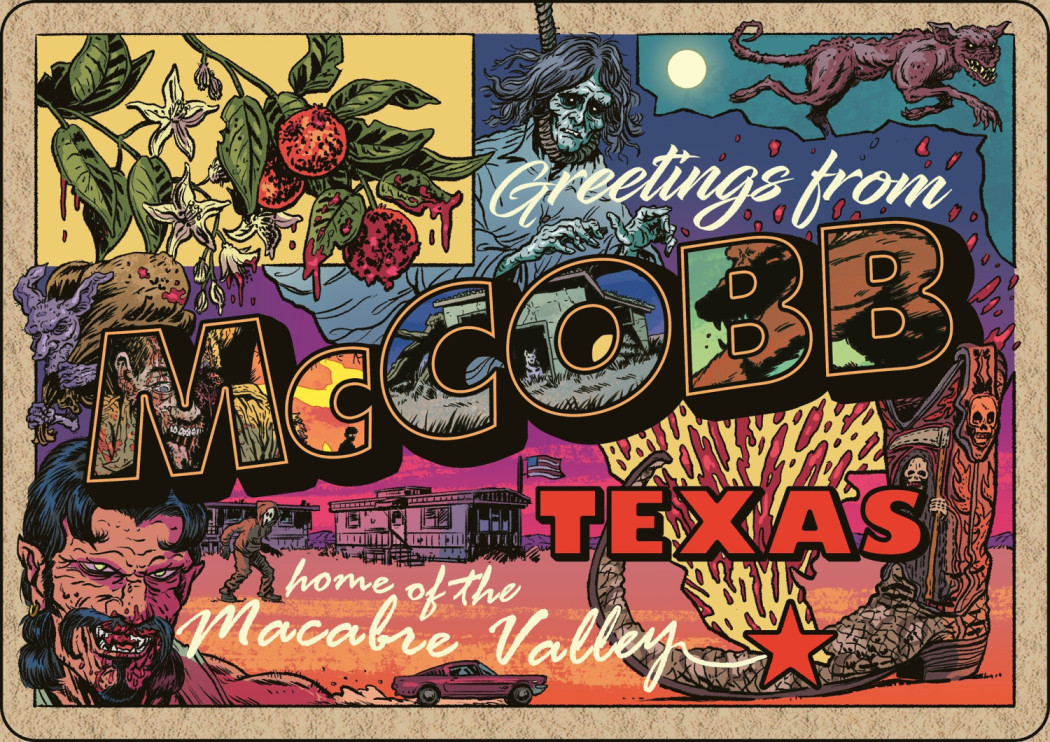
That’s why, like, 48.2% of you will likely pick up Macabre Valley #1, a new comic from writer Zack Quaintance, artist Anna Readman, colorist Brad Simpson, letterer Becca Carey, and designer Jared K. Fletcher. Currently crowdfunding via Kickstarter, the series follows an unnamed journalist (referred to as The Kid) as he takes on his first journalism job as a night-time cops reporter in South Texas (the fictional McCobb, Texas, to be precise). But he’s got more than deadlines and prickly PIOs to manage, and The Kid quickly encounters not only a werewolf but a whole valley plagued by a burgeoning supernatural mystery.
It’s basically Spotlight meets An American Werewolf in London. Or, All the President’s Men meets Werewolves Within. But here’s why you should really pick up Macabre Valley: it’s largely about journalism in the post-truth era; the power of information to reveal the greater scope of the world; how the greatest monsters aren’t always the ones with the pointiest teeth; and why some of us will always fight for what’s real and what’s right.
Even if there is a dang werewolf in the way.
Comics and Journalism

Main cover by Anna Readman and Brad Simpson.
Admittedly, a comic about journalism/a journalist isn’t entirely novel. (See Lois Lane, April O’Neil, Matty Roth, Peter Parker, The Creeper, etc.) Even Quaintance admits the Venn diagram is often just a circle.
“I think it’s a weirdly understood job to people, for whatever reason, especially people in comics — there’s so many reporter stories,” Quaintance said during a recent Zoom call. “There’s historically been a lot of crossover; a lot of comic book writers have journalism backgrounds – the deadline-based print businesses are pretty inextricably linked.”
That’s certainly the case for Quaintance — he’s not only an editor at The Beat, but he spent several years as a cub reporter in McAllen, Texas. The whole thing filters perfectly into Macabre Valley, and it provided the perfect use of Quaintance’s specific editorial skills/powers.
“I think it puts you at an advantage to have done comics journalism, because in any sort of writing, even with journalism, you need to widely read things you may not otherwise read,” Quaintance said. “I think comics journalism really pushes you to do that. Part of what I’ve done for eight years now is read about 20 advanced review copies every week. It could be considered a cry for help. Or, it could be considered really thorough market story research.”
It’s not just reading, either. Having interviewed countless creators, Quaintance learned firsthand about the preferences and capabilities of comics writers and artists, and that’s huge when you start making comics yourself.
“I’ve heard from artists what they like to draw and what they don’t like to draw,” Quaintance said. “I think I learned a lot about the collaborative element of comics specifically by doing comics journalism and just meeting creators as people. I think if you’re not reading that many comics, you have to figure out what kind of stories you don’t want to tell as you’re writing. Having read this many comics, there’s certain things that work for some writers that I know I don’t like and would never pursue.”
A Rough Start

Variant cover by John J. Pearson
OK, here’s where my own ray or sunshine might be in order: I too was a cub journalist around the same time as Quaintance. While he was in Texas covering violent crimes, I was in West Phoenix reporting on restaurant openings and rock concerts. But we’re part of a certain fraternal order, as it were, and I appreciate what he and the rest of the Macabre Valley team are trying to do to represent journalism. Especially because Quaintance is painfully honest about his own career and contributions.
“It was bad and I was bad at it,” Quaintance said. “I didn’t do it well for a number of reasons. Newspapers were already losing their vitality to the community. I felt it even when I was doing college journalism in 2006. By the time I got into the professional world, it just felt like nobody was reading newspapers around that time. I was just going to these crime scenes and having to deal with police public information officers who didn’t want to tell me anything.”
There’s two specific points from Quaintance’s own experiences that inform how The Kid operates and is also portrayed. Not only were a lot of us back then quite idealistic, but you think what you’re doing is somehow more than just an ordinary job.
“At that age, you’re really desperate to do a good job,” Quaintance said. “Like, you’ve trained for this, you’ve had internships and stuff. Journalism, I think, feels more like a calling than a lot of jobs do. It’s this really important thing that you’ve decided to dedicate your life to, and so you don’t want to be bad at it. And you’re not making any money, either. So there’s this weird desperation to just be an amazing journalist and kick ass from day one, and I just didn’t.”
Despite that dedication, many of us saw our prospects in journalism dwindle pretty quickly. Macabre Valley isn’t just a celebration of some shimmery olden days, but a look back at this vital era of community-oriented journalism.
“I think there was a culture then around how you pay your dues with your first job,” Quaintance said. “You might be losing money if you have to move away from home. But then you move up to a better job and you start to make a living wage. But because of the financial crisis and newspapers dying, that next step was out of reach for years. It would have taken years of paying your dues instead of, like, nine months or whatever.”
Still, Quaintance isn’t bitter at all, and he said the experience made him a better writer and editor. It also gave him a sense of personal direction, explaining that he eventually learned that “if I was going to be happy doing this, I didn’t really want to do news or politics or something like that. I wanted to learn more about things I was interested in and and enjoyed.”
Blood and Newsrooms

Before Macabre Valley, he originally had the idea of writing a memoir of his experiences. However, he quickly realized that nobody “wants to read a memoir set between the writers’ ages of 22 and 26; that’s not a good time for a memoir.” So, he combined it with yet another idea he had: a “werewolf priest in Texas comic, and the werewolf priest was going to be the main character and it was going to be really slap-sticky.” Like, super slapstick, folks.
“There would’ve been subsequent short comics that were, like, ‘Priest runs for Congress’ or ‘Priest goes to space,'” Quaintance said.
Yes, Macabre Valley had to be werewolf-forward. (Quaintance admits there’s one joke that he says “if I hadn’t thought of the line, I don’t know if I would have moved forward with the comic.”) But it goes deeper than solid gags; the book’s a fusion of horror and journalism into some utterly thoughtful. Admittedly, there’s just as many more horror titles as there are heroic journalists, but that was generally the point.
“I think you’re right: there is a [horror] renaissance right now,” Quaintance. “I think being aware of that didn’t make me hesitant. But it made me want to push harder to make it more and more personal until it was very much my specific take on a horror comic. And so because of that, I wanted to do a horror comic that only I could do with mixing in the setting, the themes, and the voice of it. That was something I was aware of, and that’s how I dealt with it.”
So does that mean The Kid — who remains nameless as an homage to Cormac McCarthy’s Blood Meridian, a favorite of both Quaintance and Readman — is basically a stand-in for our enterprising writer? Sort of.
“I had an experience where I felt like I was idealistic and naive and it’s smashed up against the difficulties of the news business and the harshness of the news that happens on the U.S.-Mexico border,” Quaintance said. “Then past that is a total layer of fiction. Like, all the smoking, and I never wore a tie to work once. Plus, our newsroom was pretty clean. There’s a lot of choices made to fictionalize it and bring in horror tropes and the genre stuff.”
A Werewolf Free-For-All

Just don’t expect Macabre Valley to lean into the horror you might be more familiar with in recent years.
“I’m not so much into the family trauma variety of horror that’s been popular lately,” Quaintance said. “Everything is about grief and overcoming stuff. The monster is always a metaphor for trauma. My relationship to horror is I like a little humor with it. I like a little cheese with it.” In that vein, I mentioned From Dusk Till Dawn and Bordello of Blood as referential tent-poles, with Quaintance admitting, “Those were two of the, for better or worse, first four movies I ever saw as a kid. I do have a preference for goofier horror.”
So much about Macabre Valley, then, tries to reflect that very dynamic. Even the choice of monsters says a lot about the book’s interests in treating horror like journalism — something to be dissected and explored with honesty and depth.
“There’s less rules with werewolf,” Quaintance said. “There’s full moon and silver [as weaknesses], and that’s really where it stops. That’s the only thing people have really established. So you get a lot of flexibility with it. I think a werewolf can be frightening and funny.”
According to Quaintance, that multifaceted interest is something he shares with Readman.
“I think she’s just as capable of being funny with her cartooning as she is scary or serious,” Quaintance said. “Like, she just has a tremendous range. And I just thought by looking at her work that she would get the tone perfectly.”
Quaintance added, “She makes so many great micro choices everywhere — what to exaggerate and what to ground. One thing we talked about was combining Cormac McCarthy with the first season of True Detective. And so I think that finds its way in there.”
Simpson, too, deserves similar props, with Quaintance explaining that he “colors a lot of Dani’s work, which is not outwardly similar to Anna’s, but I think in the ballpark for sure.”
A Slice of The Unsettling

But Macabre Valley quickly takes all that humor and gore and uses it for much more transcendent fare. It’s what all great writing does: Brings you in only to hit you with something profoundly true. Case in point: There’s a wonderfully gross scene in #1 where The Kid first encounters the werewolf — and he projectile vomits in the most wonderfully horrific way imaginable.
“He just picks himself up and he’s trying to take notes and ask the priest questions,” Quaintance said. “That is very much based on my own experiences when I’d cover these really terrible news stories. As long as I’m holding my notepad and taking notes, it’s like a shield. You use your profession as a shield from what’s happening around you when you’re a journalist covering terrible things. And so that was the reason he wasn’t like, ‘Oh my God, werewolves. I might die.’ It was just, ‘I’ve got to figure out what’s happening here.’”
Here, Quaintance gives even more props to Readman for that scene; it’s just one moment where she takes direction and truly runs with it. There’s another scene where Quaintance simply wrote “squalid newsroom” in the script, and Readman ended up with a terrifyingly filthy newsroom that reminded Quaintance “a lot of my college newspapers.”
Readman even kills it with one stomach-churning shot of some old pizza.
“I’ll tell you why that’s gross: Because in the panel proceeding the pizza…was a rat,” Quaintance said. “That’s why Anna is so great. I didn’t script the pizza bit; she just added that.”
Real Life, Fictional Scares

Still, it’s not that The Kid is somehow ignorant of werewolves and other supernatural threats (or that of stale pizza) across issue #1. (Quaintance teases that a two-page spread in the debut outlines other “monster of the week” options that’ll define the five-issue arc.) Instead, with a whole weird and wild valley to cover, our young hero has other things on his mind.
“The real horror for him, I think, is the death of his idealism,” Quaintance said. “Yeah, there’s a giant werewolf disemboweling people in front of him. He doesn’t like that, but the journey he’s on is different. He’s definitely on his own journey with dealing with his idealism smashing up against the cruel reality, some of which seem totally impossible. When he has a choice to make, it’s around journalism ethics. Not like, ‘Do I kill the werewolf?’”
From the deeply personal, Macabre Valley then extends into larger societal issues. As mentioned, the story involves the U.S. Border Patrol, and how a series of mysterious agent deaths may or may not be related to our new werewolf friend. For one, it’s just Quaintance further leaning into his experiences in McAllen, and how he worked extensively with Border officials during his reporter days. Even the priest is taken from that oddly magical time.
“The priest, the human version, is based on a feature story I wrote,” Quaintance said. “There was a priest down there who was an anti-border wall advocate. He drove a van that had a ‘No Border Wall’ sticker and he adopted, like, 20 dogs, and they’d follow him around everywhere. When you’d got to mass, the older, calmer ones would walk up the aisle with him and sleep on the stairs to the altar. It all swirled together.”
But he never intended the story to be overly political, even with the ongoing issues with Border Patrol and ICE dominating the news cycle. It’s not Quaintance denying the political, but rather recognizing (not unlike all good journalists would do) that there’s fundamental problems on the border that speak to larger issues/concerns.
“There is a lot to say about [immigration],” Quaintance said. “And one of the things that I did want to say was that I was down there almost 15 years ago, and a lot of what’s happening now was happening at a lower level.”
Quaintance added, “Immigration is just this issue that gets kicked around like a political football. And there’s just not a good faith effort to do anything meaningful about it. If there’s politics to [this story], it’s that this is a status quo that we’ve picked and it just goes back and forth and it leaves room for bad actors and people doing their job poorly.”
“He knows that there’s something funny going on, but he has no journalism tools to address it.”
To go back to The Kid and his whole approach with the werewolf, he doesn’t have many other options. (Quaintance said multiple times that our lead won’t turn into some monster hunter, even if he might eventually have “friends who were involved in the paranormal and the evil down there.”) Because whereas silver bullets might dispel a werewolf, the same can’t be said when your foe is a power-abusing government agency.
“If a federal law enforcement agency is just straight lying to you, what could you do,” Quaintance said. “He’s a 22-year-old crime reporter for a newspaper that’s on its way out and has no resources and very little stature in the community. He knows that there’s something funny going on, but he has no journalism tools to address it. And I always felt like that when I lived there…I had absolutely no idea what the Border Patrol was doing on a daily basis.”
It’s a dynamic born out of even more of his journalism career, and how different coverage areas often experience markedly different ways of conducting good, important journalism.
“I had a police reporting internship in Peoria, Illinois,” Quaintance said. “You had a police scanner so you could hear all the traffic. You knew what the police were doing all day. And at the end of the day, they would put all the reports in a little folder and you would go to the police department and you could read the reports of everything that happened. But then I go down to McAllen and I’m covering breaking news, [and] there’s no mechanism whatsoever to ask Border Patrol what they did today. So that was something that I had always thought about.”
The Story’s True Monsters

I’d mentioned already that Macabre Valley is very much about the “death” of journalism (especially the important local/community variety). But it’s not just about one man’s ruined career prospects. Rather, Quaintance and company use Macabre Valley to demonstrate that the real terror isn’t just monsters, lost idealism, and/or political corruption. It’s that a certain bell has been rung for cities nationwide, and we can never, ever go back.
“Years ago, newspapers had the power to investigate with a ton of resources,” Quaintance said. “And then if that didn’t work, if they were being lied to and they knew it, they could take to the editorial page and the community would be up in arms. But you take away the resources and the impact of the editorial page, and they don’t have any recourse.”
Quaintance added, “And I think we as a country haven’t really processed that idea that these community papers, which had kept us informed on the local level and right outside our door for a 100 years, are just gone. And really nothing has replaced it. You can get your news from online, and it’s mostly sensationalized world news. There’s pockets of good local news coverage, but we’ve really lost the well-resourced papers staffed by members who’ve grown up in these areas. I think it’s really sad.”
But despair not, dear readers. It’s around this point I made a comment that Macabre Valley is basically “Green Arrow if he knew how to submit a FOIA request.” And, sure, it ain’t your standard superhero story at all, but these ideals/values permeate our lead and define what he does to a tee. So, maybe it’s a superhero story, too — if your savior’s a nerdy kid constantly out of his depth.
“Idealism is a constant in a lot of superheroes, and [The Kid] definitely has that,” Quaintance said. “He’s definitely not fearless in the moment, but it’s an act of great courage to believe in journalism so much that you would move down to that place and jump into a night reporter’s job. I think he’s got some elements there of heroism, even if he doesn’t traditionally present that way.”
In some ways, Macabre Valley is trying to be heroic by picking up that “journalism slack.” (Well, as much as it can as a werewolf story.) Even the way Quaintance talks about the team’s dynamic feels very similar to that of a truly great newsroom.
“Being a newer creator, I think the most important thing to do is to work with really professional letterers and designers,” Quaintance said. “Because there’s just so many small things that you don’t even know about having not made a ton of comics. They will absolutely teach you and make sure things don’t fall through the cracks.”
More Gore in Store

‘Werewolf Priest’ print by Raul Allen.
And if Quaintance has his way, this team will have many more stories to crack. While support for the Kickstarter will inform the long-term future of Macabre Valley — the campaign lapped their $6,500 goal in 10-ish days — there’s lots more stories to tell beyond South Texas.
“There’s this town in Northern California, outside of Sacramento, that has a disproportionate amount of cult and murder activity,” Quaintance said. “We could switch up regions, and we could take our journalism concept on the road across the country to other strange regions.”
But for now, Macabre Valley is happy to explore the many horrors and wonders of their fictionalized McAllen. If this story is any indication, you can expect a lot from the series proper. There’s werewolves eating crooked border patrol agents; a young journalist trying to hold up a dying industry; heaps of monsters; plenty of “satisfying emotional arcs”; and so much more still. Macabre Valley is both fully layered and unwaveringly direct, a story about finding the truth of life when that prospect’s never been easy.
If you still need an eye-grabbing headline to truly grasp it all, you’re in luck as Quaintance has one at the ready:
“My friend John did a little preview for me — he put, ‘Lone Star, Full Moon.'”
The Macabre Valley Kickstarter runs through Wednesday, October 15. To support the book, head here.



You must be logged in to post a comment.