


The Forgotten Five isn’t your standard superhero story.
Admittedly, that could describe a lot of titles.stories nowadays. But that doesn’t change it from being true — The Forgotten Five feels like this warm, novel approach to the “genre” in a way that some other titles just can’t muster.
It helps that it’s creators aren’t necessarily associated with big superhero tales — writer Alex Segura is better known for books like The Question: All Along the Watchtower and Dick Tracy, and writer/co-creator Sara Century is a journalist and fiction writer (check out A Small Light & Other Stories). There’s also the fact that it features a rotating series of artists, including Pat Kennedy — chapters one and two — and Dean Kotz — chapters three and four — alongside letterer Chas! Pangburn.
OK, that last point’s not exactly out of the norm for superhero stories. But how’s this: The Forgotten Five is released primarily via Patreon. Which not only means you’ve got to subscribe to read, but there’s all sorts of different backmatter (that’s not really backmatter, given its placement outside a traditional comic) that extends and augments an already “varied” reading experience. If nothing else, it’s a semi-inventive approach to allowing creator-owned titles to reach new audiences and to add something beyond the litany of Kickstarter campaigns.
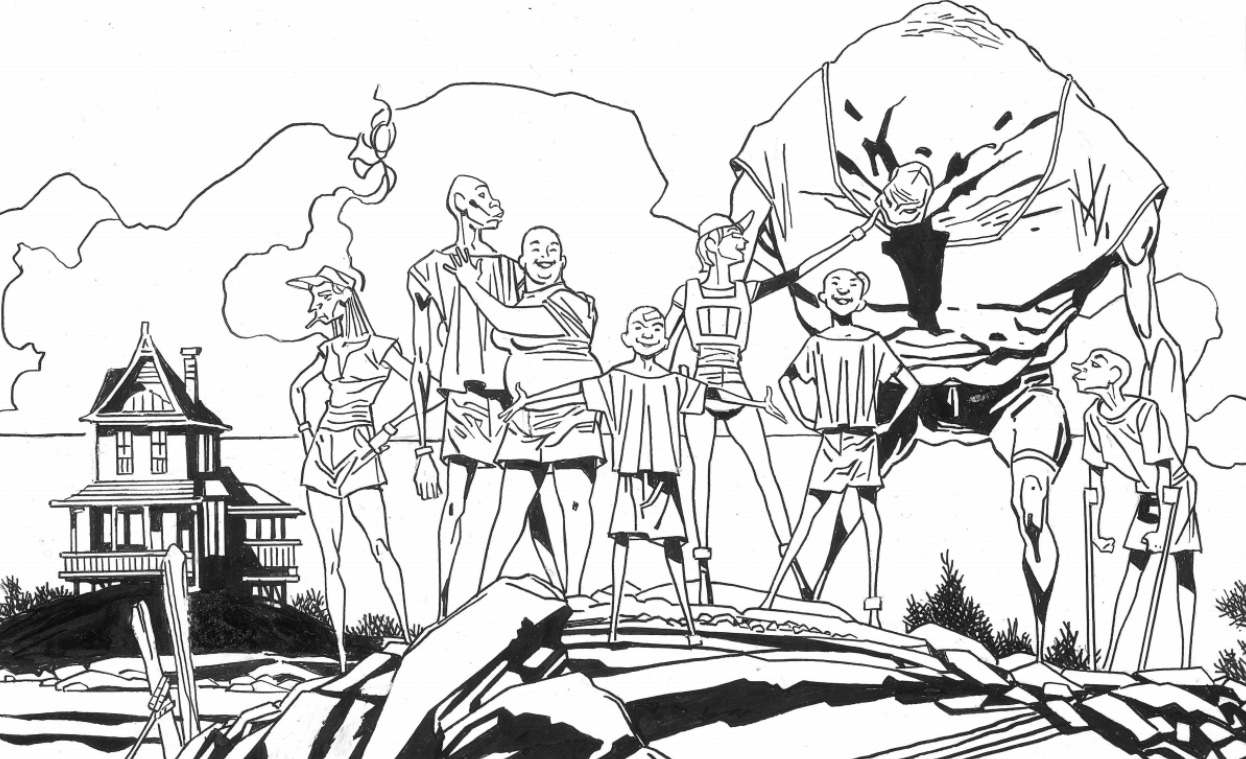
Oh, and we haven’t even gotten to the story itself. There’s a slightly deeper dive below, but the gist of it is that a bunch of kids go to a punk concert, and instead of having a good time, they’re given superpowers that they never wanted by entities far beyond their juvenile understanding. The narrative proper then bounces back-and-forth between their youth and middle-ish age, when they’re forced to reunite to battle foes/threats they assumed long since buried.
In that way, The Forgotten Five is quite different in the best, most exciting way — it’s basically X-Men mashed up with Love & Rockets, this “sort-of superhero series” that clearly loves and admires this larger tradition but not enough that it can’t also play around with its tropes and confines a little bit. It’s all the stuff you love about the “capes and mutants” crowd, but so much more textured, inventive, and utterly charming. Take that, Superman, Wolverine, etc.
Need more proof that The Forgotten Five ain’t your papa’s superhero story? Both Segura and Century were kind enough to answer some questions before chapter four debuts in the near-future. (And chapter five, which will feature a new artist, is already in the works.) The pair not only talk more in-depth about the plot and story structure, but they also discuss the Patreon-centric approach, the influence of Chris Claremont on the series’ creation, their favorite cast members, and much, much more.
If you’d like to read The Forgotten Five, become a member/backer now. (The first chapter, however, is free to read.) Below, enjoy exclusive previews of art from chapter four.

From chapter one.
AIPT: What’s the elevator pitch for The Forgotten Five, and what was the germ for the core story?
Alex Segura: Well, at its most basic, The Forgotten Five sprung from Sara and I just talking about the comics we loved [and then wondering what a blend of those books, comics (like Jaime’s Locas and the mid-80s Claremont X-Men) would look like. But I think it’s more than that – it features some of the things we’ve become known for in our individual work. It’s really about a group of outcasts who are cursed with powers and abilities in a world that already kind of hates them, and what happens after the big superhero fireworks – when the kids have grown up and moved out.
To get a bit more granular, years ago, an ancient power was awakened by an overly-ambitious scientist, and that awakening sent a shockwave through the world, activating powers in people around the globe. Not all of those activations were literal, but somehow a covert government agency known as the Contingency figured out a way to track down these cursed individuals and turn their powers on. Some of them are our protagonists – gutter punk kids who want nothing to do with being a superhero or fighting crime.
But now saddled with these powers, they find themselves under the tutelage of Polly Napier, a former Contingency agent, who’s made it her life’s work to protect these targets. Told in two eras, we see the kids in their earliest days, as they grapple with being hunted and their new, terrible abilities, and in the present, as the former superheroes realize that their work might be far from done – with clues pointing to a familiar evil rearing its head yet again.
AIPT: What was the motivation for doing this story primarily via Patreon? Why not more “traditional” means or even crowdfunding a la Kickstarter? What’s the reaction been like in terms of traffic/sign-ups/etc.?
AS: One of the big things for us was having runway to tell the story we wanted to tell – that meant, not limited to one-shot or mini-series or the whims of a publisher or a single crowdfunding campaign. It was about content and building an audience. Our idea was that we could always repackage the story in various ways once the work was done. So, theoretically, we could crowdfund a high-end hardcover or partner with a publisher to release the story in single issue or trade form, but our biggest goal was to try and create infrastructure to be able to tell the story and worry about the rest later. Which, amazingly, we’ve been able to do so far.
Sara Century: We have plans for print, so to me it’s more important that we chose to do this ourselves. And that all just boils down to the fact that this is a story that can’t be subject to market whims. We want The Forgotten Five to unfold over years, and there isn’t a publisher that I know of in 2025 that could guarantee us an ongoing run on that scale. So we hope that readers will sustain it by subscribing directly, because that was the only route we saw to telling the story we wanted to tell.

From chapter three.
AIPT: Why is the superhero “genre” still ripe for storytelling enthusiasm? And do you place The Forgotten Five closer to spoof, satire, and/or send-up?
AS: The Forgotten Five is definitely not a spoof, parody, or send-up. We’re playing it direct, but we’re also telling the kind of stories we like to read, and that sadly aren’t as supposed by the traditional comics market anymore. Novelistic, long-form, serialized stories that don’t feel like they’re going to end after an arc or one-shot. We want readers to get invested and settle in for the long haul, and we want to present them with amazing art from some underrated greats, like Pat Kennedy, Dean Kotz, and Craig Cermak – all pros I’ve had the pleasure of working with before that deserve greater acclaim.
SC: There’s definitely some tongue-in-cheek stuff in there, but I think The Forgotten Five is unique because of how much it wears its heart on its sleeve. Besides, detailed character work, bonkers sci-fi, ethical dilemmas, and philosophical commentary are all vital elements of superhero comics. There’s a very real history of superheroes as a rebellious, subversive, and political genre. In some ways I find it more interesting not to do a send-off or spoof at this point and to instead lean into utter sincerity with this book.
AIPT: I’d read that this series was inspired (at least in part) by Chris Claremont stories of the ’80s. What about that legend, those tales stood out or resonated?
SC: We’re both just X-Men Heads who imprinted on that era, including Louise Simonson’s work on New Mutants and X-Factor, too. We’ve chatted about missing elements that a lot of writers lean away from these days, like excessive sound effects, prose-style narration, thought bubbles, side characters that have their own little arcs, and the overwrought soap opera element. So I’d say format has been the biggest way it’s popped up in the series. Now everyone is like, “Show don’t tell.” We’re like, well, let’s do both, we love Claremontian prose.
AS: Yes! We want to give readers a pass into a sprawling, complicated world – readers are smart, they don’t need everything over-explained to them. They want to poke around and see what’s happening. The Forgotten Five is only beginning, but in our heart of hearts, we could be working on it for a long time.

From chapter three.
AIPT: Do you have a favorite cast member? Maybe someone who you think is special amid a really solid collection of characters?
AS: I really like Steve, who we meet briefly in chapter two – this was an instance of me and Pat having a sequence for another project that had been orphaned, and then I brought it to Sara and we decided to just weave it into The Forgotten Five because it synced up almost too perfectly.
It’s just a fun little narrative detour that we can leave dangling until we want to come back to it. Steve is not your typical hero – he’s just a lovesick puppy who is going down a very bad road. I love characters like that. Of the core team, I really like Amina, conceptually, because she’s apart from the “Five” – and from what we’ve teased, there’s an idea of where her story goes. But sometimes the “how” of something is more haunting than the spoiler, if that makes any sense. Readers may know what’s going to happen, but the journey is what will stick.
SC: I like Darla Desolate! She’s based on a handful of different lesbian vampire stories. It’s been a blast to write her as kind of an agent of chaos playing in everyone else’s lives. I love all the characters so it’s hard to choose, but I say Darla because I think people need to appreciate her. If someone tells me there’s a lesbian vampire in a comic, I buy that comic.
AIPT: From the feel and language of this book, it feels like a superhero story very reflective of life in 2025. Is that a fair assumption – is this a story about being your own hero when you see the true face of it all and realize no one else is coming to the rescue?
AS: I think it’s safe to say that The Forgotten Five is a very modern superhero story – in that, yeah, these kids are taking on the role of heroes, but they don’t really want it. But like you said, there are no Avengers-like team swooping in to save the day. They’re in a very dark and desperate world, and life was tough for the teens before they got power.
So it’s not like Teen Titans or whatever where they’re excited to have powers and put on costumes. It’s all very much a necessity and desperate need. The Forgotten Five is a story about what we do when we’re cornered, and how we respond to a dire situation. Some of us step up, some of us run, some betray what they stand for. That’s a big reason we wanted to show two different eras – so while you’re reading the early days of the team, you also jump ahead and see what’s to come, and it’s up to the reader to try and connect the dots.

From chapter four.
AIPT: How does the collaborative process change given that it’s Patreon and there seems to be added time between issues/chapters? Would it be a different story under different parameters/circumstances?
AS: We ran into some scheduling speed bumps at first, not gonna lie – Pat was dealing with some life stuff and in retrospect we probably launched too early. But on the bright side, that lead us to bring Dean aboard, and he’s become such an integral part of the team. He really brings a gritty, realistic vibe to the “present” stories, allowing for Pat (and Craig, starting with #5) to shine in the “past” story.
I think that, yes, if we’d gotten an advance from a publisher or something like that, we could just sit back and work on the book, but we always envisioned this as something we did in tandem with the audience, and the benefit of the Patreon is you get to see the work as it comes in – like Chapter 2, which we posted a partial version of.
We’re in the process of sharing an expanded and final version of the chapter to patrons very soon. So the benefit of the Patreon is that you get this live studio audience that watches your every step, and can be part of that adventure instead of just getting it all in one dose. Though we do hope/plan to have print versions of each set of issues coming very soon. More on that as we finalize it.
AIPT: This is for Alex specifically. You’ve done some vaguely/adjacent meta things with Secret Identity, Alter Ego, and The Legendary Lynx. Do you see The Forgotten Five as fitting or connected to those – is it about letting fans take a peek behind the curtain of the comics industry?
AS: I don’t think it’s about getting a peek into the industry – but it’s certainly about showcasing and being transparent about the process, sure. I’ve taught classes on pitching comics and I’m very deep into a book series about the construction and creation of comics, so that’s always top of mind. But like I said earlier – this is more about building an audience that is a slow burn, and not throwing something out there and hoping it hits a home run at its first at-bat to ensure another at-bat. We want folks to become immersed in this world and want more, and support the creation of more. So far, it’s working. We have a great team, too. Not just Pat, Dean, and Craig, but our letterer Chas! Pangburn and editor Priya Saxena. It’s very much a passion project for all of us.
But back to the meta of it all – if it was up to me, all my creator-owned stuff, novels and comics, would exist in the same universe. There’s a nod to The Awakened, the superhero murder mystery I created with Michael Moreci and Dean Kotz (who is now drawing The Forgotten Five), because it just made sense to nod to it, and it made me feel some fun, classic Marvel vibes. I’m always game for a fun Easter Egg or hat tip because it makes me happy, but it won’t mess with the reading if you’re just enjoying this book.

From chapter four.
AIPT: I feel like so much of this title’s power and impact takes place outside the story proper (i.e., all the extra posts, house ads, etc.) What’s that approach do for you as storytellers, and is it fun to amp up the “geek factor” in that way?
SC: Sure, and it’s about getting to middle age and feeling regret, or missing your old friends, and thinking about what you wish you did differently, and how to move forward from that. And seeing the next generations inheriting a world that isn’t any easier or more simple than the one you grew up in, and feeling very serious angst over that.
AS: We want people to be surprised! To not know what’s coming next! I think that’s really hard to do, particularly with established characters in recognizable worlds. But with The Forgotten Five, we can kill a character and keep them off the board, for example, or tweak someone’s lore. It’s all new and we want to recapture that feeling of having no idea what’s going on and loving the ride anyway.
AIPT: How far do you want to go with The Forgotten Five? And could you see “crossover” with a trade release or something similar down the line?
AS: Sara and I have the first two “seasons” mapped out — which runs about 20 or so traditional issues, but we could write and work on the book for a long time — and we hope to, as long as folks support it. I think the goal has always been to use the Patreon as the springboard to other formats, so we’re in talks to create printed single issues and collections (print and digital) to accompany the main Patreon stuff — and making sure each of those components is appealing, like having color in the print trade or stuff like that.
AIPT: What else should we know about The Forgotten Five, superheroes, comics, etc.?
SC: Comics are good! There’s nothing better. The Forgotten Five is a great comic and we love making it.



You must be logged in to post a comment.