


(Editor’s Note: Spoilers ahead for issue #1)
What is Die?
Is it “goth Jumanji,” where a group of friends (siblings Dominic/Ash and Angela, Isabella, Matt, and Chuck) are sucked into a fantasy world now run by their old friend (Sol)? Is it an actual corresponding RPG game, where players experience first-hand the excitement and terror of this novel world? Is it also its very own metafictional universe, one built by versions of famed authors like the Brontë siblings and H.P. Lovecraft?
Yes to all of those, but it’s also something else further still: A love letter between co-creators Kieron Gillen and Stephanie Hans.
“It’s a universe created by and for Stephanie Hans,” Gillen said in a recent Zoom call. “I always say she’s like the ocean because Stephanie has two modes. When she’s doing the storytelling in her breakdowns, you see she’s telling a story. And then when she’s creating these spaces, she loses herself in it. And occasionally she goes too far in the direction, but she’s always creating more and more.”
And it turns out, with a new sequel series coming down the pipeline, Die isn’t close to being fully formed.
Rolling The Dice
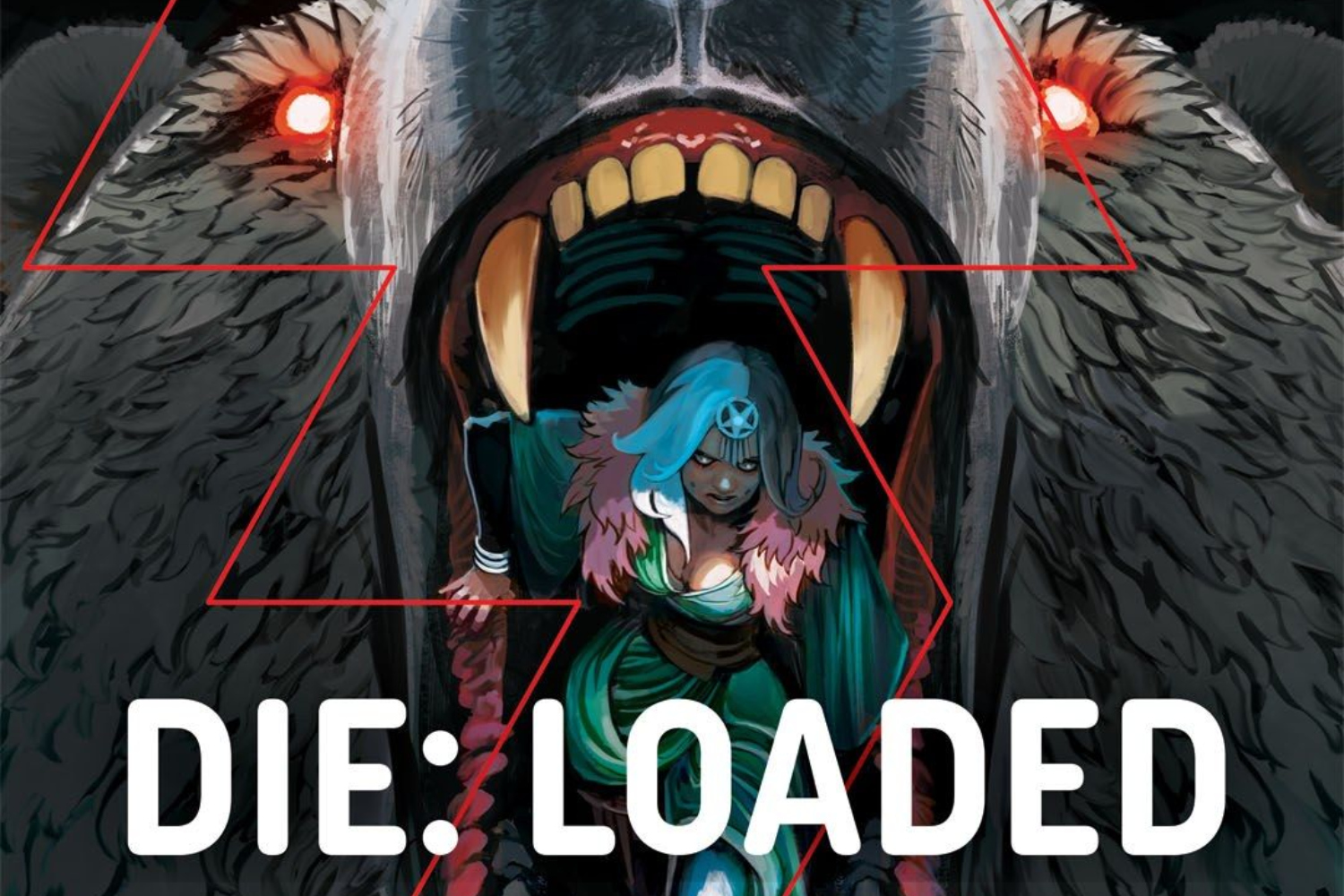
The aforementioned sequel is Die: Loaded, which takes place one year after issue #20 (released in September 2021). Chuck is dead, and the rest of the group (including Sol) are reintegrating into a world still grappling with the physical and existential threat that is COVID.
But before we get into the meat and potatoes of it all, there’s an obvious question: Why a sequel?
Gillen is quick to point out that, technically speaking, the RPG is the sequel, with him and Hans adding to the world and story via gameplay, artwork, and other corresponding dynamics. But as to why a proper comics sequel, Gillen’s answer hearkens back to the very heart of Die.
“Why on earth would we ever stop Stephanie drawing it?” Gillen said. “That would be lunacy.”
As for Hans, she’d just assumed that this universe would just keep right on growing.
“Ever since I was a young person, I used to finish the stories in my head,” Hans said. “I always thought that there would be so much more to explore again, And then we did the RPG. But it was never a finished story. Everyone has a personal story with this story.”
But even that answer — because we can! — doesn’t get at something much deeper still. It’s this idea that not only do they want to tell more stories, but that never being done is a function of this “creation.” It’s something shared with another beloved, Gillen-penned series.
“Die is probably a sister book to Phonogram, which is like the first book I did with Image,” Gillen said. “The idea of Phonogram is a story when I made up the core idea and brought it to Jamie [McKelvie]. It’s a metaphor and a device to allow me to talk about music for as long as I want to. And it’s personal and it’s autobiographical and it’s weird. That’s kind of what Die is – in terms of it’s a robust device for allowing me to talk about people and games and what art does to them and what games are for.”
It’s very much a theme that’s not only artistically satisfying, but helps Gillen find stories wherever his life may lead.
“My dad left me a mixtape when he died – and that’s a Phonogram story,” Gillen said. “And Iris, my daughter, 20 years on, was just singing ‘Fight the Power’ in the bath; that’s a Phonogram story. And Die is a bit like that. I hope it’s robust enough for me as we get older to return to it when we want to.”
Then, of course, there are other “concerns” attached to the sequel. For Hans, it’s not just that they totally love this world, but they find themselves needing more answers themselves.
“It’s a very personal book for both of us in definite and overlapping ways,” Hans said. “In the first series of Die, I got involved with characters, but my relationship to them evolved. At first, I was more attached to some characters, and in the end, I realized I was just a fool.”
Meanwhile, Gillen said that “there’s a load of stuff in Die that we haven’t shown. We haven’t shown half the gods. The basic fantasy world aspects are there, and that particular story is over. But there are other stories adjacent to it.”
So, if you thought the story was done, that’s solely on you, TBH.
“So, yes, it very much feels like a complete story,” Gillen said. “It’s because we’re good at our jobs.”
Total Party Grief

Main cover by Stephanie Hans. Courtesy of Image Comics.
It helps that Die: Loaded is meant to be a standalone effort. Gillen has said that it’s “not the story” we know, and even thematically speaking, it’s interested in new and different ideas versus the original series.
“It’s about how trauma cascades outwards,” Gillen said. “It’s about the splash damage of traumatic events. And I mean, the one line is, ‘No one’s an NPC.’ It’s a lot about looking at people who we view as background characters and from a different angle.”
That NPC angle is huge — the creators really wanted to go beyond what we already knew of Die (and, as you can see in this interview so far, it’s quite a lot). They wanted to make us question just who gets a story and what that really matters.
“Everybody has an enormous interiority in the real world,” Gillen said. “And it’s one of those most noxious things, the idea of the NPC being used as a right-wing shorthand of reducing people to just tiny bits of mechanics and that’s all they are.”
That’s why Die: Loaded focuses on Sophie, the wife of Dominic/Ash who was left behind in the real world. Despite his attention to world-building, even Gillen was guilty of minimizing a character.
“There’s a bit in, I think issue #12, where Ash goes, when he’s talking about Sophie, ‘I don’t really talk about my wife that much, do I,” Gillen said.
He added, “So Ash talks about that for a couple of panels, as lamp-shading the fact that Ash has a wife in the real world. And Ash hasn’t forgotten that per se. It’s just not relevant to where the story is indirectly. And that panel made me feel that I’ve actually done Sophie wrong. That’s explicitly me as the writer going, ‘I haven’t got space to give this character the attention I think they deserve.’”
And it’s not just insulting to a character, but very much goes against Die‘s core interest in all things RPG.
“The thing about RPGs is you step into other people’s shoes,” Gillen said. “That’s what fiction does. You read a novel and you’re forced – especially a novel which is stream of consciousness – to see how people self-justify and move through it. So that’s what I wanted to do – explore these people and their friends and family and all that around it.”
Sacred Rage

‘Youngblood’ variant cover by Stephanie Hans. Courtesy of Image Comics.
In some ways, Sophie almost had to be the main character. There was something about her that, even from a visual standpoint, spoke volumes the second they began working on this latest series.
“I think the first sketch [of Sophie], I didn’t change a thing,” Hans said. “The other ones I had to turn around a lot more, but I had her in one go, I think.”
Hans added, “I was just remembering that on my first sketches, I noted a few things. Something like ‘sacred rage’ – the thing you get as a woman in a perimenopausal stage. I think Sophie, as a woman my age, is very easy to understand. You just want stuff to get done.”
And focusing on Sophie doesn’t just provide a new focus, but her very presence extends and augments the primary story.
“Ash is narrating and talking about how Sophie was by herself raising a kid during COVID,” Gillen said. “Chuck’s body arrived six months earlier…and so she spent six months knowing that one of them had been killed. And the second you start taking Sophie realistically, that changes that shape. And that’s kind of where stories come from.”
Some of that same dynamic is facilitated by the art. Gillen said that so much of Die is “cracking a world in two, and there’s so much for both of us to play with.” And even Hans has slipped in little ideas and such “playthings,” and those have in turn inspired Gillen to ask important questions that move the story forward. Let’s use an example from the first series, yeah?
“And so in the first series, you have a general of Little England who’s a tiger with an o-ring chain,” Gillen said. “Like, where did that guy come from? I don’t know. But if we ever go back to Little England, he’s turning up again, because I want to know what his deal is.”
Admittedly, some people might have a problem letting go of their favorite characters, like Grief Knight Matt (or the aforementioned general, maybe?) But as Hans explained it, these “new” characters will quickly become important in all the right ways.
“I’m hoping that people get enough because obviously it’s a worry – Ash really was the lead character,” Hans said. “But I think it’s a big move. It’s also a necessary move to widen the book a bit. I think Sophie is such a solid character, but as the first-ish reader, I was also a bit concerned of not having enough of the former cast. I forgot about that so soon because the characters are very real. I got attached to Sophie, I think, even faster than I got attached to Ash.”
Gillen also recognizes the possibility of some people being disappointed. At the same time, though, he said that people will still be able to explore their faves — just in a new way.
“You’re not going to get much Ash; you’re going to get Sophie and then learn Ash through it,” Gillen said. “And it’s not all through Sophie’s flashbacks, but Sophie’s real life is also Ash’s life.”
Gillen admits, however, that they also want to keep people guessing as they develop the cast even further.
“We’ve definitely created more options for people who could be in Die in the first issue than there are spaces,” Gillen said. “So you can’t actually guess one for one. I’m sure readers are going to read the issue and go, ‘Oh, I reckon these people are going in.’ I did that. That’s the game. That’s 100% what I want. It’s like, who is going to be the Avengers?”
But even if you do figure it out, you may not be any closer to actual answers.
“So what I’m hoping is we get to satisfy the urge of people who want to know more about, I don’t know, Matt but without actually just putting Matt back in Die,” Gillen said. “But, of course, I’m also not saying Matt isn’t in Die either.”
‘Crawling in Between Spaces’

Variant cover by Peach Momoko. Courtesy of Image Comics.
Let’s spend a few more minutes, then, with this idea of reconciling with what Die has already done. Because using characters to explore more established characters isn’t just to simply tease fans. It’s part of a much larger approach by the creators to make sure Die: Loaded feels unique and novel and not just another add-on story.
“Stories I consider resolved from the first volume, I don’t touch,” Gillen said. “And I approach from different angles. But as you said earlier, it’s like the trauma echoing out.”
It’s a kind of pseudo-rule inspired in part by a rather famous TV show, a series that knows that the key to any good story is an increasingly robust cast of characters.
“One thing I really liked about Breaking Bad, there was never an end to it,” Gillen said. “That made the end of it feel like a bit of a cheat, but all the way it’s like, ‘Oh, yeah, you do stuff and then some other stuff. Then that person always has a brother.'”
Which is to say, it’s about figuring out what makes these characters so darn interesting and compelling. And how do the duo of Gillen and Hans actually do that? Well, they ask questions, duh.
“At least to me, I always knew more about Sophie than we said,” Gillen said. “…You just think about it. I know that sounds incredibly obvious, but it’s like, ’OK, where is she from? What’s her job?’ All these very, very basic things – you just dig and dig and dig. Where did her and Ash meet? What does she like?”
So Sophie, for example, got to be the star because the more the pair actually asked said questions, the more they felt surprised and/or compelled enough to focus on her.
“One of the real things about the structure is the fact that all of it makes me dig really hard into all these individual people, which means I discover them,” Gillen said. “So we do all the thinking about who they are, what they do, all those extended family questions about who these people are. And then when you actually write them, you discover more. Like, the characters who I thought were going to be a bit more innocent are sharp-edged characters who are a bit more playful and have meaner sides. Or vice versa, and they’re more tragic.”
And it’s very much a similar process for Hans. It’s about diving deeper and seeing what meat and sinew actually exist in the crevices of these folks.
“So there is always some part of me crawling in between spaces,” Hans said. “I try not to go too much into Kieron’s story.”
Hans went on to add that so much of this aspect of the storytelling process is based solely on how she responds to what Gillen has whipped up for the scripts.
“Kieron, he works more as a writer than as a script writer, you know,” Hans said. “But at the same time, a lot of the things don’t have a lot of description in itself; it’s a blank canvas for me. And I can just put everything I have in my mind right now. And for me, as a person who has a lot of things that I like to explore, like hyperfixations and everything…I can just go all in.”
Board Games and Superstition

Courtesy of Image Comics.
As we get back to the topic of Sophie, though, there’s one more aspect of the Gillen-Hans collaboration worth addressing. Once they have these characters percolating, how do they decide who ends up in the book?
Why the only way that ever truly works: an in-person (albeit friendly) shouting match.
“Stephanie came over for our summit. We hung out in my house in London when I was still living there,” Gillen said. “We basically stayed in the shed and argued about what should we do? Who interests you? What are the aspects of these characters? Like, we had a larger cast than we have in the final comic and we had to choose between what we thought was cool and what wasn’t cool and how we should do them. And that’s even before we started actually writing the thing.”
So, then, what else about Sophie (aside from what we already know, of course) made her so darn compelling? Well, for one Gillen said she’s “been through a series of discombobulating events,” and that a demands a lot on the ol’ empathy muscles. And, as it turns out, that’s really the point of this whole darn thing.
“The second you start really trying to think about what it would like to be somebody, you go a bit like broken in the head,” Gillen said. “And that’s good. That’s kind of the point of the exercise. Die tests you — what do you want?”
Similarly, Sophie’s experiences speak to another tent-pole of Die as the story continually blurs and breaks the lines between fiction and reality.
“There’s the question of what is real for her,” Gillen said. “As in what is her understanding of the word ‘real’ now anyways. That’s where we end up digging with her in lots of ways. She’s a complicated woman in that way.”
As an extension of that, Sophie has grappled with uncertain circumstances, and that kind of approach feels perfectly suited for the wonderfully ill-defined confines of Die.
“She has been battling nature for years; she wanted to have a kid and she couldn’t have a kid and that was her last chance with IVF,” Gillen said. “So it’s about a distrust in nature as well. There’s [also] a superstition running through Sophie as well – a low level trauma response that people disappear.”
But no matter what she does, there’s one more aspect of Sophie that remains eternally true and profoundly relevant to this latest storyline.
“The one thing I really like about Sophie as a leader is she doesn’t know much about fantasy,” Gillen said. “Ash was a big fantasy head when they were teenagers. And so having a character who really knows very little about what the f**k’s going on, that’s great.”
Gillen added, “One of my favorite lines is, ‘It’s just like one of those board games that you played at Christmas and you have to try to listen to the rules before the wine kicks in.’ Sophie’s that kind of character. I think that makes it very accessible for people who aren’t into RPGs as much. But also people who do know RPGs get the joke.”
Paying Your Debts

Courtesy of Image Comics.
For all her unknowing, though, Sophie becomes perhaps the coolest class in all of Die: A Godbinder. For those unaware, they can basically ask gods for “favors” in return for a little divine assistance.
Not that she had a choice. No one ever really does in Die.
“She didn’t choose to be the Godbinder; there was only one dice there. So, in other words, Die decided she was the Godbinder,” Gillen said. “Of course, I made Sophie, and I made Die, so the meta level is true. But then I gave her a second choice, and that’s key. She has to grab the dice and then she chooses what to do with it.”
We won’t spoil what that choice is here. We will, however, let Hans share a related albeit decidedly nebulous story that shows how much, intended or otherwise, Die borrows from our own reality.
“The place I was born – Moyeuvre-Petite – has maybe 600 people,” Hans said. “The people there don’t have a name, because the bigger city [Moyeuvre-Grande] are called Moyeuvriens. So we are called the Foxes.”
But why did Die (read Gillen and Hans but also not them whatsoever) then divine for Sophie to become a Godbinder? Well, Gillen said it has to do with “Stephanie Hans, because Stephanie nailed the character the first time.” At the same time, it goes further still — Godbinders play a very specific role in the world of Die.
“The Godbinder is about many things, but it’s about your relationship with other people,” Gillen said. “That’s the core metaphor. And the fact that it’s also a flexible metaphor, because it’s specifically about relationships with these gods. The idea of these gods are things external to you, but also reflect things you kind of want or need. What does being a people-pleaser in her case look like? I love this idea of what do these choices mean.”
Gillen and Hans also wanted to use Sophie to expand our understanding of the Godbinder concept. We’ve already seen how Isabelle wields the class in the first series — as a “big warrior with a big battle axe,” according to Gillen. This time around, though, Sophie uses the power in a way that feels organic to her knowledge, skills, and general presence in this world.
“No, this Godbinder we’re showing is very different. She’s small,” Gillen said. “She’s basically the thief for the party. We get the richness because she’s a woman in her 40s. That’s kind of important. And she’s not a woman in 40s who is choosing to be a different age. She’s explicitly a woman in her 40s.”
In turn, that caused Gillen to encounter another instance of Die‘s unique ability to make its own creators face their own lives/circumstances, and what they do (or do not) to then mine for inspiration. It’s that aspect, I’d argue, that doesn’t just make Die unique, but reminds us how much this series reads us as much as we read it.
“The biggest problem with Sophie…I didn’t want to just write Chrissy, my wife,” Gillen said. “Even the fact that I gave her the bear — the bear is the archetypal Chrissy animal. So I had to choose the bear because it’s dark. I think Chrissy’s first poetry book [was] called Bear, but I’m going out of the way to make her not Chrissy. She really isn’t very Chrissy in lots of ways.
Gillen added, “But at same time, I’m writing about having a child during the COVID pandemic years, and I’m writing about my experiences of early parenthood. This is some of the stuff I’m mining in the book. But that, of course, overlaps with Chrissy. So I’m being careful, because I don’t want to step on those shoes.”
The God of Art

Courtesy of Image Comics.
Still, Sophie’s not the only important feature of Die: Loaded. At the end of issue #1, we’re introduced to a second party member, who (without spoiling too much) is deeply connected to a former party member. Here’s a hint: issue #2 focuses on the “God of Art,” and some cast member is currently studying that very subject in Manchester.
If your answer was “Stephanie Hans,” you’d get at least half a point for inventiveness. Hans is, as Gillen put it, “literally the God of Art as far as the whole world is concerned.” But rather than cameo in her own book, perhaps that speaks to the power of Hans’ art in this latest series.
Because, while there’s no denying her skills and prowess across the first series, Hans steps up in some major ways across Die: Loaded.
“Stephanie’s very hard on herself in lots of ways,” Gillen said. “And she’s always trying to push her art in different directions and try this and try that. And that’s just part of the joy. There’s some stuff that Stephanie does that’s just a surprise. Like, there’s bits where you know where you get Stephanie Hans’ money shot. There’s a bit in issue #5 where the characters are in a maze and it’s like, ‘Oh, right, I wasn’t expecting that.’”
But more than just honoring Hans — seriously, the look and feel of Loaded is even more stoic and dramatic, with everything coalescing even more brilliantly than ever before — there’s another reason for the art-centric focus. (Of course there is; it’s Die for crying out loud.)
“There’s at least one reason I wanted to start on [the realm of art] – because Stephanie and many other people and myself all noted the fact that I was doing history of RPGs, and it ended up being much more literary history,” Gillen said. “And the RPGs aren’t that; they’re also the covers. Like, what is art for in an RPG? Where does art come from in RPGs? And so starting there as a background, I’m sure you’ll see how that also juxtaposes with the character.”
For her part, Hans said she “gets bored very easily; I need something to entertain myself.” But even that semi-dismissive answer doesn’t get at why the art feels even more vital across Loaded. Shoot, the sheer emotional range alone (even just in theory so far) is maddeningly impressive.
“Die has always been quite modular, but the first six issues are all really different,” Gillen said. “Issue #5 is really heavy and literary. Issue #3 is bleak, but bleak in a very different way. And issue #6 is just kind of sad and melancholic. Issue #2 is so beautiful.”
And if you don’t want to get all bummed out, there’s comedy, too.
“Like, issue #4 is really genuinely funny; it’s definitely just a comedy,” Gillen said. “Stephanie used to say she was never a funny artist.”
And Hans is quick to admit she can be funny — just not in a way that you might’ve ever expected.
“Some people are very good at doing the four-panel sketches, like Bill Waterson [with] Calvin and Hobbes,” Hans said. “I’m not that kind of artist, obviously.” Her greatest humorous contribution, then, comes from a rather unlikely god: “The Tyrant’s really genuinely funny for me. I like to draw him, too.”
All Hail Chuck

Courtesy of Image Comics.
In addition to Sophie and Godbinders, Die: Loaded has some other important features. For instance, there’s even more perspective on yet another interesting class.
“We’ve met one Dictator,” Gillen said of Ash, who used his/her power to control others. “And now you’re going to see a very different take on the same concept, even with similar powers. And that is quite important, because that’s also a bit that opens up Die as a fantasy world in that it doesn’t have to just be big old warriors – it can also be this little druidic stabby lady.”
They’re also going to “show all the gods,” Gillen said. In addition to the “funny” Tyrant, there’s The Judge and The Archivist (both also described as “fun”) and another exciting deity who “doesn’t show up until the second arc.”
In addition to gods, expect four new regions in Loaded‘s first six issues. And, yes, even these places are thematically and narratively significant.
“When I chose what regions to go to, I was thinking about what these characters are, what their life is about, and where they’re going to go,” Gillen said. “And, of course, I can’t say what regions I picked and what bits of art position I’m showing…”
Gillen said that one “is the closest we get to a Brontë-esque issue. And it’s almost a living essay.”
(If you’re confused about what a “Brontë-esque issue” might actually mean, here’s a refresher. In a drastic oversimplification, the Brontë siblings basically created parts of Die‘s world, and were in turn sucked into this place as story characters. Go re-read Die‘s first four arcs if you really need to understand it further.)
Suffice to say, Die: Loaded won’t feature nearly as much of these massively meta components.
“One of the things about the structure of the book is, since we’re introducing the cast at the speed we are, we get a chance to really introduce them,” Gillen said. “That means, in a way, you get to get the focus episode, and there’s less of the world building this time. There’s less of the random essays about the Brontës. We know Die’s nature has been established, and we can just really dig into the characters. Hopefully we can make people fall in love with them quite quickly. It’s a bit like meeting people’s exes. You get to see a very different image of them.”
And while we’ve already addressed that major characters from the first party won’t be featured as much, that doesn’t mean they don’t still play a major role. (And not just as someone to effectively introduce and contextualize these new members.) Case in point: Even Chuck, whose dead body arrived six months before Loaded even takes place, remains terribly important.
“Chuck’s arc does tell of Isabelle…Chuck’s basically treating it like a game, with Isabelle saying, ‘Let’s take it real,'” Gillen said. “And it ends with Isabelle murdering somebody and saying we should have just done it, and Chuck basically defending the people. So they basically swap moral positions in their desperation. So Chuck dies a hero, but it doesn’t change the rest of his f**king life. That’s why we start at Chuck’s funeral – you get to see the chaos he left behind.”
But Chuck isn’t/wasn’t just a purveyor of mayhem. His mere presence (again, even as a corpse) is another reminder of an unwavering lesson of Die.
“A lot of the characters took themselves very seriously,” Gillen said. “And I think Chuck’s idea to prod the story a bit was really useful. Because it stopped the book from becoming too dour. At the same time, he’s a tragic character. He’s dying of cancer throughout the whole story.”
Gillen added, “And death doesn’t really care if you’re laughing at it – it’s one of those things that brings focus to your life. He died there, but it doesn’t change the fact that, you know, your kids hate you or whatever, or whatever they feel about him. Dying doesn’t mean that Die is finished with you.”
A Bonus Round

Courtesy of Image Comics.
And beyond more story to tell — the pair were apparently finishing up issue #7 as of our pre-Halloween interview — Gillen and Hans have completed even more Die-centric work in recent months.
The same day as Die: Loaded #1 drops (November 12), Image Comics will release a “quickstart edition of the RPG,” Gillen said. Even if you’ve never played a single other RPG in your life, this one’s for you.
“It’s basically comic format, 56 pages, and everything you need to do to start playing the RPG,” Gillen said. “Why spend 40 quid on something that you may not understand or have interest in? I think there’s a bunch of stuff in the RPG manual that people who just like the comic would like, even if you never play it.”
Gillen added that, starting in Loaded #2, the backmatter will feature “a few beta rules…specific rules and character backgrounds for all 12 gods. I’ve certainly got some more Die RPG ideas there, but that’ll be further down.”
And, sure, this kind of multimedia/multifaceted approach will help sell comics and RPG manuals alike. But if you haven’t been paying attention, that’s not why Gillen and Hans do it – at all. No, they do it because it’s part of who they are and what really matters in this world: Creating stuff with your pals.
“What I love about RPGs…it’s like punk rock or whatever,” Gillen said. “You get together and you do it with your friends. You don’t have to be good because doing it yourself is good.”
And “doing it” is exactly what they could keep doing for years to come. When I asked both creators if they’d still be working on Die in, say, 30 years from now, they quickly reminded me they’d be nearing 80 years old.
“I’ll literally look like the Dungeon Master from the cartoon,” Gillen said. “Also, think about Stephanie’s back and wrists!”
Meanwhile, Hans had an ingenious solution that I only partially hope is just a joke: “I think I’m going to have to have to have a child myself and train them.”
But in all (?) seriousness, Gillen had one answer that struck me as being especially significant. Die is everything we’ve discussed and so much more still. Die has rewritten how we engage with fantasy storytelling. Die has helped its creators better engage with their art and their audience (and their friends/collaborators). Die has even allowed us to the see the power of a truly great story universe. Die is everything and utterly eternal — so long as it still works, of course.
“Like, you never know is the thing,” Gillen said of Die stories down the road. “Hopefully we wouldn’t need to do it. But hopefully if we wanted to do it, it would be there.”
Die: Loaded #1 drops November 12.


You must be logged in to post a comment.