


Not to reduce years of hard work by hundreds of people, but video games often boil down to the ending. If done right, you get something badass (Portal 2) or deeply poignant (Red Dead Redemption, even with the Jack Marston part). Drop the ball, though, and you’re left with something counterintuitive (Prince of Persia) or something half-cocked and unfulfilling (L.A. Noire).
In the case of Cemetery Kids Run Rabid, the ending hits even if I’m not entirely satisfied.
Here’s what you need to know going into to Cemetery Kids Run Rabid #4. Birdie, Maddie, and (sort of) Wilson have been playing Nightmare Cemetery to rescue Pik, Maddie’s brother. Since the end of Cemetery Kids Don’t Die, Pik has been stuck in the game world, and his body’s been piloted by a kind of AI demon and the game’s King of Sleep. Pac-Man, this clearly ain’t.
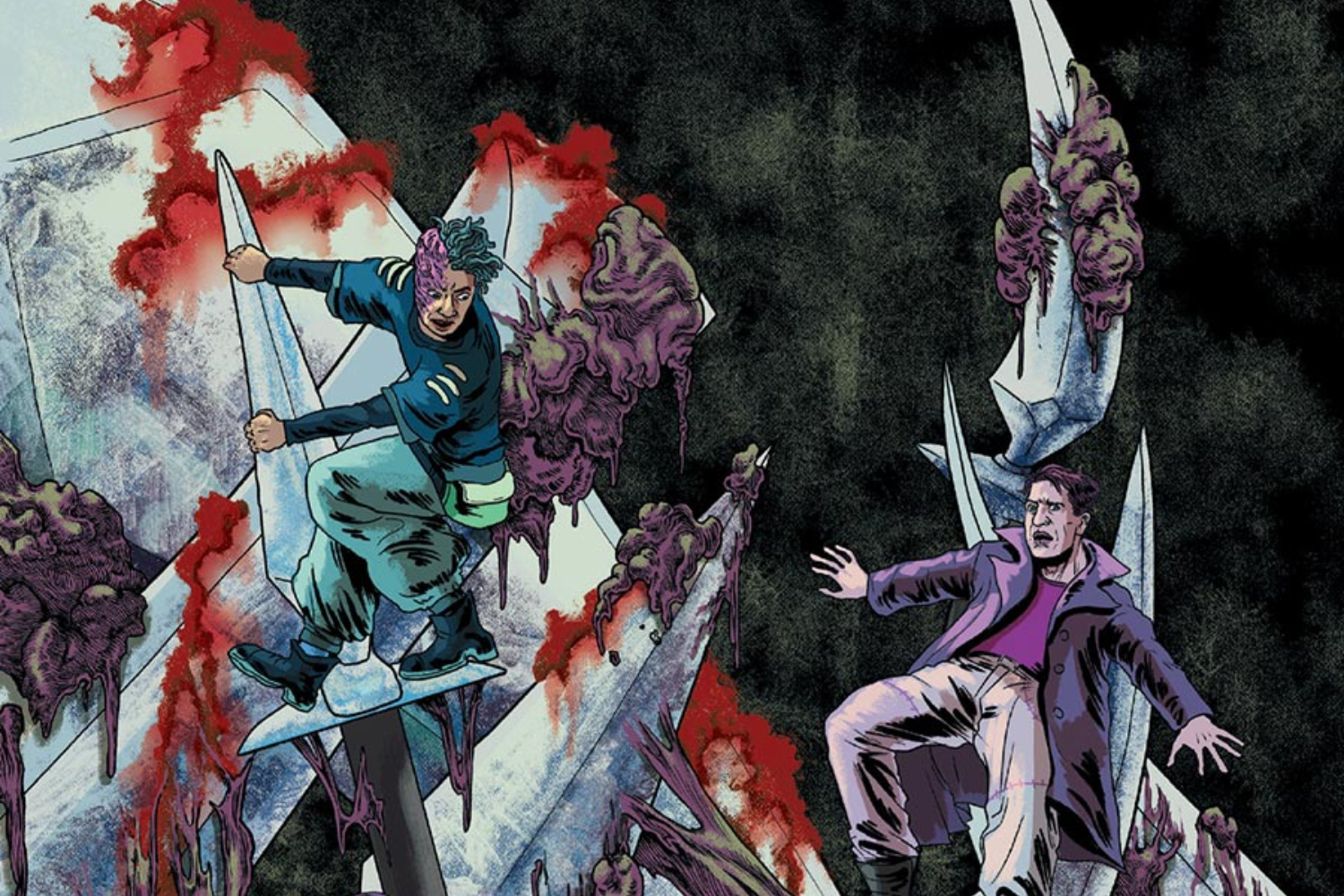
Despite the overt “gaminess” of Cemetery Kids Run Rabid, the thing I’ve taken away has almost everything to do with its increasingly poignant exploration of community, digital life, and the modern era’s increasingly dehumanizing tendencies. Even in issue #4, where the video game action is sharper than ever — artist/co-creator and Daniel Irizarri and colorist Brittany Peer go full-on Final Fantasy X meets Dragon Ball Z with some badass fights with Birdie and Maddie — the focus has been on this book’s extra lethal ability to dismantle our emotions.
As I’d mentioned in my review of issue #3, there’s some big ideas percolating about “digital violence and depersonalization” and “young people’s relationships with media/the digital space.” They’re topics that felt like they’ve demanded big brain work as a compliment to all the vivid biopunk nastiness and general fantasy badassery.

Main cover by Daniel Irizarri. Courtesy of Oni Press.
There’s even more here that further bolsters this power. I don’t think it’s too much of a spoiler to know that Pik is eventually rescued, and while that’s a generally a feel-good moment, the book maintains its ability to uplift but also eviscerate its characters and readers with a “twist” that’ll gut you where you stand. And on the way to that happy-till-its-not ending, Cemetery Kids Run Rabid does generally facilitate some larger conversations around its big interest/tent-pole ideas.
Birdie and Maddy, for instance, have an interaction toward the issue’s midway point that hones in even deeper into ideas of community, and how increasingly young people are left to fend for themselves if they’re going to, say, thrive in a world where their online spaces are being controlled and they must contend with existential threats like AI and censorship.
Agai, when the Cemetery Kids face these moments (vivid social commentary baked into the cake of video game awesomeness), few books can beat it. That speed/tone is a testament to writer/co-creator Zac Thompson, and how he understands so intuitively this world, its influences, themes, and real-world implications, and threads the needle perfectly to lay some truly solid foundation. (Foundation, I’d add, that the art team need to excel, as they do in moments where the Cemetery Kids almost find themselves consumed by an ocean of “NPC kids,” which is a truly brilliant synthesis/encapsulation of the book’s many themes.)
But beyond that, the issue didn’t have nearly enough room to work with — what we mostly get is the depth and finality of resolutions. By the time it gets to the actual ending of the issue, something felt decidedly off. With the light at the end of the tunnel finally visible, it was as if Cemetery Kids Run Rabid didn’t know what to do with itself. The final pages feature a lot of overt exposition by the kids (mainly Birdie), and while it resonates as being thoughtful and also a touch depressing, the hybrid magic of this book felt deleted or just overly minimized. It was as if some epilogue meant it could lower its defenses, and what we got was a long credits scene over more action and engagement for the reader/player.
I certainly felt myself impacted by the words here (there’s one comment about the fate of Pik and Birdie’s dad that’ll smash your heart), but I didn’t feel like I was involved as much. So much of this book’s magic has been throwing us into the proceedings, and making us fight alongside the Cemetery Kids to work through these massive ideas. That’s what made it fun and compelling — not the dope monsters (the Pik-demon hybrid here gets ample time to shine) or even Maddie’s multi-armed warrior character disarming dudes, but rather the emphasis on our shared humanity.

Variant cover by Jenna Cha. Courtesy of Oni Press.
Instead, I think Cemetery Kids Run Rabid #4 was more overtly focused on building its own future. That’s certainly something I’m doubly, nay triply excited about — this book deserves a long-term future a la Saga or The Walking Dead, and it has the legs and heart to truly go the distance. But it’s that disconnect from what made this book so great (the immersion, the confrontational tone, the proper way of contextualizing video game mechanics, etc.) that felt so disappointing. That, and without spoiling too much, the groundwork of its next chapter felt a touch cheap.
Yes, it’s a future that involves/centers on Wilson, who has been a major perspective character for this volume and deserves even more spotlight. (His unique “condition” of being “barred” from the world is a rather refreshing perspective, and even visually he balances the game and real worlds, horror and reality.) But after being all but ignored in issue #4 (clearly a pivotal time in this book), I can’t say Wilson’s next chapter happened organically or with all that much measure.
And that perhaps boils down my biggest issues/concerns with this ending of Cemetery Kids Run Rabid: That sense of earnestness. I’d always felt like this book was thoughtfully, deliberately assembled — everything it accomplishes (and that’s a lot) stems from the creators’ care and attention. But in the absolute home stretch, things felt a little rushed. Sure, we’re rushing toward something bigger and better, and this story could grow to reach its narrative and structural potential with power to spare.
But where Cemetery Kids Run Rabid could have been so potent all along, a big enough stumble at the end really stuck with me. It was like we could’ve had Metal Gear Solid 3: Snake Eater (epic and maybe open to some interpretation), but instead we got another level of Super Mario Bros. (“Sorry, reader, your much-anticipated grand finale is at another castle.”) None of that takes away from the journey, and Cemetery Kids at-large is still among the most relevant and affective books I’ve read in quite some time. We should celebrate all of its accomplishments in form, storytelling, and A-1 character work — even with a mostly middling ending.
The next time I plug in to this game system, expect me to be overjoyed but also just a smidgen gunshy.




You must be logged in to post a comment.