

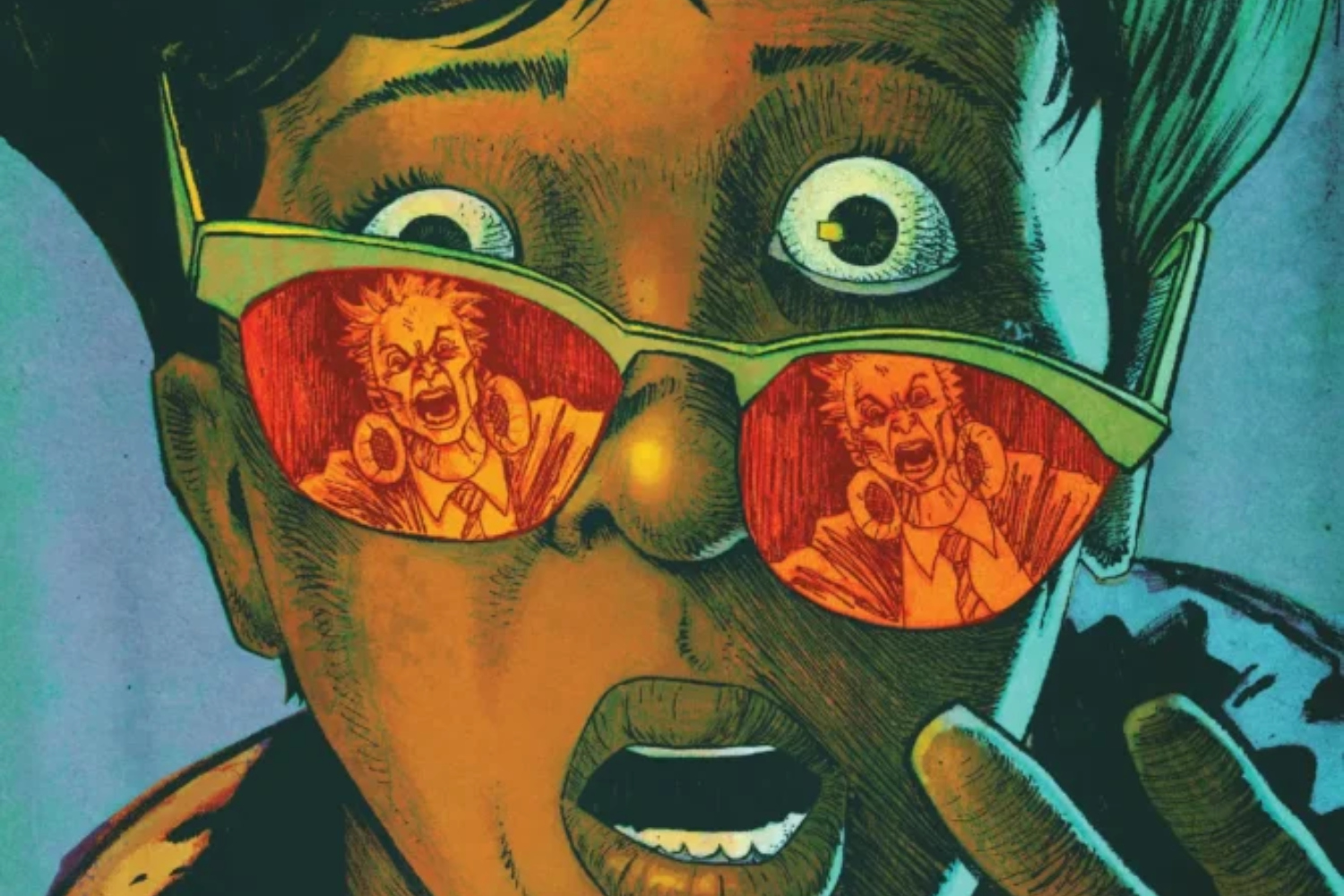

I’ll admit it: I’ve been put under a spell by Is Ted OK?
After not only being gifted all five issues at once, but getting to talk in-depth with writer-artist Dave Chisholm, it was hard not to feel swept up by the magic of this book. And that’s not even getting at what actually made it genuinely vital, as our paranoid friend (Ted) sees himself fumbling into a strange new chapter after he meets the good-natured Sarah (who happens to be spying on him for their employer, the depressive, overreaching Ayn-Styne). It was the kind of Vertigo-adjacent, massively relevant story of corporate overreach and personal disconnect that we need more of right now.
But the follow-up issue can be the real make or break for any series. The magic of Ted could have just as easily been smoke and mirrors, and what felt like a massively important story for 2026 could have just been a fluke of timing. In a story where perception and reality truly are fickle beasts, Ted could’ve just as easily been pulling its own “tricks.”
But it didn’t, and Ted #2 only reaffirms my devotion to this deeply important comic.

Courtesy of Mad Cave Studios.
First and foremost, Ted #2 tackles the big question from #1’s cliffhanger in a really interesting way. That question, of course, is “Holy shit, how the hell did Ted survive being total engulfed?!” And the answer is, well, we don’t really know. And that’s not a cop out, either: The whole hook of Ted is that it makes you question what’s actually real and what’s, say, a delusion. But it’s never in some cheap or flimsy way, or with an approach that is meant to feel obsessed with its own transcendent brilliance.
Instead, I think what Chisholm does well in this regard is best represented by the art’s scope. Across issue #2, there’s moments at work where Ted discovers, for just one example, a giant room with robots and other sci-fi impossibilities. Chisholm not only has an inventive aesthetic — sort of like 2000 AD meets the video for “Paranoid Android” — that you recognize an unshakable sense of near-future familiarity while experiencing the shock of something you know can’t be truly real. Then, you add in the sheer technical mastery displayed by Chisholm, as he instills a sense of maddening depth, plays with our sense of gravity and spatial reasoning, and generally makes us feel as if these moments might swallow us whole. And that, in turn, puts us on a mostly level playing field with Ted himself.

Courtesy of Mad Cave Studios.
So what you ultimately arrive at is perhaps the purest goal of connection and empathy I’ve experienced in a comic in some time. That we are all small, terrified, and confused about the shape of this world, and through that we are primed for a true story. And it is, once again, not Chisholm being clever or working through various tropes for the sake of his own artistry. Instead, he deftly and efficiently puts us right into Ted’s shoes, and we feel as if we’re right there with him in trying to find the center as the world around you knew dissolves into something scary but oddly compelling. Ted seeks answers for what is happening (if anything, of course, and why that matters) in a way that immerses us and promotes deep humanity and emotionality with every pixel. It’s sci-fi as it was best intended — to disarm the audience and make them grapple with their own humanity in deep and passionate ways.
And Chisholm furthers this dynamic elsewhere across Ted #2. Specifically, the increasingly potent relationship between Ted and Sarah. As Chisholm himself mentioned in our interview, this is very much Sarah’s story as opposed to simply belonging to Ted. That doesn’t take away agency from Ted — even if he does feel more like an avatar or agent for the really thrilling story bits and visually exciting stuff. Sarah, then, is our representative when we are faced with the new truths of the world, as she responds by doubling down on her relationship with Ted. She agrees to help him discover what’s actually going on while battling her increasingly potent guilt for not letting Ted know the truth (she’s basically his personal Big Brother).

Courtesy of Mad Cave Studios.
There’s a few things to take away from Sarah’s experience. Guilt, for instance, feels hugely important — it’s never overbearing as this trite display of morality. Instead, it feels like such a sharp commentary on socialization right now, and how complicated it can be to make and keep connections (and why we still have to find the courage to do so regardless). Similarly, it feels like a stand in for the disconnect and isolation we all grapple with in 2026, and how meaningful connections seem to be a finger’s length away. And in that same conceptual vein, it goes further still for Sarah, and her connection with Ted is a chance to “make up” for past failings with a loved one. (Perhaps that’s connected to the voicemails she keeps leaving…?) It’s all very much both a creative exercise as much as a deeply personal one, and in that way Ted doubles down in all the right ways as this massively humanistic experience.
I also think that after Ted #2, you can almost read this as two books. The one where it’s Ted and Sarah, working through the tenuousness and uncertainty to forge a bond that might help them better understand life. And then the other book where it’s Ted either abandoning that connection or finding the “real” truth. And so in that way, we’re not just getting this wonderful feel-good story about the power of friendship. We’re also getting a commentary on personal responsibility, the influence of misinformation, mental health and the responsibility of society, and even the nature of love/whimsy/etc. in a world where all that’s increasingly hard to come across. Again, though, all of that is rooted deeply and unwaveringly in those bonds of friendship and connection. That whatever the book is trying to tell, and no matter how exciting, abstract, intellectual, etc. it may get, it’s always in service of what this means for us as undeniably social creatures.

Courtesy of Mad Cave Studios.
Of course, Ted is already technically two books, as the “B story” deals with an interview between a journalist and Noah (TM), the world’s first trillionaire. In this second issue, we get even more insight into Noah’s work at The Dome, and how the concepts of surveillance and social power may influence what happens with Ted. But mostly, we get what I’d call the “inverse” of Ted and Sarah. Where that dynamic hums with life, Noah and the journalist show us what happens when there isn’t that bond or sense of equality. What you get, then, is more familiar in the worst way, a pairing that hums with a corporate artificiality, and this idea that you can manipulate yourself into being a good person (and not doing the hard work a la Sarah). It’s a pairing that denies that there’s something more powerful than what two people share when they need it the most.
And for that small but mighty lesson alone, Ted deserves not just my continued applause but genuine devotion. Chisholm took a brain-melting start and built on to it with gusto, giving us this rich, textured story about the present, the future, reality, the human experience, and what connects it all. (Hint: I think it’s that we don’t know much beyond that we need each other.) I don’t think I ever really thought that things could’ve actually imploded after Ted #1. However, I also didn’t see the second issue landing with this much subtle grace, overt power, and general creative intensity.
If Ted is, indeed, controlling my brain, let it never cease.




You must be logged in to post a comment.