


Of all the deep dives I’ve done in recent years, the one for Is Ted OK? has to be my favorite.
Not just because I think it’s well written (and my wife would agree), but I think it got to the very heart and soul of this series. And that’s very much the vast and abundant love and care applied by writer-artist Dave Chisholm to this entire book. It was my hope that, if you took nothing else away from those 5,000 or so words, it was that Chisholm truly adores this story, and he wanted to give us something singular and magical in the realm of modern comics.
And by god I truly think he’s done just that.
It’s really hard to try and organize my thoughts about why I think Ted is such an amazing and important piece of comics work. Everything I try to say somehow feels like it’s only a fraction of the actual truth, and my meager brain isn’t quite enough to truly and fully explain the masterclass Chisholm has created here. I don’t say this often, and even now it feels a smidgen hyperbolic, but I earnestly believe this could be one of the most important books of this decade. Truly.
So, to leave myself even a dash of sanity, here’s my mostly random thoughts, assembled less with care and more in trying to seize the white hot core of joy I feel every time I think about Ted and what its debut has accomplished.

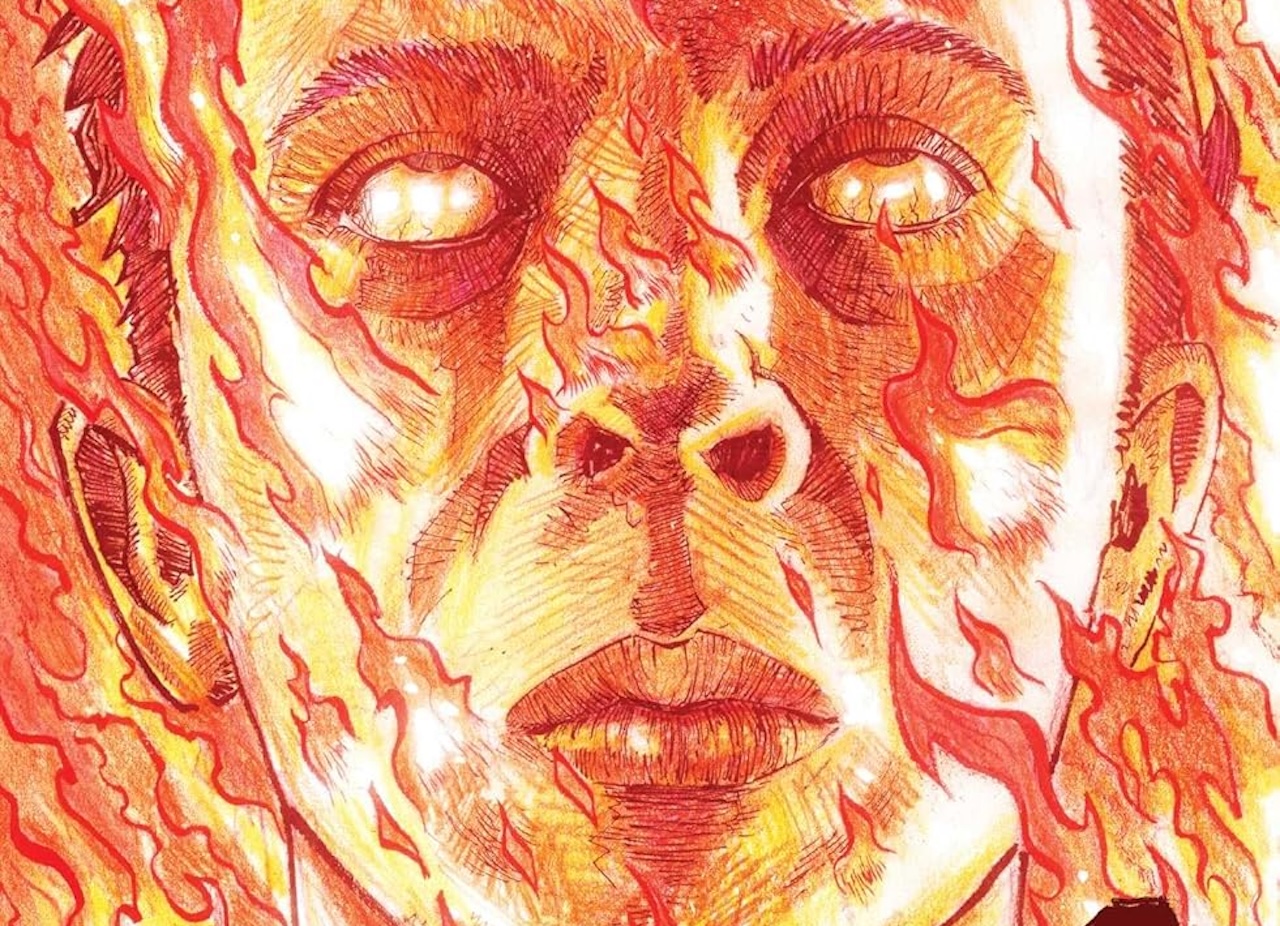
Variant cover by Christian Ward. Courtesy of Mad Cave Studios.
The Maddeningly Personal: The premise of Ted is simple enough — an office worker in a semi-dystopian near future is being surveilled to see if he is, indeed, OK. And with love and attention to spare, Chisholm gives that premise lots of room to maneuver. From his unnerving character design to the frantic way Ted claws and screams after waking from his many ongoing nightmares, you feel the character’s robust desperation.
And that deeply human core means so much: Ted may be this big, artistic achievement, but it’s very much tapping into the doom and anxiety I think many of us are familiar with nowadays. It’s just close enough to our own world that we can connect with Ted in this really elemental way, and that makes the corresponding heights (or depths?) of this series all that easier to handle.
Life With Other Apes: Yet Ted isn’t at all about our lonely little designer. No, it’s as much about Sarah, who is forced to monitor Ted for the same employer (the familiar enough Ayn-Styne). And in that way, the personal becomes something so much more, as Chisholm raises huge questions about technology and interpersonal relationships and the surveillance state — these ideas that can feel nebulous at times but are now heaps more personal and relatable.

Courtesy of Mad Cave Studios.
At the same time, Sarah is no mere literary device but a very real person, and just as she struggles to keep her distance and still help Ted, we too reconcile with our own place in a world where distance is the default and connection feels impossible. Both characters have depth and agency, and yet their relationship plays out in continued service of the larger story.
Art to Crack Open Your Face: Be it Spectrum or Enter the Blue, everyone knows the singular visual identity Chisholm has cultivated over the last decade or so. But with Ted, those skills feel heightened — this is a man who is literally swinging for the fences, and seeing Chisholm’s skills elevate across this book is deeply impressive.
The thing I love about Ted is that you can see and feel the shadows and line work at play — it’s like Chisholm wants us to connect with his presence and understand the gap between the fictional and the real. In the space, then, there’s just enough distance to make for something that’s exciting and playful but that we are still obligated to explore through our own feelings/personal lens.
Be it quiet moments of Sarah tracking Ted, pops of horror with the aforementioned night terrors, or even the weight and thrill of a gnarly car crash, Ted gives us so much to mull over. It’s a book that is both a bowl of visual candy and a world of endless crooks and corners — this thing that you want to engage with teeth a-snapping but still find wondrously overwhelming. In that way, Chisholm has extended this book’s thematic heft in a ways that are utterly intoxicating.
More Art to Crack Open Your Face: OK, I’m not quite done talking about the visuals just yet. The other thing that really shines across Ted is the pacing and how that relates to the visuals. The first half is lots of offices and Ted’s apartment — things that don’t feel initially exciting but give Chisholm a chance to world-build in a really neat way. Then, toward the second half of the book, as the Ted-Sarah “relationship” really picks up speed, there’s so much violence that’s both unnerving but also undeniable. (No one draws fire so darn invitingly as Chisholm.)

Courtesy of Mad Cave Studios.
This build, for me at least, isn’t just effective storytelling; it’s also a chance to almost tell two different stories. One story about two people meeting in one world, and another where they meet in a world of slightly different circumstances. That isn’t just interesting conceptually, but plays further into this book’s interest in making us question reality and our own senses, and that in turn connects us to both Ted and Sarah in refreshing and potent ways. It’s sort of like the device with Sarah leaving a message (serving as a form of narration): It pokes our brain to get us thinking about the true scope of what we’re seeing and how our own uncertainty is exactly what we need to focus on throughout this “journey.”
Cooking Your Brain on Low Flame: In a similar way that the story builds to more “extreme” moments, I also thought a lot about how Ted balances both sci-fi and more grounded storytelling. It’s not just enough that some aspects of this story make us feel like it could be our own world simply a few years later. (I love that aspect as it grounds Ted in literary fare like Neuromancer, albeit more subtle and measured overall.) Rather, I also think that this aspect is once more Chisholm playing with us in the very best way. Which is to say, we are invited to contemplate what’s real, what’s fantasy, and what’s something that’s going to push these characters forward into strange new paths.
This idea that, sure, this could be sci-fi or just horror or something else entirely, and we won’t really know for sure until the characters eventually do. That element once more unites us with our leads in such a way that we need them more than they need us, and that feels like the best, most endearing kind of storytelling I’ve seen in some time. I can’t assume what is or isn’t across the whole of Ted, and that’s as exciting as it is deeply uncomfortable.

Courtesy of Mad Cave Studios.
Social Commentary, Social Wizardry: If Ted does land squarely in our backyards, it happens toward the end of issue #1 when we’re introduced to Noah, the world’s only trillionaire (and owner of Ayn-Styne). As he’s interviewed by a journalist outside a domed city that once housed a war-torn international hub (how’s that for familiarity?!), Noah instantly makes us think of associations to the Elon Musks and Mark Zuckerbergs of our own world. But I don’t think Chisholm is just saying, “Hey, look at these billionaire losers ruining the world” (even if he’s very much doing just that). Instead, this section feels like an end-cap: A nice little teaser, if you will, to draw your eye/attention without ruining what’s down the actual aisle. It’s a way to make this book feel deeply relatable without cutting its wings in such a decisive manner.
It almost feels and is treated like a second story, or even some kind of back-matter of sorts. And through that, Ted grows even wider and robust without taking away what matters: A story of two people in a world they only think they understand/know. The fact that Chisholm has plans to eventually push this “B story” further into our field of vision is another instance of a masterful storyteller taking his time to grow the story properly and methodically.

Again, there’s so much more I could say about Ted. And even what I put down here still feels like I’ve only unveiled one tiny corner of a vast night’s sky. It might take me a handful more deep dive features to truly get into Ted’s narrative might, artistic displays of technical and emotional prowess, and thoughtful dissections about truth, reality, human relationships, and what’s next for our species.
But in the meantime, let’s just leave it at this: Is Ted OK? is magical f**king comics, and you won’t be the same after your own readings.




You must be logged in to post a comment.