


Second issues really are so dang important.
(In music parlance, please see the “Sophomore Slump.”)
And while I’m truly, unwaveringly beating a dead horse by saying it as often as I have by now, the fact remains as steadfast as ever: Stories can absolutely flourish or fail depending on how the second issue pans out. A story’s debut can bum-rush through its own issues/downsides via that initial tinge of excitement, and it regularly takes that added acreage of another issue to ensure that creators are building on what’s working (and addressing what maybe wasn’t clicking).
But in the case of Tigress Island #2, this chapter flourishes because it gives us exactly what worked and even decidedly alters/expands the formula at an important moment in this book’s development.
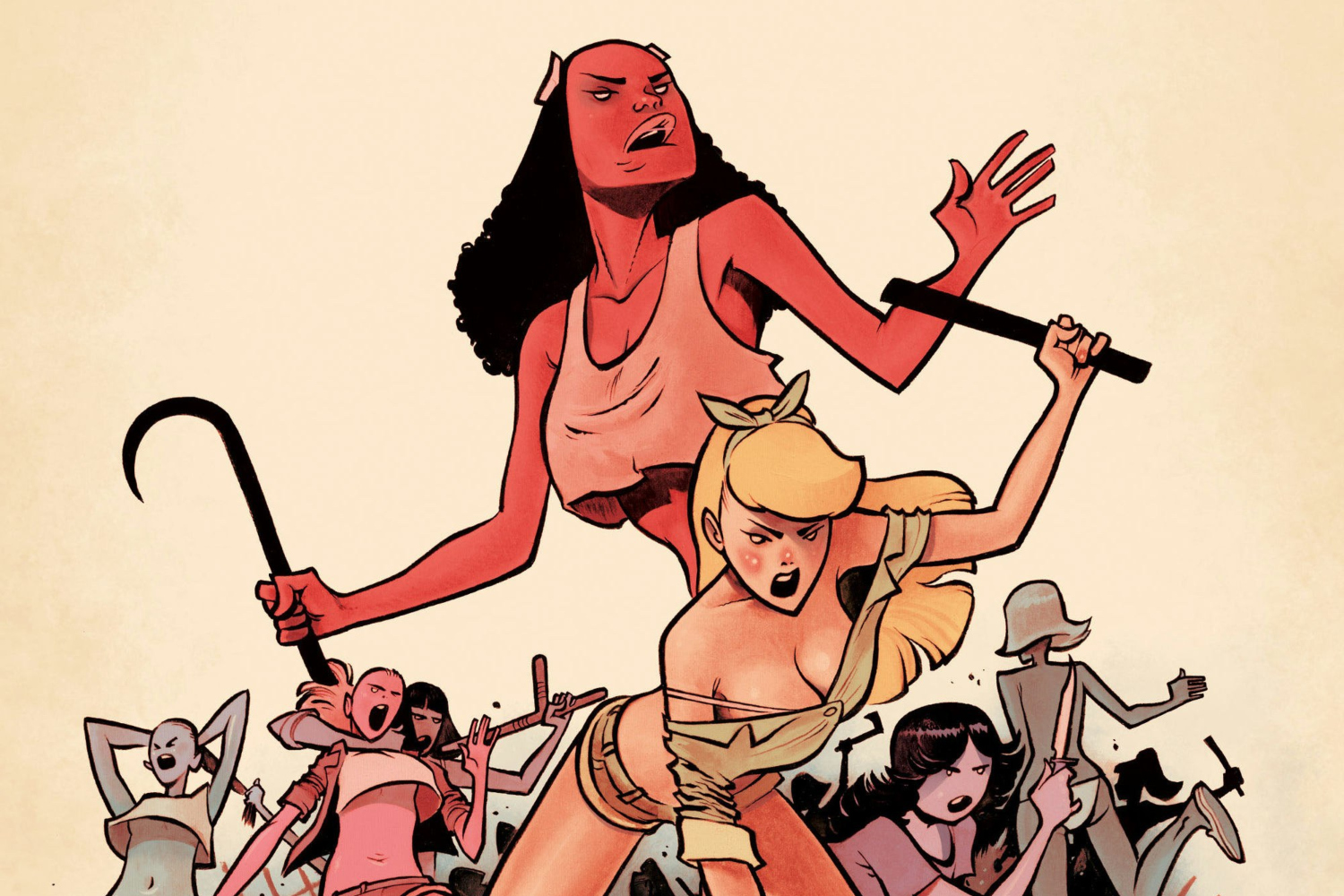
If you somehow missed issue #1, Tigress Island (by writer Patrick Kindlon and artist EPHK) follows a group of women — Bridget, Lonni, Yulia, Hema, Delight, and Vanessa — after they’re kidnapped and taken to a tropical island to be used as sex slaves by some rich dickweed. It’s a very relevant take on early ’90s exploitation flicks, and the creators went for the throat almost immediately with something violent, absurd, and generally engaging.
And, obviously, there’s even more of that in Tigress Island #2. For one, we get more in-scene flashbacks to understand our “squad,” which is a device that continues to 1) help our immersion and 2) unite the girls around common ideas/themes while allowing them to still stand out as proper individuals. (The “theme” of this issue’s flashbacks were how men did them wrong, and that mix of funny, painful, and absolute relevance is this book’s absolute sweet spot.)

Variant cover by Zawayuki. Courtesy of Image Comics.
We also get heaps more violence, and instances that truly stand on their own. At the most “basic” end of this spectrum, the issue ends with the first part of the group’s breakout plan, and it’s an uptick in violence and chaos that is more of that one-two combo of comedy and poignancy.
It’s an intoxicating mixture of sentiments and energies that creates a dissonance like all great exploitation films and really makes our experience varied and challenging (even as it doesn’t seem like anything “complex” is happening). And by complex, I mean the story’s not exactly There Is No Antimemetics Division, but that’s OK because it’s about the humanity pushing this narrative forward and how it makes you, the audience, engage in genuine emotional labor.
Meanwhile, in the middle of the issue, there’s a “hygiene check” that facilitates a different kind of violence. It’s one where EPHK moves away from displaying these oddly cartoonish, nonetheless intriguingly developed characters, and instead focuses on the angles and details of, say, a set of hair clippers. It completely strips the humanity out of the book, and that’s basically the point.

Variant cover by Steve Mannion. Courtesy of Image Comics.
It then becomes about the cold, unwavering efficiency of said clippers, and how it doesn’t care about anything other than cutting hair. And that’s the “humanity” these women faced before the island but especially must absolutely battle now: this thing that’s unfeeling for anyone but its own machinations. It’s a small but mighty approach, and one that really unnerved me for its ability to suck the air out of the room and show us what they’re really facing.
Of course, there is eventually some brevity born of that moment, a chance for a quick laugh or two and for the women to come together to learn about one another and plan for the aforementioned big breakout. That commitment to humanity against all the odds is interesting: Tigress Island doesn’t just want the “team” to be strong, but us as well. They want us to remember that as challenging as this book gets (textually, emotionally, etc.), we can find something of value amid the dingy dungeons.
Be Sure to Read: “An enclave of pain, enlightenment, and sass: Patrick Kindlon and EPHK bring us deep into Tigress Island“
Not that it’s all sunshine and sparkles; rather, it feels like this book settling in such a way that it wants to engage with and even check on us as it goes about its rather complicated, demanding work. That it won’t spare us from feeling these things to work through their social/personal value, and ultimately it won’t treat us any differently than it would our leads. In that way, Tigress Island feels as if it’s grown (or maybe extended) in some important ways as it brings us along more overtly.
Said growth also includes adding new prisoners to the mix, including a young girl from Sierra Leone named Mariana. There’s also some other, unnamed women in the facility, and the tension leads to a confrontation that will shape the remainder of the team’s breakout plans. I love the idea of having more women here: It not only makes sense, but speaks to the depth and intensity of the issues here, and how women have to live in these cages (metaphorical and otherwise) even when their stories aren’t being shared.
And the fact that this “new” group of women also end up fighting with our team is hugely important: Not everyone’s going to gather around and sing “Kumbaya,” and the fact that there’s anger and violence among these women is one way to further respect and never phone in the important discussions being facilitated across Tigress Island. They’re people above all else, and that’s often a messy, emotionally nuanced process that needs to be sussed out respectfully but also with intent.

Courtesy of Image Comics.
Similarly, issue #2 doesn’t try to be “equal” in its development of the core team. Lonni, for instance, now comes off as the de facto leader, which makes sense if we’re going to have meaningful group dynamics. But that makes Lonni stand out, and she’s certainly a bold, compelling soul with heaps to offer the story’s various moving parts. Meanwhile, Bridget really plays more of the dumb, younger sister role, which is just more texture that feels deeply human above all else (and that matters). Meanwhile, Hema gets her own backstory outside the main girls, and I’m curious about her in a way that didn’t exist before.
Sure, these decisions are important for the overarching story in this issue, but it also shows that the creators aren’t afraid to move around this world a bit. They’re OK to let some stories shine over others because it feels thematically appropriate to not let everyone have a voice every time. Tigress Island may be about respect and lending voices to those who need it, but it’s just as much this tight, streamlined storytelling experience, and that counts for so much of our immersion.

Courtesy of Image Comics.
And in terms of giving folks a proper spotlight, there’s even some brief insight into the “warden” of this jail (who I’m going to refer to as The Mistress given she hasn’t been given a name just yet). Now, it’s not a ton of backstory; it’s really more of a chance for her to show off her innate cruelty and nihilism. But it lends just the right kind of emotional depth and maybe even sympathy. OK, maybe the closest we can get to sympathy without landing on that exact word.
Because it’s not that you feel bad for her, but that you understand how these systems of power work and that even victims can be given a modicum of power to further perpetuate these structures. Or, that just because someone is of your ilk doesn’t mean they somehow share your ethics/worldview. (Same with the confrontation with the other prisoners; these power dynamics are real and ugly.) The Mistress should care, and she relishes not caring at all, and in that we get a villain with real legs.

Courtesy of Image Comics.
The Mistress is, in short, a shining example of how Tigress Island never flinches and always, always moves forward. With a villain we can understand, the world is all that more robust and demanding, and it calls for us to work even harder to truly engage with this story and what it’s trying to do.
To make it easier (for example, making The Mistress a mere stereotype) would be insulting and belittling for everyone. Instead, the book never ceases in its efforts, and it leans into something as much as it stays open and ever-evolving just to get us into this world feeling all that more excited and desperate.
Whatever moves and configurations it has planned for the rest of the series, Tigress Island has nailed its second issue with gusto, grit, and the right amount of charm.




You must be logged in to post a comment.