

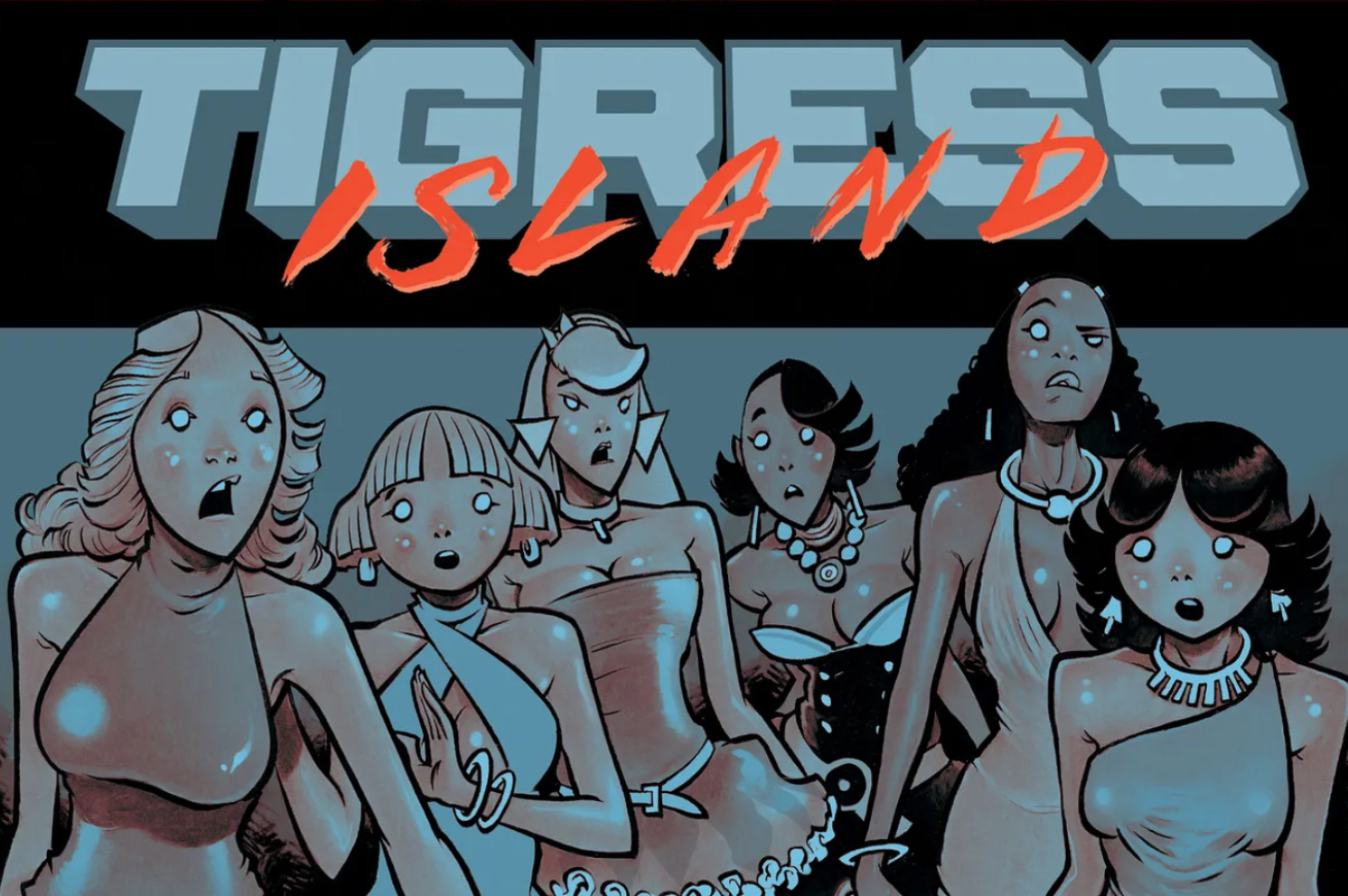

If you want to truly understand Tigress Island, you need only comprehend the titular animal.
Seriously.
Just follow me through the bush and trees…
The Deadliest Weapons
Here, writer Patrick Kindlon and artist EPHK have joined forces to celebrate the wonder of exploitation films, with a special focus on the late ’80s/early ’90s. We follow a group of “down-on-their-luck actresses” who find themselves stuck on a distant island “run by a sadistic female warden.” With no hope of rescue from the outside world, the girls must work through their trust issues to get out alive.
And oh what a team the creators have assembled. There’s the bright-eyed, overly eager Bridget; the cooler-than-1,000-cucumbers Lonni; the hard-edged, no nonsense Yulia; the somewhat mysterious (at least for now…) Vanessa; the smart and easygoing Delight; and the glamorous and worldly Hema. Each one is cast as both the “vapid ingenue” and the textured, nuanced leading actress, and in that chasm of context comes the very best kind of characters. Tigress Island is powered by that very kind of tension, and our “team” offers ample opportunities for gags and cutting dissections alike.
Still, you likely heard “exploitation film” and perhaps groaned and/or eye-rolled the full 360 degrees. But both creators see their chosen “genre” as having actual depth — EPHK likened it to “The Dirty Dozen, but directed by Russ Meyer.” Not that they necessarily tried to be so deep with it, mind you.
“I know I’ve itemized a lot of frustrations with the current state of comic book writing, and I’m sorry for my petulant nature here, but perhaps my biggest complaint is the intent to be profound is really off-putting to me personally,” Kindlon said.
Which is to say, you can have thoughtful, meaningful stories, but they don’t have to be so obvious or overt. A tiger may have stripes, yeah, but they’re more for camouflage than for advertising anything.
“I am a person who makes things for a living, and has for a long time,” Kindlon said. “And I believe that anything that I’ve done of any value whatsoever has been by accident. It has been a subconscious thing that has emerged in what I’ve made. And that I did not become fully aware of what it meant even to me until after its creation.”
Case in point: 1974’s Deadly Weapons, in which a “woman with a big chest uses said chest to suffocate men,” according to Kindlon. Citizen Kane it ain’t, but that doesn’t mean it’s still not important.
“Now is it possible that that is a feminist commentary? Is it possible that it’s a commentary on the commodification of women,” Kindlon said. “But my hope as I watched this stupid movie is that maybe the person who made it did not intend for anything except ‘I have a silly idea that I want to manifest in the world.’ And then, 20 years later, they watched their own movie and said, ‘God, this is about my mother.’ Can it not be both? It should be both.”
His creative partner, meanwhile, looks at in a similar but slightly different manner: Tigress Island may be “direct,” but that’s the point, right? It’s like a tiger going hunting: closing the gap and striking you right where it’s most efficient/meaningful.
“I say simple. It’s not simple, but maybe the structure is pretty simple,” EPHK said. “Like, we’re going from one scene to another. But then something else comes out of that is much more…I don’t want to say political – more human. There’s many more layers that come through it that were maybe not planned and we should let them exist because they’re part of the project.”
Kindlon also frames it in terms of his own creative heroes, including the “didactic and intention-based” Pat Mills.
“If you didn’t love Pat Mills, I would not blame you because he can be difficult to get through,” Kindlon said. “And I aspire to be the opposite…only on reflection do you see that there could be something more to it. And you give me the credit. Of course, we give EPHK the credit as well, but I’m saying…you give me the credit as a writer to assume that.”
Tiger Bros

Main cover by EPHK. Courtesy of Image Comics.
And since we’re talking about collaboration and teamwork, maybe now’s the perfect time to discuss how the duo actually got together. Because, unlike other big cats, tigers mostly go it solo — and EPHK intended to keep it that way.
“[Kindlon] asked me to do a few covers, and then eventually you asked me if I was interested in doing some pages,” EPHK said. “And I immediately said no. I always say no. I don’t want to work with any writers. The only reason I do comics is to tell my own stories. But then we [kept] talking and you wouldn’t give up and you continued sending me ideas.”
So, what won EPHK over so that they might’ve formed an unofficial “ambush”? As Kindlon tells it, it’s less about his creative skills and more his “salesmanship” (honed, in part, as the frontman to the wonderful punk band Drug Church).
“EPHK is not the only gentleman I’ve convinced to do work who otherwise did not want to do work. Atsuji Yamamoto, who I’m working with at the moment, took a lot of convincing,” Kindlon said. “And, look, this is not ass-kissing; it’s a real sentiment for good reason. These are gentlemen who don’t need writers necessarily. It’s a nice pit stop on your career.”
And it really isn’t, as Kindlon so succinctly put it, about “ass-kissing.” Rather, it’s an awareness by a writer that a certain level of deference is required in the name of making great comics. That if their team (or “temporary, non-breeding social group,” if you’re so inclined) is going to survive, they must recognize who is doing what work and why and when.
“I think that writers in the past 20 years really have known that their primacy has been unchallenged in the direct market,” Kindlon said. “And I’m grateful for that. I love a well-written story. But it’s a false pedestal; it’s not real. I think that without looking like a servile worm…I break my brain for two weeks. This man breaks his back for five weeks.”
Kindlon said that issue of “primacy” means that many writers become a “perpetually insecure creature because obviously it’s not their work that a person is flipping open the book and being immediately grabbed by.” But he’s a tiger, gosh darn it, and he knows when to let someone else get the kill.
“The way I handle it is to not be insecure. I’m just deferential,” Kindlon said. “If EPHK says to me, ‘I really think this needs to be at night because I believe that this will be most evocative if there’s moonlight on the wet leaves…’ there’s no part of me that would ever go, ‘It has to be daylight, sorry.’”

Variant cover by Kaladen. Courtesy of Image Comics.
EPHK agrees — to an extent, of course. He said that while he may be “physically be putting a bit more in right now,” it’s ultimately about the teamwork. Without Kindlon, EPHK knows he’d have to survey the entire jungle himself.
“Most of the books that I’ve done, all the books I’ve done before, I wrote them myself,” EPHK said. “The ability that I have to be able to not spend any of that time on that – the concept we talked about together – but to get the scripts and then to…know that I can depend on them. So many times I’ve had a hard time seeing where everything is going. But I know after two-and-a-half issues, I can blindly just follow the script. Once I’m finished, once it’s all colored, and I can read it for the first time and it f**king lands. The beats are perfect.”
And you can’t deny the results. EPHK said that he’s “never worked so much and been so stressed and so forth, but at the same time, they’re my best f**king pages. And every night I’m looking back because I’m having so much fun.” Kindlon, meanwhile, says he’s enjoyed leaning into his “high level of trust in this man,” adding, “I’ve been really writing abusive pages, just pages that are almost physically possible.”
And while these two comics tigers aren’t quite done with the five-issue run, and more sprained muscles are coming down the pipeline, Tigress Island will absolutely reflect their little back-and-forth.
“Even though you’re putting in a lot less work now, it’s worth so much to me because the work we’re putting in now is going to stay with us for a long time. This book is going to be republished,” EPHK said. “These pages we do, they’re out there for a while. So, it is a collaboration. It’s on different levels, like 3D chess, I guess.”
Battling The Audience

Variant cover by EPHK. Courtesy of Image Comics.
If I were working with the metaphor of lions and not tigers, I might now ask a question like, “And just what kind of kingdom might they be trying to eventually lord over?” But even if I’m not mixing my metaphors, Tigress Island is still very much the end result of this kind of obvious legacy building.
And that has almost everything to do with crafting the exact kind of story they want to tell. (Sort of like how all tiger stripe patterns are as unique as snowflakes? You get it.)
“The real meat of the story is all EPHK, because it’s all this perpetual movement in one direction after the first issue,” Kindlon said. “And even the first issue has the movement to the island. So really the whole thing is just movement, moving forward physically in so many ways.”
Part of the core momentum of Tigress Island is facilitated via the dialogue, something that EPHK has been a fan of since Kindlon wrote Frontiersman.
“The beat of a story is the most important thing in comics. And most of our book, the beats are based on the dialogues,” EPHK said. “So that’s the magic. That has allowed me, for the first time ever, to be able to put 100% of my energy on making cool layouts, good art, and good colors. And I can just blindly trust wherever the bubbles are supposed to be wherever.”
You feel it across Tigress Island #1. The girls’ share so much background and context in these whip-sharp conversations, and each person comes alive through their own tones and patterns. It’s very much where the exploitation comes in — it’s all snazzy insults and lines with big drama (but elevated, of course). If nothing else, at least it’s not damn narration.
“In the last year, I’ve discovered that I hate narration,” EPHK said. “I found very rare examples of narration that works, but it’s very limited and very subtle. There are too many American comics with endless narration.”
EPHK added, “Because that destroys the beat – that’s the anti-beat. The way I see it, the comic has to read itself. You have to forget that you’re reading it. You’re into the story. A really good story, you don’t remember if you saw it as a movie or if you read it as a comic.”
Kindlon is very much of the same mentality: Narration is a crutch we routinely don’t require.
“A lot of Americans get hung up on narration as a tool of the story rather as a tool of the atmosphere,” Kindlon said. “And I think that’s what I get hung up on. And not to be too much of an asshole, but could some writers also maybe use it as a tool to show that they can write prose?”

Variant cover by Luana Vecchio. Courtesy of Image Comics.
Fun fact: tigers use both a roar that can be heard two miles away as well as quieter “chuffing” that can even “paralyze” their prey. No buffet of meat is won with just one tool, ya dig? It’s a concept EPHK is especially cognizant of given his past works.
“So I think that some of the most effective narration is describing,” EPHK said. “If the correct writer is on those books and tells you what insects are making noises and tells you what things are rotting that you can smell. I think that’s effective narration.”
EPHK added, “And my last book, Harpy, there are huge chapters that are just silent; no dialogue. So I tend to tell the story purely visually. And I think the mix of that, of my reflex to try to show things visually happening and Patrick’s super sharp dialogues, I think is going to create this weird mutant that I think will be interesting.”
Ultimately, it’s about sustaining immersion for as long as possible.
“I don’t want to get out of the story. I want to read the story,” EPHK said. “I think absolute immersion is the captain’s box explaining the character. I could say, ‘Chris Coplan, 38, has IBS.’ There’s a visual way to convey all of that.”
(For the record, I’m 40, and I just eat far too much dairy.)
It’s about, as EPHK further explained, “choosing your battles.” Not every tool/approach works every time, yeah, but also sometimes your “prey” (i.e, the audience) has to feel like they’re in charge. Even just least a little bit.
“That there are some moments where you need the reader to be at a more precise place, but many other places, where just showing a direction, is enough and the reader will do the rest,” EPHK said. “And the reader will fill in the blanks with their personal stuff, which is even better for the story because it makes it more personal to them. You should concentrate your battles where you’re trying to show very precise things for only the very important things in the story.”
As The World Turns

A character study of Bridget. Courtesy of Patrick Kindlon and EPHK.
Of course, Tigress Island has its fair share of “tricks” in taking down its prey. In-scene flashbacks are just one of them — without taking us away from the “present,” we get a snapshot of the girls’ background or some other humorous moment to temper our immersion. It’s a bit of handy context that also makes sure the story moves swiftly and efficiently.
“I’m glad you enjoy those flashback elements because – and I’m not taking shots at my peers or my superiors – it’s just a matter of taste,” Kindlon said. “Comics being a visual medium, I’m often shocked at how you will have two characters in an extended conversation. It’s maybe a medium shot, close up.”
That’s why Kindlon likes a pro like Mr. Hellboy himself, Mike Mignola.
(Editor’s Note for 3/10: We’ve changed the word “broad” in the following quote to “frog” per subject’s correction.)
“Mike is a genius at this because he uses those moments as an opportunity to generate more vibe, and to show the rest of the room,” Kindlon said. “What is this frog doing? What’s the statue? Because he intuitively understands that two people talking for a page is a waste of a page and that there has to be something visual.”
It’s a feature that comics uses so well, and that some other mediums just aren’t as effective in maintaining or emphasizing.
“I made fun of that one of the Batman movie…because Christopher Nolan had so little faith in the viewer that the one time that people have an extended conversation, it’s Commissioner Gordon and Batman [and Harvey Dent],” Kindlon said. “He rotates the camera around them the entire time so that there’s always physical movement. This conversation in which there is no physical movement. They’re just facing each other, but it spins around them because, and it doesn’t seem to represent anything.”
And, sure, that’s annoying to an extent, but Kindlon can’t blame the Nolans of the world, either.
“It’s the right instinct,” Kindlon said. “Like, why are these two people talking? Unless I’m going to get an emotional beat out of their faces or their body language, I have to reward the audience with something worth looking at.”
It goes back to picking your battles, absolutely, but it’s also a recognition of what makes comics so singular and unique in the first place.
“There’s the other aspect of it, which is what comics can do that books can’t — tell a story and show you something else,” EPHK said. “Because in the novel version, there is no flashback. We would have to describe it. So we have to stop saying what we’re saying.”
EPHK added, “But you [also] brought in the opposite, which is what comics can do that movies can’t — you can just stop and just look at this picture…and pick back up whenever you’re ready. And so I think it’s good for comics.”
So, if you truly know your chosen medium, you know why people came to it in the first place. From there, you can give them exactly what they want, even if folks don’t always know what that might be at the onset.
“You don’t give readers enough credit, so the work becomes a little bit more accommodating to a casual read or a surface read,” Kindlon said. “And then you develop a reader who only is capable of that. You see this with film very obviously. You can get studio notes to death, executive notes to death where…at the end, you’re explaining the same thing multiple times. There’s no rhythm to the thing and there’s absolutely no space for ambiguity.”
“Don’t Tell…Amadeus?”

A character study of Delight. Courtesy of Patrick Kindlon and EPHK.
Here’s a good instance of these two tigers showing exactly how they hunt. Because as they tell it, they invited so much ambiguity into the process that they didn’t even know they were telling an exploitation story in the first place.
“I find a lot of the stories most of the time tell themselves,” EPHK said. “Or not tell themselves, but they become themselves. You tell them, but they take their own [feeling]. When we started talking, we were like, ‘OK, we want a few things.’ And we were like, ‘Andy Sidaris and all these…straight to video [titles].’”
The story took shape, then, when they trusted themselves to find something of meaning and power, and to hope that that same “energy” would bring readers firmly along for this jungle cruise.
“Nowhere did we have this story in mind,” EPHK said. “This story came out of [Kindlon’s] brain mostly, but you know what I mean? I’m sure that a lot of the stuff that came out were results of things that previously weren’t planned from the beginning with very loose concepts of how it should go by the fourth or fifth issue. And I wanted it to go weird and we wanted this and you brought in this and then something else came – and it’s something that we couldn’t have done either of us. And that thing is the book.”
And by “discovering” the exploitation angle, the creators were able to bypass a lot of the early issues of writing a story and instead fully emphasize the things they wanted (like dialogue over narration, for instance).
“I’m sympathetic to the writers that you’re talking about – folks who say, ‘This is Don’t Tell Mom the Babysitter’s Dead meets Amadeus.’ And you go, ‘OK, well, I know those two things, so I guess,'” Kindlon said.
Added Kindlon, “Our book is execution. I think that by choosing this exploitation milieu, we gave ourselves a hook that we don’t have to explain much more. Our genre does that for us. So we get to just execute. Because we chose something that when you see it visually you go, ‘Oh, right. I went to the video store. I watched television late at night.’ You understand the genre as a thing, and then it makes it so people are either in or out.”
Still, it’s not just enough that people are “in” or “out.” Because in the case of Tigress Island, the story “structure” might make for maximum immersion, but the subject matter can be another test entirely.
“That’s another filter to our readership – people might look at it and go, ‘I really hope to God they’re not making fun of something serious,’” Kindlon said. “I’m never making fun of any human misery. But there is a way to process so much of the ugliness of this world in ways that are life-affirming and you come out to the other side of them. And some of that is people do it through humor.”
Because the creators recognize that an island of kidnapped women fighting for survival isn’t going to be an easy sell for a lot of folks.
“Telling that story and putting that story first is one way that people get through these things. And then there’s the exploitation genre, which is often about the ugly threat and the almost ‘Abbott and Costello’ approach to escaping that ugly threat,” Kindlon said. “And that is where our book falls to a large degree. The threat is sexual exploitation. That’s an ugly thing, right? So making that palatable to an action adventure story is a hard job in some ways. If we can pat ourselves on the back here, I think we did a hard job.”
The Center of Pain

Courtesy of Image Comics.
Both Kindlon and EPHK are putting their mouth (full of sharp tiger’s teeth, of course) where their money is and then some. Because when they talk about the heaviness of Tigress Island‘s subject matter, it truly doesn’t get much heavier.
During our hour-long chat, we inevitably touched on an important but mostly unsavory topic: the real-world comparisons regarding Tigress Island. You can’t have a story about sex slaves escaping an island without instantly thinking about Epstein Island.
“I can’t decide if this is really good for the book or really bad for the book,” Kindlon said. “I’ll say this because it wasn’t on purpose, right? We started talking about this a while ago. I think it was already going on like it was, but it wasn’t front-page news. It was just this crazy thing. It’s going to be hard for anybody to pretend that there’s no link, but there is no link.”
But even if there isn’t a direct link, the creators aren’t shying away from people’s natural reactions. The book was “never intended to be a reflection of any specific incident,” and while the Epstein case is a unique beast in and of itself, the “narrative” is familiar enough (even if, once again, the depth and scope is singularly, existentially unsettling).
“There’s a number of movies specifically from the late ‘70s that have an ugliness to them,” Kindlon said. “They’re obviously feminist commentary in their own way, and they are about exactly this, right? So this idea of wealthy people, or otherwise elites, exploiting women in circumstances that physically they cannot easily remove themselves from – it’s a trope in exploitation fiction because it’s real.”
Added Kindlon, “And I don’t mean specifically Epstein Island. What I mean is this notion of isolating vulnerable people for the sake of exploitation. Now, it’s a funny thing for us to land on as a topic because exploitation, the genre, is by its nature talking about heavy things in a light way. And a lot of people right now are on the fence if they want something light regarding topics that are so serious to them.”

Courtesy of Image Comics.
But just as they hoped regarding other key aspects of Tigress Island, Kindlon and EPHK truly believe that the right audience can enter the book with the proper context and perspective in mind.
“We hope that our readers give us the grace to understand what our intentions are,” Kindlon said. “Everybody has somebody in their life who was probably not on Epstein Island, but relates very well to the idea of, ‘I was in a situation that I could not escape, and where somebody was taking advantage of me.’ Watching it on the news is impactful in its own way.”
It’s a level of honesty and commitment that Kindlon further maintains in other, non-Tigress Island ideas/projects.
“I’m doing a hardcover on Kickstarter right now that is about real people who were murdered, [and] who were sex workers who were almost uniformly women of color,” Kindlon said. “Do you know how hard a needle that is to thread for a white comic book creator? I want to give the reader the respect that I hope they will give me in return, which is, ‘Hey, I’m telling a story because it fascinates me. And because there’s something in it that I feel my brain wants to expose.’”
It’s a belief, then, that we can touch on these especially sensitive and complicated subjects with decency and intent. And in doing so, we’re not just entertaining ourselves, but affirming something deeper about the human condition.
“You want [someone in] The Handmaid’s Tale to find a machine gun and kill everybody,” Kindlon said. “Even if this only manifests subconsciously [that] you’re rooting for the underdog in this circumstance, that’s good. If you’re a normal person, a healthy-minded person, your desire for justice manifests as you rooting for the character that you feel has been done wrong by. And that is, to me, whether it ends well or poorly for that character, the commentary perhaps of this book.”
The Not-So-Silver Age

Courtesy of Image Comics.
As we’ve seen, reading Tigress Island is going to require some truly hard work from its future readers. And while Kindlon and EPHK understand the story won’t ultimately be for everyone, there’s another interesting thread here worth discussing. It’s one that respects people’s sensitives and the like, but also understands that, like the exploitation bent of the story, perhaps Tigress Island is meant for a certain crowd. And that’s totally OK.
“I’m starting to believe that there are major generational differences where I almost can’t assign something of value judgment, like good or bad, because it’s beyond my understanding,” Kindlon said. He added that “what strikes us as completely normal dialogue would read too chatty and inane” to folks of another generation.
But he’s not just discussing the dialogue yet again, and to hone in further, Kindlon recounted an interesting story. He was recently speaking with a friend/cohort who is maybe 10 years younger. They were talking about one semi-popular creator, someone who Kindlon just can’t connect with whatsoever. (“I think it’s a very tin ear that this person has,” Kindlon said.) However, his friend said the creator’s work “speaks to my sensibilities,” with the person adding (per Kindlon that “what rings as tin and a less nuanced back and forth is…what feels stale to you reads super clearly to me and people my age and people who are also autistic.”
Sure, you could just excuse it as another instance of “old man yells at cloud,” but it’s an important recognition that there are clear differences between audiences. And for all the creative team’s talk about what this story does so well, this aspect is a huge component of the book’s “success” so far.
“I found it really fascinating because I was just sitting here going, ‘This is terrible,’ but that reads like [David] Mamet to this guy. It reads perfectly because it doesn’t rely on entendres,” Kindlon said. “There’s no lack of clarity between people. So in neurotypical conversation, there’s a lot of latitude given to double meaning, to potential sarcasm. And so much of what we’re conveying to each other is actually below the words. But his point was that that’s really difficult for him to divine out of a piece. And he loves this new generation of writer that is more literal, more direct in his view.”
And it even goes the “other way,” if you will.
“Certainly Silver Age comics can read very differently than modern comics, right? They just do,” Kindlon said. “And then there’s this return to literalism that is going on right now that is not to my tastes, but maybe it speaks to a younger person much more than it would me. Roy Thomas is very difficult to do as a younger guy. And I’m sure that it becomes even more strange and unknowable to people younger than me.”
Added Kindlon, “Let’s say [age] 35 to 45 is right in the sweet spot for a certain type of Mamet. After that, maybe guys like [Joss] Whedon…that we absorb through other pop culture and manifest in our work.”

Courtesy of Image Comics.
It’s the recognition of these differences that Kindlon thinks is especially important. Not only for properly contextualizing Tigress Island and what if offers, but bringing something back to comics beyond the release of one funny, thoughtful book.
“In the 1980s, we hit a place where we could safely be alongside prose literature,” Kindlon said. “And to have that same esteem, even if we understood that the medium was different. There was still that esteem because the work had things like ambiguity, which real writing does.”
Kindlon said that in recent years something has been lost that is “very much to our detriment as a medium, [and] we don’t seem as serious.” And he doesn’t mean subject matter – “EPHK and I are doing a fun exploitation thing” – but rather that making “funny books” doesn’t inherently mean you have to be so limited in your approach or subject matter. We’re still tigers, dammit!
“There’s room for ambiguity. There’s room for interpersonal exchanges that are not on the nose, that don’t simply service the story,” Kindlon said. “If you have an inferiority complex and believe that you are beneath, for example, prose literature, you’re doing it wrong. I’m not saying you should even aspire to that, but you should never assume that you can’t.”
The Tigress Island team don’t want to makes stories where “character is often informed by the throwaway line, the unnecessary bit, the thing that does not move the story forward and it moves the character forward.” Instead, it’s about shooting for so much more than the these mere “scraps” other gorge themselves upon.
“I think that we’ve gotten so far away from that in comic books in the last 20 years that it’s very discouraging to me because not everything has to be in service of the story because not everything has to be in service of the plot,” Kindlon said. “Sometimes vibe and character are more important by far. We had an idea, but the idea only becomes a story because you put these characters in and you create characters and they exchange with each other and interface with each other. And from that comes the story.”
The Great Human Revolution

The cover for the second print run of issue #1. Courtesy of Image Comics.
Yet the significance of Tigress Island isn’t just about this “revitalization.” Nor is it about inventive storytelling and creative techniques; great character work and dialogue; and/or having ample fun with gallows humor.
No, Tigress Island is very much about reaffirming our humanity.
Yes, we’ve been talking about tigers this entire time, but hear me out once again. In a story with this many layers, and context galore, it’s about engaging with the characters. Both Kindlon and EPHK said they’re “Bridget girls,” because without revealing too much, she is “the enduring optimism, and the inner child type of thing” (per Kindlon). But our singing writer also has a soft spot for Julia, adding that as “we get a little bit more of their background, and as the story progresses without any maudlin moments, it’s [Julia] who remains who she is.”
And that brings Kindlon to an odd, seemingly unrelated story about a former “asshole” boss. But said personal yarn actually speaks volumes about everything we’ve touched on and Tigress Island just as a whole. Because even the worst, most nasty tiger is still just a cat. And even the worst, most nasty person is still a dumb, scared ape. If you take the time to get to know someone at their absolute most ugly/mad/scared/terrible/etc., you just might be surprised what you’re really getting to encounter.
“He raised his voice to me so many times, and I couldn’t quit the job,” Kindlon said of his old boss. “One time I just tried relating to him on a human level. And I said, ‘Are you all right?’ He opened up about his childhood in a way that was incredibly informative…he had to interact with his brother who he had not seen in years. They had a terrible thing happened to them. Now, it doesn’t mean he was right to yell at me, but it informed his character in a way that I had not experienced previously. And he became more of a human being to me in my life.”
Tigress Island #1 is due out this week (March 11) via Image Comics.



You must be logged in to post a comment.