

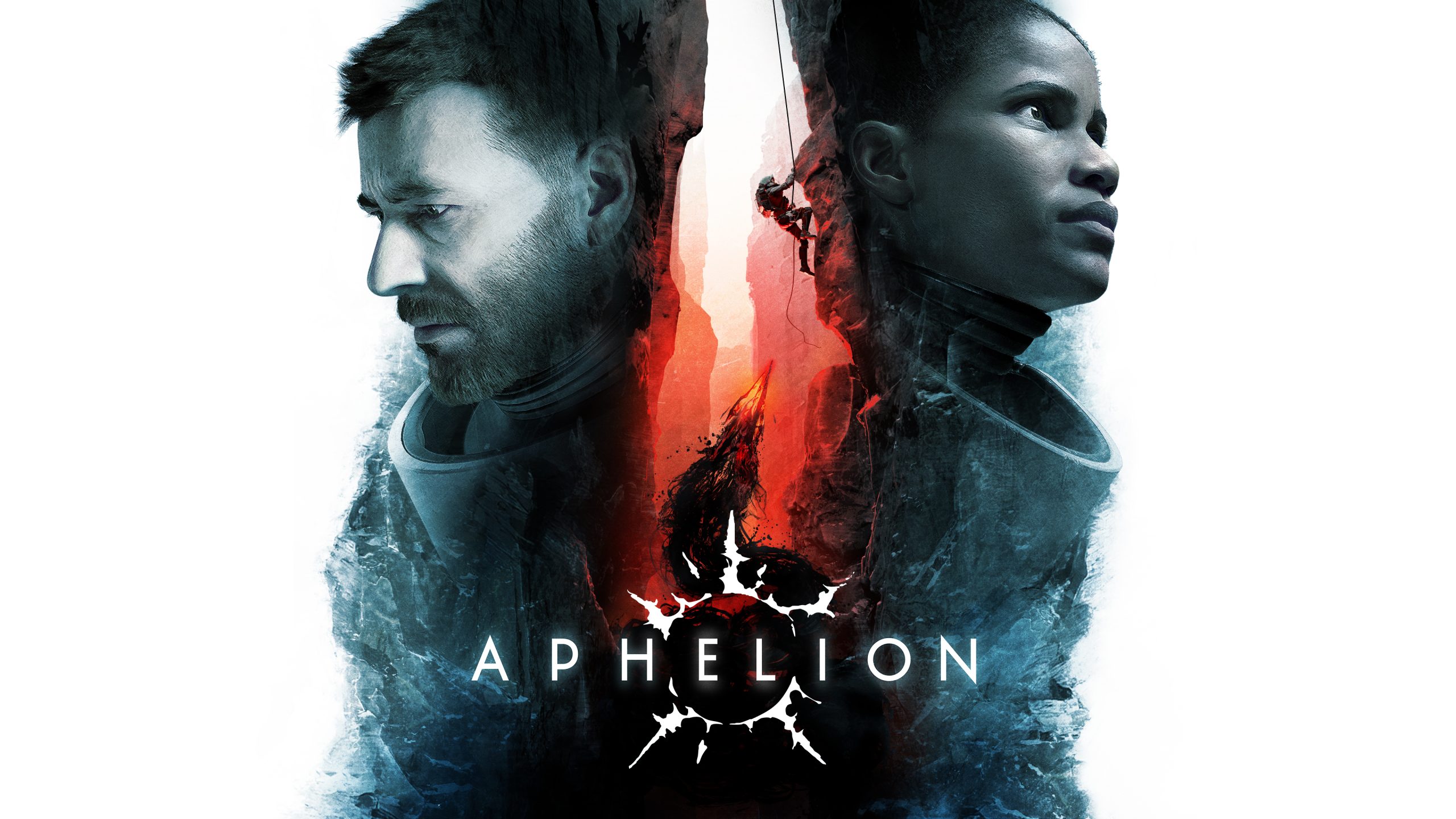

Aphelion, a new sci-fi adventure from DON’T NOD (Life is Strange, Jusant, and Lost Records), has a fair bit to recommend it, but is, ultimately, frustratingly unsuccessful. The opening hours are solid from a gameplay and narrative standpoint, and build to a compelling peak at the game’s mid-point. Its climax, however, is undone by an unwelcome combination of imprecision, jank, and poor set design in gameplay and a late shift in narrative focus from what had been the game’s core to a comparatively underdeveloped side element. What makes these failures all the more frustrating is that they’re tied to admirable, and often impressive, creative ambition.
At its core, Aphelion is a platformer. Dr. Ariane Montclair (Vanessa Dolmen, The Wreck), one of two astronauts on the European Space Agency’s Hope-01 mission, must traverse the frozen planet Persephone using her wits, her athleticism, and her growing understanding of the planet’s unique electromagnetic field after her ship is wrecked in the game’s opening. Her journey is fraught with peril. Brittle ice threatens to give way if she moves across it too roughly. A jump between handholds while scaling a wall doubles as a jump across a chasm so deep that it might as well be bottomless. Braving a storm means darting between spots of cover while exposed to lethal cold.

While platforming is the base and primary component of Aphelion, it has two other major modes: stealth and adventure. The stealth sequences are integrated into Ariane’s platforming chapters when she encounters an aggressive, hostile alien lifeform that seems to be actively hunting her. The adventure sequences see the player take control of Ariane’s badly injured crewmate, astronaut Thomas Cross (Eric Geynes, The Walking Dead: Last Mile), as he explores an unexpected human-made base on Persephone.
In terms of gameplay, Aphelion is a success with caveats as a platformer, is interesting but stilted as an adventure/exploration game, and mediocre to bad as a stealth game. Ariane’s platforming toolkit is simple and effective. She has her athleticism and her skill as a parkourist; a winch, which serves as a climbing rope, a way to build momentum for longer jumps, and an improvised grapple for tearing down obstacles; and two scanners, one she uses to track her distance to her objectives, and the other she uses to analyze and interact with the currents and knots of Persephone’s electromagnetic field.
Ariane’s journey across Persephone requires 3D navigation; backwards and forwards, up and down, based on where she needs to go and what her options are for getting there. These sections are where Aphelion shines, particularly the climbing, which is consistently smooth, elegant, and tense; and the blizzard, which gracefully integrates a ticking-clock mechanic from Thomas’ adventures as Ariane battles not only severe weather but a night of the soul.

The biggest issue with Aphelion’s platforming sections is that, while the core traversal mechanics are polished, some of the gameplay surrounding them is imprecise and janky. When Ariane stands by a ledge that she can climb down, Aphelion offers a prompt to push a button so that she can mount the wall. In practice, this repeatedly required multiple button pushes. By contrast, her grapple releases from being attached on a hair trigger but takes longer to attach or re-attach, which can lead to Ariane falling to her doom despite frantic button pressing and the presence of the prompt indicating that, in theory, it should still be possible for her to attach the grapple.
The awkwardness is also present in Thomas’ adventure sequences. Thomas doesn’t have Ariane’s range of movement, since he’s both badly injured and dependent on the limited range of the mysterious base’s external oxygen tanks and their hoses. Managing his rapidly draining emergency oxygen supply as he moves between tanks is his key challenge, but they’re hampered by the fact that the “release hose” button is finicky. It’s a minor, but consistent issue that breaks immersion and interrupts the narrative flow of Thomas’ chapters.

The stealth sequences, however, start mediocre and grow steadily more irritating until they bleed Aphelion’s climax of its fun and its dramatic impact through sheer frustration. Past a certain point in the story, Ariane will encounter the Nemesis, a smoky alien serpent that tracks its targets through sound or physical contact. The Nemesis is aggressive and, if it catches Ariane, instantly lethal. She can sneak around it, and temporarily distract it by using her scanner to trigger a distraction, and if worst comes to worst, run.
On paper, Aphelion’s stealth sequences are built similarly to its platforming. Ariane has a set, but flexible toolkit that she can use to accomplish her goal, be it scaling a mountain or evading the Nemesis, and succeeding in Aphelion requires creative use of those tools. In practice, the stealth sequences follow a set pattern: find the distraction, trigger it, and slip past the Nemesis to the next section of the encounter arena. This wouldn’t necessarily be a bad thing, since a highly managed set piece that’s thrilling is still thrilling. In Aphelion’s case, though, the similarity of its assorted Nemesis encounters makes their jankier aspects all the easier to notice.
While the Nemesis has set rules, it’s drawn to sound, and physical contact with its beak will result in an instant game over; they are implemented messily. It’s hard to tell what exactly the creature’s range of hearing/vibration detection is, and it isn’t clear whether physical contact with its body, rather than its beak, will trigger its attack. Worse, the distraction will, at times, not seem to work, and not because of player error.
At their worst, Aphelion’s late-game Nemesis encounters are an exercise in aggravation, less a puzzle to be solved and a challenge to be overcome than a timesink that means seeing the same death animation over and over again until the game cooperates long enough for the player to muddle through. While there are two solidly designed encounters with the creature, one early and the other at the midway point of its run, more often than not, the Nemesis’ arrival means that Aphelion is going to bog down until it’s gone.
This, unfortunately, includes Aphelion’s climax, which prioritizes stealth over platforming while introducing a sudden new mechanic and some confusing set design. Part of the climax requires crossing terrain that had previously and recently resulted in an automatic game over. There is a visual indicator that the terrain is safe to traverse, but it isn’t noted, unlike other navigation challenges, where Ariane or the game itself will call attention to where and how she can move. It’s strangely obscure. This, combined with the overprioritization of the game’s weak stealth over its solid platforming, makes what should be a tense, exciting climax a chore.

Aphelion’s storytelling and character work aren’t as disappointing as its game design, but they leave a lot of interesting potential on the table. Ariane and Thomas are likable enough, particularly their shared stick-to-itiveness despite their mission beginning with a catastrophic spaceship crash that costs them just about all of their tools. But while Aphelion builds its dramatic core on their shared history and relationship, it doesn’t share enough of either for their tale to shine.
Dolmen and Geynes do good work, but neither Ariane nor Thomas gets the space they need to truly shine. The Nemesis, even setting aside its ties to the weakest part of Aphelion’s gameplay, fares worse. Accounting for the fact that it is a non-human alien monster without human-style expressiveness, it still lacks a personality or recognizable behavioral patterns. Ariane tells the audience that it’s hunting her relentlessly, but it never reads as doing so. Compared to memorable stalker-type enemies like Resident Evil‘s Mr. X and Nemesis or the Xenomorph from Alien: Isolation, who had character in their monstrosity, Aphelion‘s Nemesis is bland.
The strongest storytelling in Aphelion comes from moments where there is enough information provided for a story beat to feel complete, whether that’s Ariane or Thomas getting an answer they’ve explicitly been searching for or piecing together the miniature narratives that make up the greater narrative of the crew who came to Persephone before Hope-01. The big picture of what’s happened and happening on Persephone is interesting, but like Ariane and Thomas’ history, too much is left to imply for it to land successfully.
Aphelion has good platforming, two fine vocal performances, a solid look, and a better hook, and ultimately, it isn’t enough. Jank intrudes on the best parts of its gameplay and consumes the worst, and the character work and narrative lack the details they would need to click. It’s a swing and a miss.




You must be logged in to post a comment.