

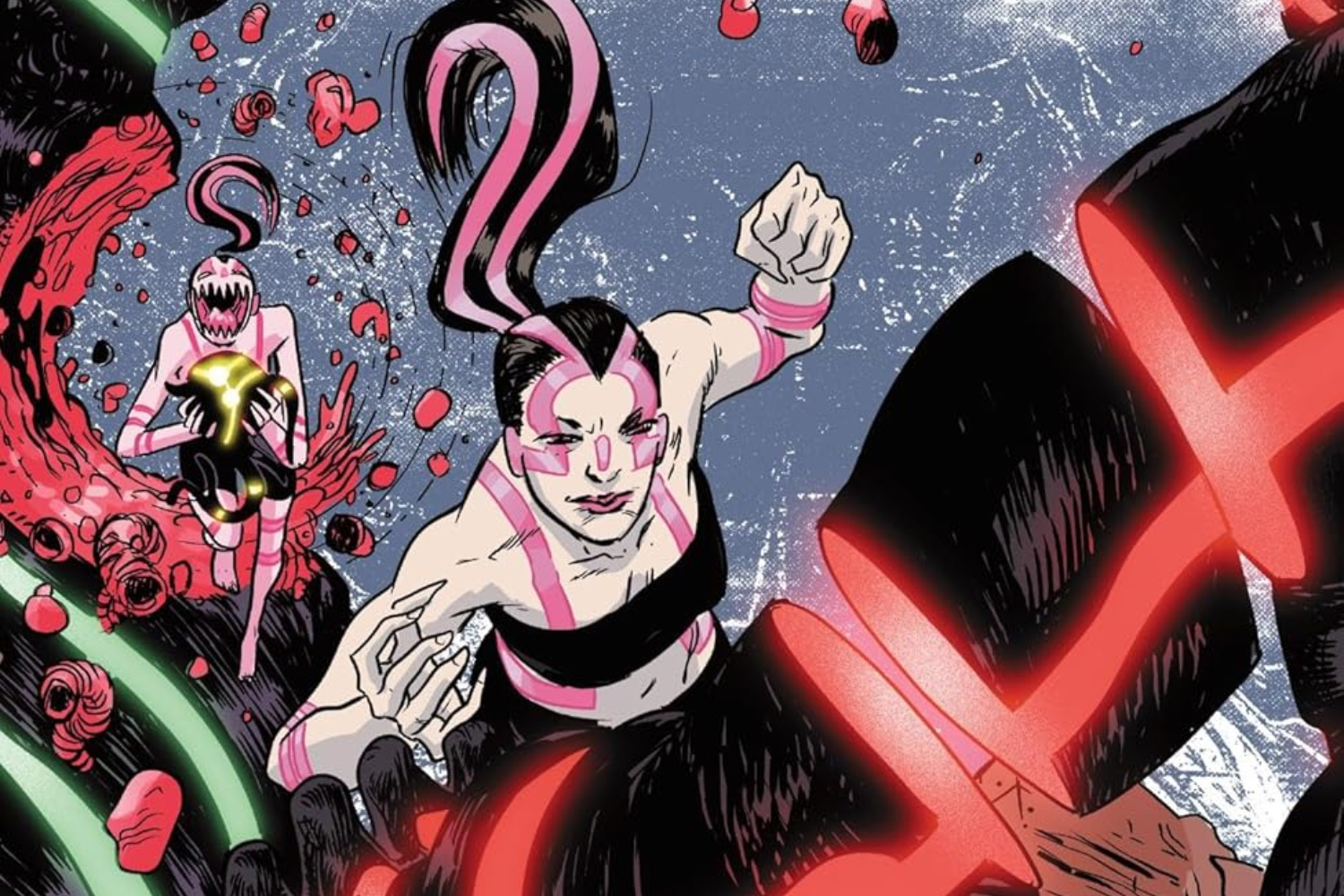

After two promising but ultimately underwhelming issues, Malevolent #3 finally clicked.
Should it have taken as much real estate for this story — about cops and their hybrid partner/weapon policing a world where demonic possession is the norm — to actually take off? No, not at all. But I was more than happy to wait, as issue #3 saw Justin Jordan’s script finally balance its many objectives (let Morgan shine, give the cops more depth and value, unfurl this complicated world) in a way that proved truly entertaining. And that’s on top of some great work from artist John Bivens and colorist Felipe Sobreiro, as they made greater use of the full power of these Mals.
But issue #4 is a big pivot back to the start of the Mal “invasion,” an origin story that comes just when it seemed like momentum was finally on the creators’ side. And while it could’ve gone sideways right away, Malevolent #4 works well enough to add to the reasons why this book is increasingly closer to its truer potential.
Now, seeing how the Mals came to be wasn’t exactly revelatory. Without spoiling too much, I’d describe the process as akin to Sunshine or 13 Ghosts — take from that what you will, but expect lots of demonic savagery, glowing portals, and that sturdy melding of sci-fi and horror aesthetics. What it really gave us, though, was two people — researchers who are basically responsible for the Mals’ presence on our world. I get the feeling that we likely not see them again, but they nonetheless felt genuinely fully-formed and actually quite significant. The pair were given the right amount of personality and development to get us to care, and to perhaps realize just how much our own hubris as a species played in reshaping this Earth.
And, again, what the premise lacks in innovation it makes up for in emotionality. One researcher proved especially gung ho, and the other was more a solid voice of reason. While one of them eventually won out, I certainly gave a damn about what this dynamic said not just about man’s feckless use of technology and annoying scramble for relevance and existential meaning, but also that real people had been really affected. That kind of personal disconnect really informed a lot of Malevolent’s core issues across #1, #2, and #3 — we couldn’t care about the cops because they seemed half-formed, and it really took Morgan some time to cultivate meaningful texture and nuance. But in Malevolent #4, the characters’ motivations and arcs felt developed even as they were headed toward a rather deliberate, obvious enough ending.
It felt like a battle of our better angels versus our baser desires, and that offered a moral core that feels very much at home with this book’s interest in demons (and re-configuring our understanding of this “threat.”) That duality/dichotomy is also very much at the heart of Morgan, and to see it play out elsewhere really convinced me that the book knows where it’s at, likely has a plan to get to where it wants to be, and can make that journey happen in a way that’s interesting and thought-provoking. The world feels more aligned and alive in that way after this issue, and all that fresh lore and context was a little sweet treat atop a decidedly personal tale about people reaching a truth they so desperately needed to uncover.

Main cover by John Bivens and Felipe Sobreiro. Courtesy of Image Comics.
At least some of this issue’s achievements had to to with Sobreiro taking over art duties (with Bivens primarily on handling covers). If we’re trying to make this issue feel different (i.e., set it in the past but also in a world before the Mals fully exerted their control), then Sobreiro’s more playful, singularly stylized approach helped quite a bit. (At the same time, I think any new style would’ve helped in and of itself — without diminishing some generally great work.) Still, it’s absolutely the right aesthetic and outlook for what this issue needed to accomplish at this moment, and Sobreiro clearly understands this world not better per se but in a more all-encompassing sense.
For instance, this issue featured a lot of Mal-human immersion and amalgamation — people being consumed by Mals, and even a form of possession that I’m not sure we’ve really seen before in the story. All of these instances had to maintain the core aesthetic of Malevolent (more indefinably terrible than your average demons) while maintaining a focus on the human pain and suffering. And Sobreiro did just that — he didn’t just give us more dope, techno-organic demon spirits but also how these creatures began to exert an influence and how they’d become the stuff we’d already seen in issues #1, #2, and #3.
It all felt like an early draft (in a very good way), and an aesthetic that very much fit with this being an origin story (that is, not everything had settled or been defined just yet). Things didn’t feel as collected and coalesced as before, and some of that chaos but also heightened emotionality perfectly mirrored the world that was being swallowed up by demons from another realm. It also kind of felt like Sunshine, but in a way that made the connection feel integral and not like mere fan service.

Variant cover by John Bivens. Courtesy of Image Comics.
Yet for all the praise I have for Malevolent #4, there’s a couple of happenings and general observations that irked me even slightly. For one, it’s easy to do an origin right now — you’re riding high from the last issue, and rather than march forward, you could retreat into the past where our expectations and understandings would inevitably have to change. And even if it was done well (which, again, it was), it still feels like we now have one less chance for Morgan to develop and/or for the cops to further establish themselves beyond mere stereotypical trappings. That, and four issues in and we barely have a proper foundation. (Doing the origin now almost felt like a do-over in that very regard.)
And speaking of Morgan, the issue ends with a reveal around her that would’ve resonated more if 1) I hadn’t already assumed this very outcome (and been connected to it more meaningfully) and 2) it had done anything to genuinely tweak our perceptions of her whatsoever.
Still, Malevolent #4 is a true enough success. Even with those “issues” at hand, it’s at least a positive step forward for the book at large. At least some characters got their chance to be real people and add to the story; the visuals achieved some important goals regarding a level of grounding (and also just looked plain cool); and our connection to this world feels even more pronounced (even if our immersion may not still be perfect). I hope we can keep this momentum going into Malevolent #5, and that this book dials in even more demonic action, tension and mood, and genuine human drama.




You must be logged in to post a comment.