

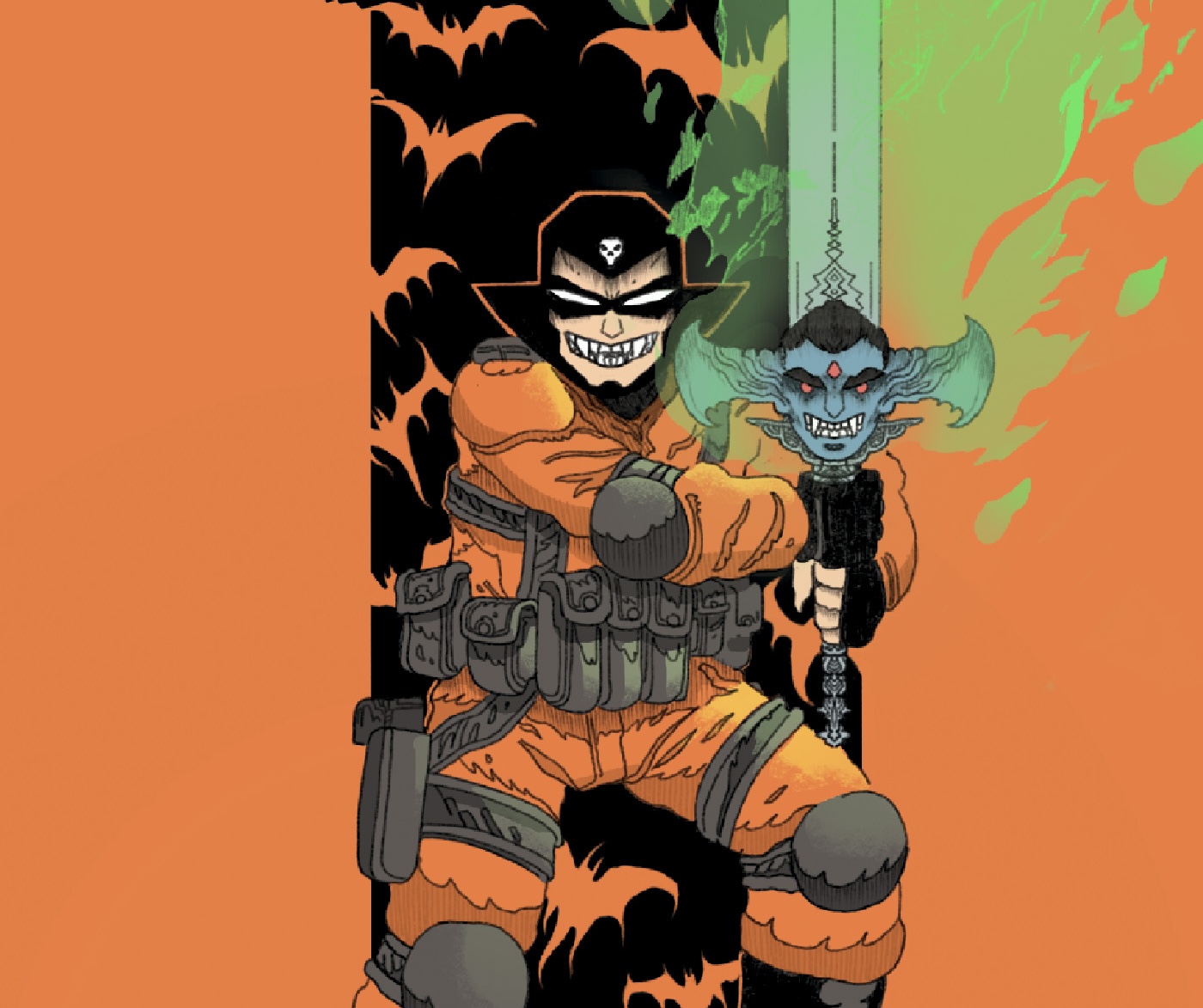

As Oni Press prepares to release Halloween Boy Vol. 1: Last of the Halloween Boys, AIPT can exclusively present a new essay from Dave Baker titled Deconstructionism Is Over, a bold and deeply considered take on the current state of comics and where the medium should go next.
Timed alongside the release of Baker’s latest graphic novel, the essay examines the long shadow cast by deconstructionist storytelling. From the influence of landmark works to the industry-wide embrace of grim, grounded reinterpretations of heroes, Baker lays out how the approach has shaped comics for decades. He makes it clear that while those stories have value, the continued reliance on tearing down heroic ideals has led to a creative stagnation that is hard to ignore.
That argument feeds directly into Halloween Boy, a project that serves as both a response and a mission statement. Written, drawn, colored, and lettered by Baker in his signature duotone style, the series follows a mysterious adventurer navigating cosmic threats, personal legacy, and the weight of his father’s past. The upcoming hardcover collects the first five issues of the self-published series and features a brand-new cover, marking Baker’s first full-length comics work since Mary Tyler MooreHawk.
Baker has described Halloween Boy as an attempt to rebuild rather than dismantle, pulling from pulp traditions, horror influences, and classic adventure storytelling to create something that feels both familiar and new. It is a story driven by action and imagination, but also one rooted in themes of family, purpose, and identity.
Oni Press Publisher Hunter Gorinson praised Baker’s work, noting, “HALLOWEEN BOY is a brawling, bloody dose of 21st century pulp fiction with a brain buried underneath all of its bruises. Call your comic shop — because The Demon Who Lives is coming!”
With Deconstructionism Is Over, Baker puts his ideas into words, offering a clear-eyed perspective on the past, present, and future of the medium. And with Halloween Boy, he puts those ideas into practice.
Read Dave Baker’s full essay below:
Deconstructionism Is Over
If there’s a solace to take in the Post-Super Hero box office domination that so many comic book adaptations have enjoyed, it’s that the term “Deconstruction” gets thrown around much less than it used to. These days most publishing companies are much more interested in making shitty “screenplay comics” than books that have an inclination toward taking an inquisitive eye toward the spandex clad social crusader. But it wasn’t always that way? The bottom line in comics is often dictated by outside forces. Whether that be a glancing literary respect or the shimmering vista of Trickle Down Box Office Economics. Either way, the median creative effort in comics is rarely dictated by what’s best for the medium, it seems.
When thinking back to the heyday of deconstructionist tendencies it felt like there was more de-construction happening than actual construction there for a while. And sometimes, even still.
Look, I’ll be honest. I love Watchmen, Dark Knight Returns, and Miracle Man. They’re great. But after a solid ten years of every single book in the 1980’s attempting to unpack, boil down, and dismantle the ideals of iconic four-color characters … it got a bit old hat.
And then, of course, it just kept going.
For another three decades.
Deconstruction became the coin of the realm in the shortbox laden arena.
These days it feels like if we do get a new attempt at introducing a superhero it almost comes part-and-parcel with a patented deconstructionist lens. Apparently, the post-irony age prohibits genuine attempts at saying something with the superhero form.
But let’s back up a second. Deconstructionism, for those not in the know, is a comic book industry shorthand descriptor used when the authors of any given project take larger than life ideas and examine them in the cold light of day. They take these demi-gods and other-worldly entities and inject them with a very specific strain of “reality.” Typical examples would include answers to boring existential questions like: How would superheroes really function in our world? What would happen if superpowers were available to governmental employees? Or where would your psyche go if you were granted other-worldly abilities? Does absolute power corrupt absolutely? All questions that gifted writers like Frank Miller, Alan Moore, and a bevy of slightly less gifted imitators, have attempted to wax philosophically on. To varying levels of success.
The two seminal texts in this area of pop sequentialism are Watchmen and Dark Knight Returns. Both comics that have a keen interest in the structure of the form—in Watchmen it’s a 9 panel grid, in DKR it’s the 16 panel grid—but it’s the boiling a character and reexamining them through a real world perspective that has been the dominant creative lesson that a virtual army of would-be comics writers have learned. Unfortunately.
The success of these books ushered in a new Grim and Gritty age of comics. Every hero grew stubble. Every villain trafficked in sexual assault. It wasn’t just a passing fad, it became the median solution for an industry already prone to imitation and derivation. There’s a place for grim and gritty. There’s a place for realism. But when the entire meta of an industry just started applying depression, suicide, and alcaholism as the go-to creative solutions? I don’t know. Kinda feels like we missed the mark. Is it possible we should head back to the lab? Maybe try and cook up something new?
Halloween Boy is my attempt at zigging where so many have zagged. It’s a love letter to all things pulp, adventure, and classic 1930’s horror. It’s me attempting to shout from the mountain tops how much I love the traditions and tropes and long-standing conventions of these characters, but re-mix them and presenting them in a way that a contemporary audience might not even be aware are homages.
Think about what George Lucas did with Star Wars. He wanted the rights to Flash Gordon and ultimately couldn’t get them, so he decided to file the serial numbers off, combine it with a little bit of Dune and his favorite samurai movies, and he was off to the races. That’s what I wanted to do for the idea of a Horror Hero. Take the traditions of the pulp adventurer, fuse it with some spooky fangs and demon swords, and see what I could get out of it.
Furthermore, there are ideas or motifs in the book that could absolutely be positioned as deconstructionist. It’s about a man who thinks of himself as the Patron Saint of the Impossible. There’s a lot to mine there, from that context, if you really wanted to. However, instead I tried to take those ideas and smuggle them inside narrative conventions that were so old and tired that approaching them with a new perspective could re-ignite something more.
Today there’s a learned cynicism that is easy to play into. Can a man really leap buildings in a single bound? Run faster than a locomotive? No, obviously not. But the audience demands those things, so we can’t jettison them completely. But we can abandon the primal innocence that it takes to imagine that someone who possesses these phantasmagoric abilities also happens to be incorruptibly good. We can reposition the character as a dark and broody demi-god with no interest in assisting civilization. Sure. We can do that no problem. That’s a narrative status quo that instantly draws real world allegory. And it is easy to understand, because it’s almost one-to-one with the abuses of power we see outside our window every day.
But, to me, it’s much more interesting to attempt to re-construct these archetypes we’ve so thoroughly dismantled, building something new. Recognizing the flaws of the old, while building on that bedrock to make something new and tangibly exciting.
Halloween Boy is my attempt at making a hero for the ages. He’s my, probably doomed swing, at adding something to the pantheon of characters that helped me fall in love with the medium of comics. Within the pages of Halloween Boy Vol 1: Last of the Halloween Boys, I was trying to make a book that would feel like something you could find out in the wild and instantly be like… “oh, I need more of this.” Every comics reader knows what I’m talking about. The jumper cables to the brain that a good back issue can give you. The random Adjectiveless X-men issue found buried on some dusty convenience store shelf, or a Dell Gold Key Phantom stuck under a crate of apples at a grocery outlet. You know the feeling, we all have come in contact with it. You come in two-thirds of the way through the story, you kind of have no idea what’s really happening, but you know you need more immediately.
I know the way I draw doesn’t always communicate a deep love for the Super Hero Industrial Complex, but trust me, it’s there. At its best? There’s nothing like reading an ongoing story that links you to people from decades in the past. These universes have been being worked on by large groups of people for close to 80 years. Are they always good? No. Of course not. But the great ideas rise to the top. And the characters that are beloved are appreciated for a reason. They’re simultaneously complicated and simple. You can build elaborate narrative ecosystems on their backs, and you can also tell direct meat and potatoes stories using them. That’s the mark of a truly great character, when they can enable and support both of these outlooks.
There’s an innocence to those characters and to the experience of finding them out in the wild. I was attempting to re-capture, build on, and evolve that exact feeling with Halloween Boy. Is he literally a legacy character in the pages of the book? Yes. But in our world, he’s obviously not. He’s not a part of a lengthy publication history with hundreds of creators who have worked on him. But I wanted to make something that felt like it was worthy of that longevity. I think we’ve had just about enough deconstructionism on the four-color page. No more bringing the hero down to our level. No more flaws and pain and mistakes. I think we could use a whole lot more reconstructionism. Idealism, optimism, and smiling in the face of the apocalypse. And hopefully Halloween Boy is a successful entry into that enterprise.
Halloween Boy Vol. 1: Last of the Halloween Boys arrives in comic shops May 26, 2026.



You must be logged in to post a comment.