

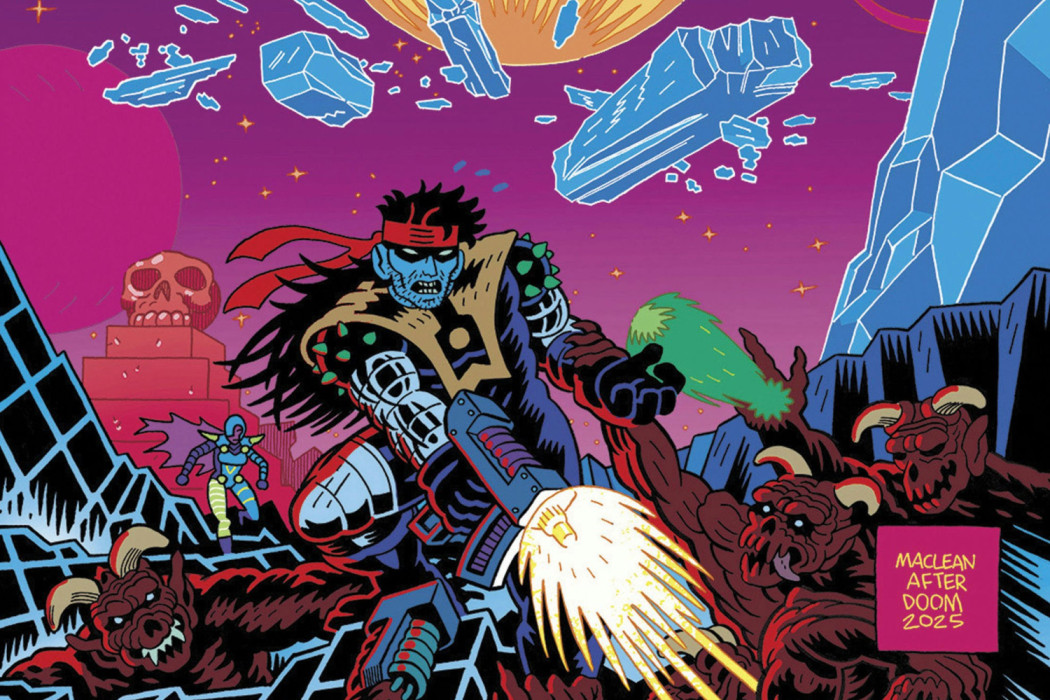

Nothing can truly last in perpetuity, and even Death Fight Forever has to wrap it up after five issues. But oh what a journey it’s been, as writer Andrew MacLean and a rotating cast of artists have put Bash Biggle and Marla Mendoza through their paces. Not only was their actual journey to take out Lord Slyther fraught with obstacles and uncertainty, but so too was our experience as an audience. The new artist across each issue meant that the book had to balance multiple aesthetics, and that also inevitably meant having to find other ways to shore up an important sense of consistency.
But all that really matters is if they could actually stick the landing, and Death Fight Forever #5 is a goodbye more than worth the several months of dazzling highs and accompanying adjustment periods.
For the grand finale, MacLean is joined by artist Erwin Papa, who really splits the difference between everyone: Alexis Ziritt’s more cerebral, utterly psychedelic stylings; Al Gofa’s “gritty but lo-fi” approach; and Sam McKenzie, who absolutely dazzled me with a more joyish but equally bonkers approach.

Courtesy of Image Comics.
And, as I mentioned before, one of Death Fight Forever‘s saving graces has been finding artists that feel, at the absolute least, like aesthetic cousins. They’re hitting at the same over-the-top vibes and blend of gore and humor that you need for a story inspired by ’90s side-scrollers and late ’80s cartoons about robot lion freedom fighters. There’s still been some adjustment between books, but it’s clear that they planned for (or at least adapted to the change) that demonstrates a drive and intellect for a book that’s basically Toxic Waste candy coated in bong water and battery acid.
And while McKenzie’s approach remains my favorite for arbitrary emotional reasons, Papa’s style was the perfect option for the curtain call. As you can see in this extended sequence across this review, where Bash and Marla storm Slyther/his minions on the green, it’s in that same Venn diagram of indie depth and intensity; joyous, unabashed absurdity; and cartoonish whimsy (that’s easily more perverse and weird than a lot else out there).
Papa’s art, though, feels like the most clean and deliberate, streamlined and organized in a way that makes sense for an ending. It’s as if we’ve reached the “final boss,” if you will, and there’s a kind of finality and corresponding emotionality baked into every line and shadow. It’s never been about which artist/style is better; it’s been about using that change to aid the story above all else. And in that case, Death Fight Forever #5 feels as silly, hungry, and dangerous as ever. Also, spending a handful of pages in your final issue in the name of this one gag is absolute brilliance.

Courtesy of Image Comics.
Still, none of this compares to what comes later in the issue, as Bash and Marla confront “Slytherlord” in the Phantom Realm. If you thought a four-page golf gag was a hoot, Papa drawing kaiju amid an interdimensional pocket realm will wipe the smirk clear away. And that corresponding battle is as huge as you’d want it to be: there’s epic transformations that practically hum with power; color work that puts a million blacklight posters to shame; great pacing and visceral intent that makes the battles feel even more real; and generally the kind of brain-liquifying wonder that brings you back to the first Saturday morning cartoon that set you on your nerdy path.
And — as has been the case across Death Fight Forever — you could practically fill your belly on all these tasty mutant snacks. Papa’s style and approach isn’t just deeply satisfying, but it also does the best version of this book’s true storytelling might: keep it all where the reader needs it. Which is to say, most of us came into this book for the nostalgic rush and uber action flick vibes. And that book recognizes that, keeping the tone breezy but blinding, as a means of cutting to the heart of it all.
Death Fight Forever #5, especially, wastes almost no time and energy building to the fight — what we get than is a recognition that we know what’s up and then even more pages spent in the sweet, sweet chaos of it all. It’s not just about efficiency or knowing what your book is about, but also respecting readers for knowing what they signed up for and why, and then operating accordingly with mutant madness aplenty.

Courtesy of Image Comics.
And that very sense of respect is further found once you make that oh-so easy effort of actually delving just below the monster-bashing surface of this mad little book. As has also been the case across all four previous issues, Death Fight Forever #5 wouldn’t dare bash you in the face with its emotional and narrative feats.
It has, as I’ve remarked with excitement and admiration several times, positioned that “humanity” in a way that its discovery depends on your own curiosity and needs, letting this book be what it needs to be to everyone in ways both splendid and multifaceted. Heaps of books try to do just that — the end result either becomes searching for value in a sea of pop culture cotton candy or a narrative so overt and deliberate you’d rather get smacked in the face with a dictionary.
Death Fight Forever, though, has nailed the “formula” — if anything, issue #5 is (once again) representative of the pinnacle of its ability to show and even hint at the emotional core while dazzling your little shrimp brain with psychedelic viscera galore. Not only that, but Marla and Bash each get their own arcs that have nothing to do with cliched happy endings or needless romantic pairings.

Courtesy of Image Comics.
By solving a tricky issue with a door, Bash makes good on his need to grow into his own solo hero while also addressing the lingering specter of his brother’s death. (That moment will genuinely break your heart, I promise.) Marla, meanwhile, gets back what she’s been seeking all this time (in a few ways, mind you) while also learning what she can and will do without. If their stories are connected (as I believe is the case), it’s about their own individuality and autonomy, with the pair working together cause they want to and not out of some extra hacky tropes.
Now, here’s where I might normally say something like, “If you don’t see what I’ve seen, it’s all a testament to my own connection with this book.” But, frankly, F all that noise — Death Fight Forever is the most satisfying book in some time for that non-committed commitment to meaningful character growth/development. In that way, it’s very much like the comparisons to Blood Dragon I’ve made over and over again: With the right mix of insanity, wit, and heart, you can tell stories that move people without making it a big deal.

Courtesy of Image Comics.
And that’s what we need more of today, these unassuming projects that want to be dumb and fun cause we need that but we also recognize that the most informative parts of life are often just as straight-up weird. That there’s clearly lessons to be found in meeting people where they are and simply showing them a little story about two people who desperately need a path forward. That being dumb and silly and un-serious to a nuclear level is exactly where life takes us; the only difference now is that it’s a worthwhile destination if we can learn something along the way.
In some ways, Death Fight Forever is actually all about what it means to be alive right now: There’s sound and fury everywhere; some people are giant monsters that need to be smashed posthaste; and the best endings are ones that make sense to you and what you need from life this exact millisecond. It’s never that deep, but that doesn’t mean it’s still not massively important. Life is your own side-scroller, so play it or don’t, bro.

Courtesy of Image Comics.
Without revealing too much, there’s one subtle line toward the issue’s end that proves that Death Fight Forever might actually find new life down the road. And, as is the case with most books that bring me even one iota of joy, I welcome “Death Fight Forever: The Battle Blazes Onward” or whatever.
But if this is truly the end, this book taught me real lessons (and not just affirmed life’s weird arc). For one, always trust the storytelling process, and even if that means changes you sometimes thrash against, fully give into the experience. At the same time, make the experience what you want, and let stories work to uplift, distract, engage, etc. Because when you do, the world seems like a better place to be in (even if there’s still pain and giant fascist lizards everywhere).
It’s a comics reading experience I’m sure will echo in my dumb lil’ brainpan for quite some time.




You must be logged in to post a comment.