


If you listened to this week’s AIPT Comics Podcast, you’ll know I had rather lofty hopes for Narco #4. (I also said “the B word” — like that actual phrase — so I was clearly in some kind of mood.)
And how could I not be hopeful? Creators Doug Wagner and Daniel Hillyard have spent the first three issues methodically building the most “grounded” of their collaborative works so far. The end result has been a slow burn mystery of Marcus (a young man with extreme narcolepsy) solving the murder of Jess, his love interest and neighbor. Where books like Plush and Vinyl reveled in the gore and chaos, Narco has been a way to play up the sheer humanity within true crime.
But every murder mystery has to reach an apex, and Narco‘s penultimate issues makes big moves that ultimately prove some combination of both impressive and irksome.
Perhaps the biggest move is that Marcus seems to be really taking to his role as unofficial detective quite well. Despite some real dangers in this issue, he doesn’t pass out once. (That device of his watch beeping with his elevated heart rate, though, continues as this really great tool for our own immersion.) On the one hand, I’m jazzed that Marcus is “growing up”; a big part of Narco has been to see if he can handle the stress, and if he can push himself toward becoming the kind of man he’d hope he might be for Jess some day. The fact that it happened after her untimely demise is a dramatic irony that cuts oh-so deep.
However, I also think stripping him of these fainting spells (even just temporarily) runs counter to the promise of Narco. In a book about a kid with some genuine deficits having to step up, no longer having said concern just sort of makes him a regular dude. And, sure, he’s got a lot of emotional skin in this game, but without real obstacles, he feels a bit ordinary and plain.

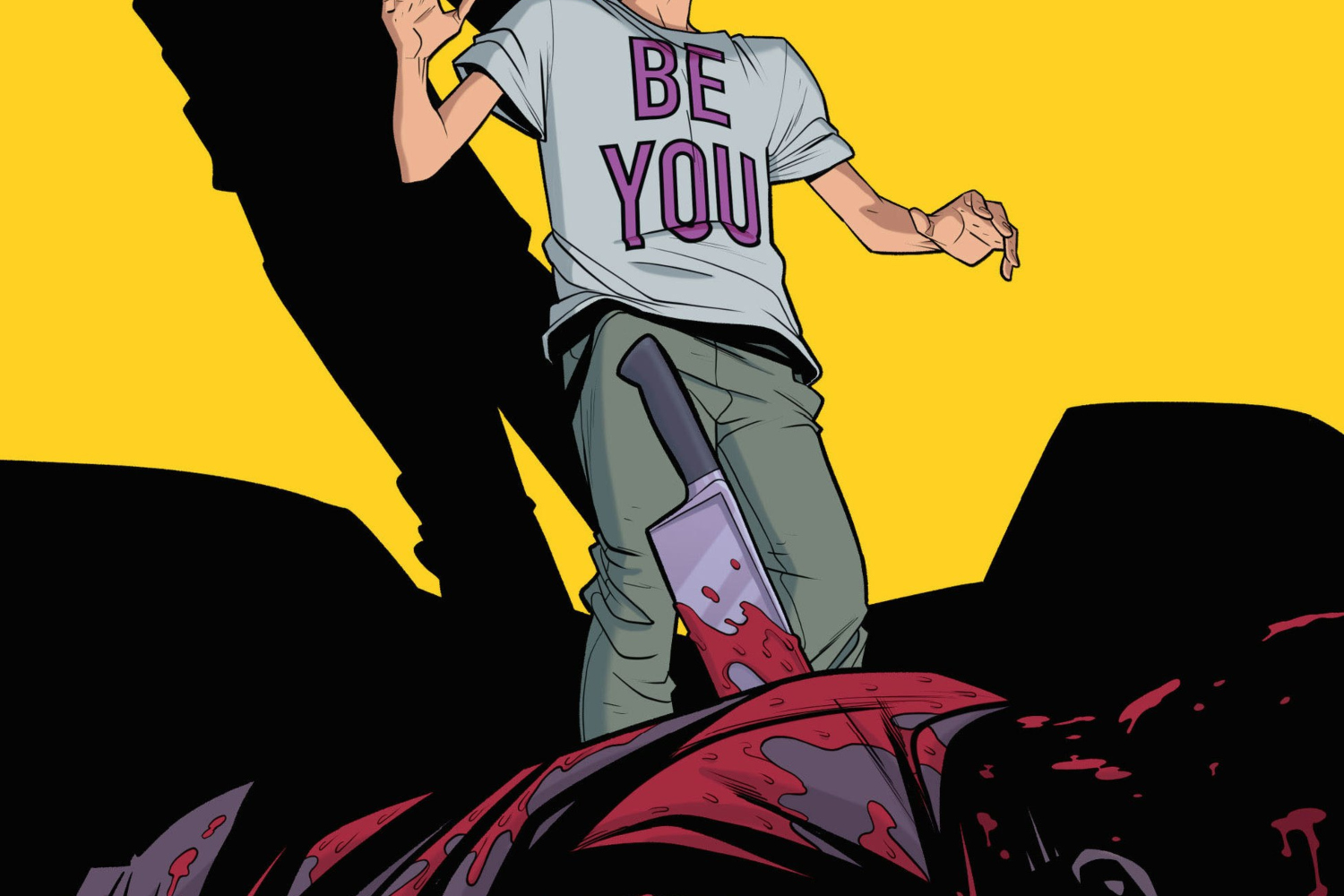
Main cover by Daniel Hillyard and Dave Steward. Courtesy of Image Comics.
Plus, his rather obsessive knowledge of true crime pretty much positions him as someone who could easily solve a murder (in theory), and that slam dunk feel just ain’t so compelling in a book like this one (and at this point in its arc). There’s nothing keeping him from his potential, and as much as I wanted that kind of development, it just felt too clean. That’s not to say he’s “cured” entirely, but with the integral character trait diminished, its “return” won’t land as it ought to.
And that’s doubly true when you consider there’s two big moments in Narco #4 that could’ve easily seen Marcus pass out like a giant opossum. On the upside, both of these scenes gave Marcus and us readers a clearer picture of the real perpetrator. On the downside, though, these same instances don’t work as well to push or even reconfigure the story/the case. It’s a real theme across this chapter: Big things happened, but that doesn’t always mean they worked efficiently and/or with maximum impact.
The first big moment involves, well, let’s call it a disaster at Marcus’ apartment. Visually speaking, it exuded a dream-like quality, and that made me think our boy had actually passed out. When the incident was revealed to be real, though, that dreamy visual quality lost a lot of its meaning and power. It also made me prefer other moments in this issue, like when we get this slightly off angle/perspective as Marcus is chilling on his couch. It was a seemingly small moment, but it put the thought in my head about how much of a role perception plays into this book, and even if the whole passing out “gimmick” was underutilized, the creators still want us second-guessing our relationship to this book.
At the same time, this incident is also the first clear cut moment we see the killer actually exert a more obvious influence across Narco. From there, it becomes pretty clear just who is the perpetrator, and I’m not exactly overjoyed by the news. Sure, the execution works here — it’s in the moments right after the accident, and it’s done with a quiet efficiency that feels absolutely brilliant. The real issue, then, is that I mostly don’t like the bitter taste it leaves in my mouth.
Wagner and Hillyard have always bucked expectations of characters (see Edwyn in Plastic), and here they’re mostly telegraphing it in a way that feels both boring and a little insulting. Again, there’s real dramatic potential (and always the possibility of red herrings being employed). Plus, Marcus is further emboldened by this realization in a way that’s quite thrilling. Still, it’s just a case where the payout maybe won’t be as satisfying as the set up.
There’s another similarly significant moment in Narco #4 involving an attack on Detective Violet. Again, it’s a big moment for Marcus: It’s basically where he enters a door, as it were, and finds himself having to choose to either lay there and die or fight forward. It’s also another strategic use of gore across Narco, which I also have complicated feelings regarding. (I do appreciate that this book has a certain contextual standard to uphold, but I’ve enjoyed the moments when there wasn’t such action or chaos. The issue felt like it really leaned on those bloody pops, for better and worse.) But there’s an even bigger concern with this scene: It doesn’t reach its proper potential.

Variant cover by Daniel Hillyard and Dave Steward. Courtesy of Image Comics.
Earlier in the issue, Marcus and Detective Dean (who have been working together officially/unofficially) have something of a falling out. And that “breakup” worked because A) it made us further uncertain about Marcus’ true role in the murder and B) it felt novel enough in the realm of crime stories. The attack on Violet, however, places her in a specific context for the remainder of the entire story, and that feels a little upsetting.
Sure, it’s always about furthering Marcus’ tension with other people (including the murderer), but it makes Violet feel small and unimportant. (And she felt so much more vital in earlier issues.) At least the stuff with Dean could factor into the finale somehow, and that makes the character and his relationships feel more important and lively. I won’t say the Violet stuff is fridging, but it did happen in the kitchen…
During the podcast, I also said something to the effect of how stories like Narco have to earn their big leap forward in action, storytelling feats, etc. It’s clear that Narco didn’t execute its penultimate issue with the greatest overall effectiveness. Those big swings sure felt that way at first, but upon closer inspection, they also rang a little underwhelming.
Our hero has certainly grown up from Narco #1, but Marcus will seemingly have an easier time despite what conventional wisdom would tell ya at this point. And while the reveal of our prime suspect is smart, it ultimately feels cliche for a book that deserved better. Still, the whole of Narco has been a wild ride, and I maintain my confidence that Wagner and Hillyard can keep it up and give us a truly sweeping finale that proves exciting, thoughtful, measured, and satisfying on a few different levels.
Otherwise, you may hear me again on the podcast, lamenting about what could’ve been for this miniseries.




You must be logged in to post a comment.