

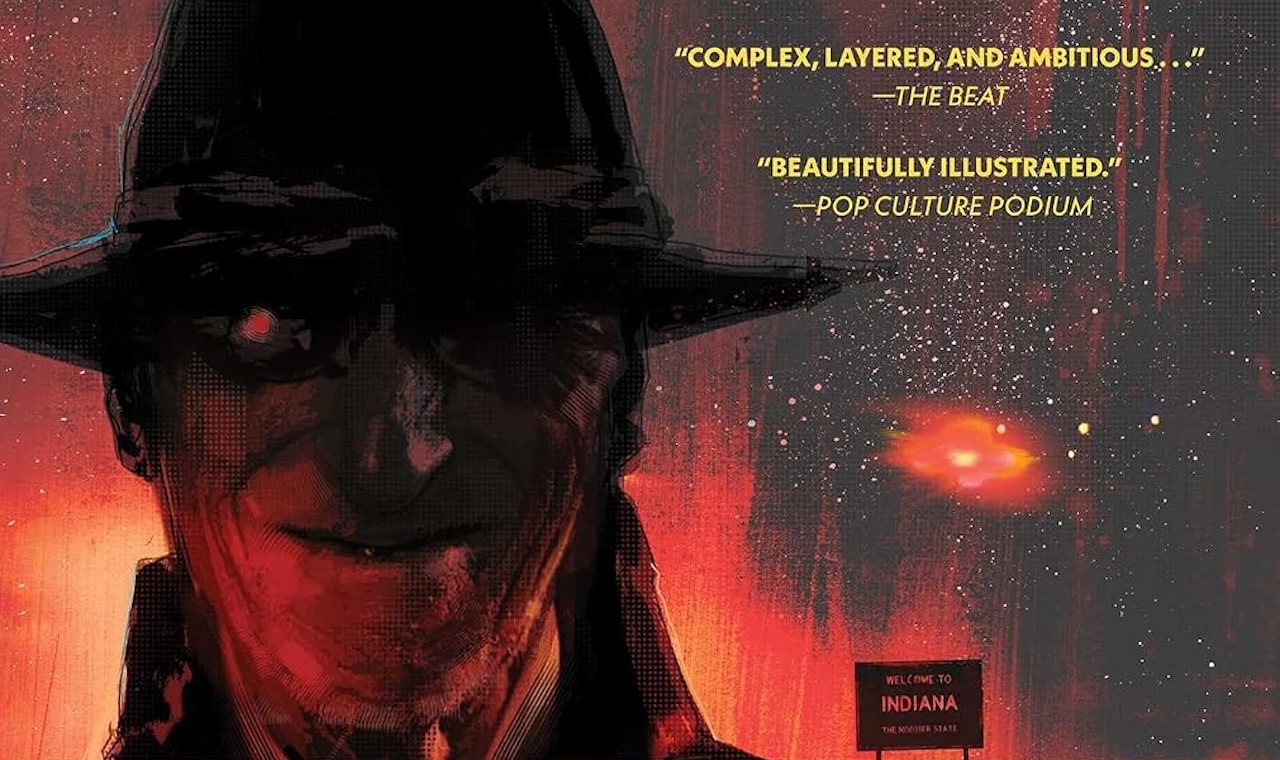

Stories about the paranormal are everywhere, ranging from UFO sightings to Bigfoot encounters. There have also been plenty of shows that explore these phenomenons from documentaries like In Search of…, to narrative dramas like The X-Files.No matter how many stories crop up, there will be pieces of media that will be their own touch on these topics, including the comic book anthology series High Strangeness.
Conceived by Daniel Noah – writer, producer, director, and co-founder of SpectreVision, the acclaimed production company known for films like Mandy and A Girl Walks Home Alone at Night – Noah curates this anthology in collaboration with multiple writers and artists to tell stories about those aforementioned topics like UFO, as well as subjects like the Astral Plane, all of which builds towards a higher, unseen order of reality.
Speaking of aliens and Sasquatches, the initial two issues are basically about them. The first issue, co-written by Noah and Chris Condon, takes place in 1967, where a journalist investigates the disappearance of a girl who supposedly witnessed a UFO sighting. The second issue, co-written by Zac Thompson, takes place in 1975 where an escaped convict is trying to live a new life after escaping his past demons, including a physical encounter with a Sasquatch. While the human stories are compelling narratives, and artists Dave Chisholm and Noah Bailey showcase their distinct styles, there is an air of over-familiarity with the premises themselves, touching upon midwestern conspiracies that are done to death.

Oni Press
The subsequent issues are a step up, as they are less about physical encounters and more about psychological mentality, starting with the 1983-set third installment written by Christopher Cantwell. After successfully testing her newly invented microcontroller Lifeboat, Cindy Freeman gets into a car accident where she and her father walk away unscathed, only for reality itself to fall apart around her. With Valeria Burzo’s quirky art, the story leans into surrealism and horror imagery whilst balancing themes of past trauma and acceptance after tragedy.
The penultimate issue, co-written by Cecil Castellucci, follows Adeline Cruise, whose life in 2001 is that of a lonely, lost aspiring artist. When she volunteers to become a subject in parapsychology study, she expresses her art more openly and finds love in the process, despite having an out-of-body experience that suggests she may have a greater purpose for the world. Of all the diverse artwork throughout this book, Chloé Stawski’s art is the standout that balances cutesy character designs with sequential storytelling that plays a lot of panels, especially when we get to the trippy Astral Plane.
The book culminates with a final issue that ties in all these singular narratives into one psychedelic odyssey as one would expect from writer/artist Christian Ward, whilst the previous artists contribute a page or two. However, this finale pretty much sums up this book, which feels more like a platform for artists to visualize all these paranormal subjects that get talked about more in the essays published at the end of this hardcover edition. With recent anthology series like Ice Cream Man and Assorted Crisis Events that are more original and experimental with their storytelling, there is a sense that Daniel Noah and his collaborators are piggybacking on what came before.




You must be logged in to post a comment.