

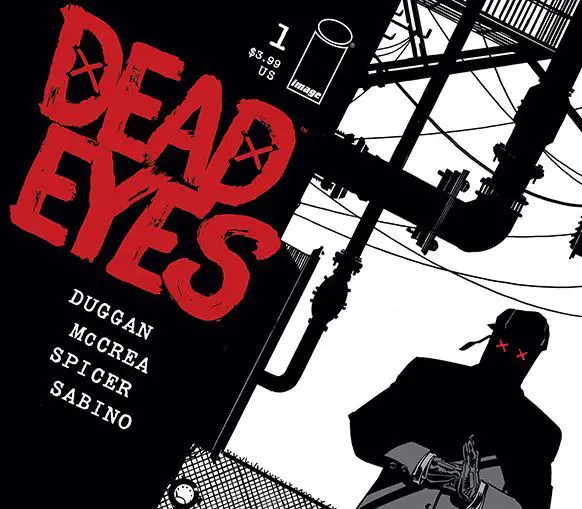

In the ’90s, a masked vigilante took down the rich and the poor. His name was Dead Eyes, but he disappeared in ’97 never to return…until now?
Within the first few pages, it’s clear Gerry Duggan is going for a meta story. Dead Eyes represents many ’90s anti-heroes made popular by the noodly linework from the likes of Todd McFarlane and Rob Liefeld. But then there was a bust and comics have seemingly grown up a little.
Dead Eyes is now a middle aged fella, Martin, taking care of his seizure-ridden, invalid girlfriend, Megan, while he suffers working at Walmart and nurses hemorrhoids. However, he’s sneaking out to start his work again.
Unfortunately, the dialog keeps the interesting concept from truly realizing its promise. When a black lady shows up, she loudly complains followed by a, “sheeeeiiiit.” When who I assume is the main bad guy shows up, his closing line is, “Find him. Have some fun. Recover every dollar you can. Then Dead Eyes dies a bad death.” I almost wonder if this is intentionally done to harken back to cheesy ‘90s comics…but it’s not funny. There’s not a spark of wink-wink meta humor.

I posit that Duggan is trying to be sincere, because every scene between Dead Eyes and his girlfriend are saccharine. Yet, these supposedly sobering domestic fights are rendered awkward by the dialogue.
SPOILERS: Martin comes back after crime fighting and Megan notices him bleeding. Unsurprisingly, she guesses pretty quickly that he’s been out punching dudes in the pale moonlight. Just to make sure us dumb readers understand, she says: “You can’t save me, so you’re taking it out on the world. But Martin…there are consequences. The world’s a different place now…” This is insecure writing. Duggan has to make sure we absolutely know what the themes are. But by spelling out these blunt exchanges, he doesn’t let us absorb the emotions that should well up and inspire us with thought and feeling.
John McRea’s art functions well. His angular style builds an oppressive atmosphere, especially when he adds plenty of little domestic details into locations. At times, panels depicting hunched characters recall Sean Philips. Other, more shadowy moments, remind me of Mike Mignola. Yet, the color work from Mike Spicer is a big let down, giving lots of scenes bland grays and browns. It doesn’t help that John McRea seems to fizzle out near the end, neglecting background details to a large degree, which really draws attention to the mediocre palette.
An artist who fusses over their work to an excessive degree would be better. Somebody who would truly remind us of the ’90s excess that unleashed legions of McFarlane clones/wannabes.




You must be logged in to post a comment Login