

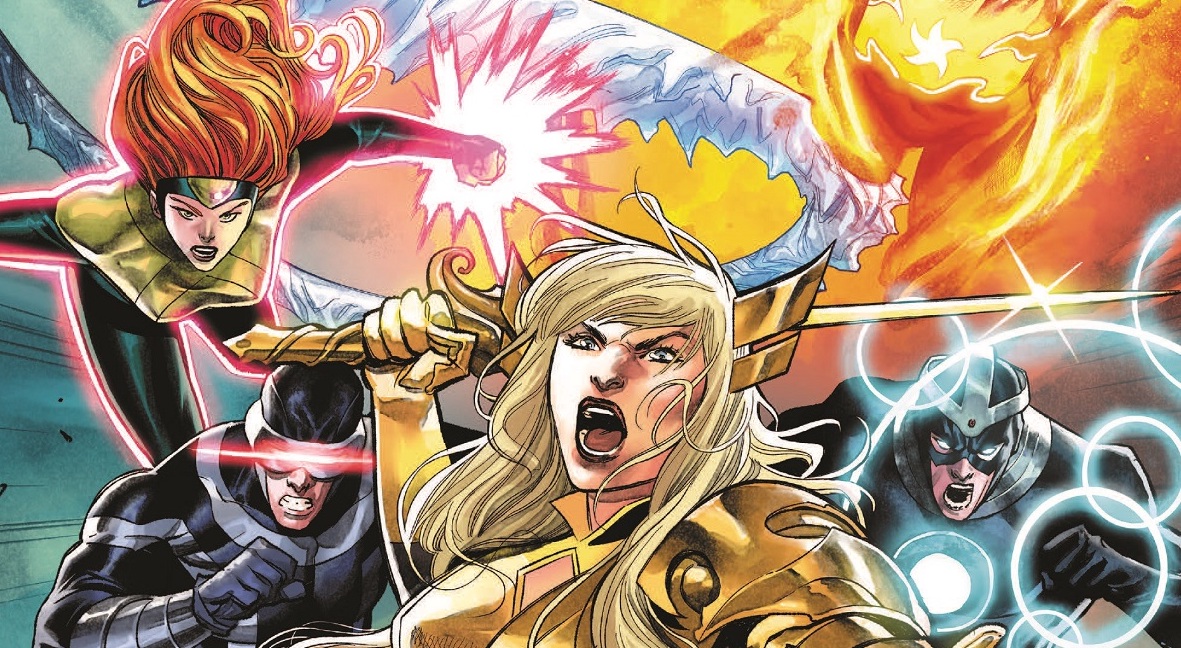

The newest installment in Gerry Duggan’s current run on the X-Men sees the book gratifyingly address many lingering concepts and plot threads established by the X-Office over the last few years. Even while this run departs significantly from the tone in the Hickman run that preceded it, it continues to play with weighty concepts around evolution and genetic competition, while also giving it a clear “superhero” tone. We see a return the Children of the Vault, a group that evolves at a rapid pace inside their pocket universe, and even a successful tie-in the Judgment Day event with the Celestials passing judgment on members of the team.
In this trade, we get issues #13-18 as well as the Annual from that same year. It’s a rather large book when compared to some of the other paperbacks Marvel publishes, and while it contains three distinct arcs, there is still plot continuity between each. The first few issues are direct tie-ins to Judgment Day, which may be disorienting for readers who find this their first introduction to the crossover. Yet, Duggan does an admirable job setting the basic premise, and then committing completely to the massive “judgment” battles that ensue. Following the last Hellfire Gala, Firestar became a member of the X-Men, and ample space is given to integrating her into the current team configuration. The Annual written by Steve Foxe also attempts to use the character as a distinctive perspective on the Krakoan state of mutant affairs, which was a worthwhile effort.

The second arc, featuring Forge and his mysterious Project Blackbox, is the strongest of the storylines, having the team gaze towards the future in how to defeat the Children of the Vault. It’s a great story that brings a satisfying conclusion to the Synch/Wolverine arc from last year. The fact that Duggan felt it necessary to tie up those previous narrative threads rather than dragging them out needlessly is a good sign for the X-Men and feels like some thought and plotting is at work for the line.
All the art is strong throughout the trade, but there is some inconsistency in the styles as it moves from issue to issue. C.F. Villa (#13-14, #18), Andrea Di Vito (Annual), and Joshua Cassara (#15-17) all do fine work on their respective arcs, but the change in design is noticeable when reading these all at once. Cassara does beautiful justice to each character he draws, giving them personality in their slight movements. His work, often known for its gruesome and gory scenes, has been turned down a tad for these X-Men issues, even though the moments with Forge provided more than a few opportunities to wince in fear along with the character. C.F. Villa’s Judgment Day fight scenes, with towering Celestials overhead, are great comic visuals. While the line work is simple, it gives some vibrant weight to the narrative.

And my, were there a lot of variant covers for these issues! Most of them are reprinted as full-page spreads at the end of the book, but sadly the trading card variants are given the ¼ page treatment. That’s a bummer, as those covers look great and deserved more space to shine.
We are now some years from the House of X arc that radically reconstituted the X-books, and while there have been some missteps in the runs that followed, this collection of X-Men issues demonstrates just how capable the current team behind these books is at creating engaging, connected stories.




You must be logged in to post a comment Login