

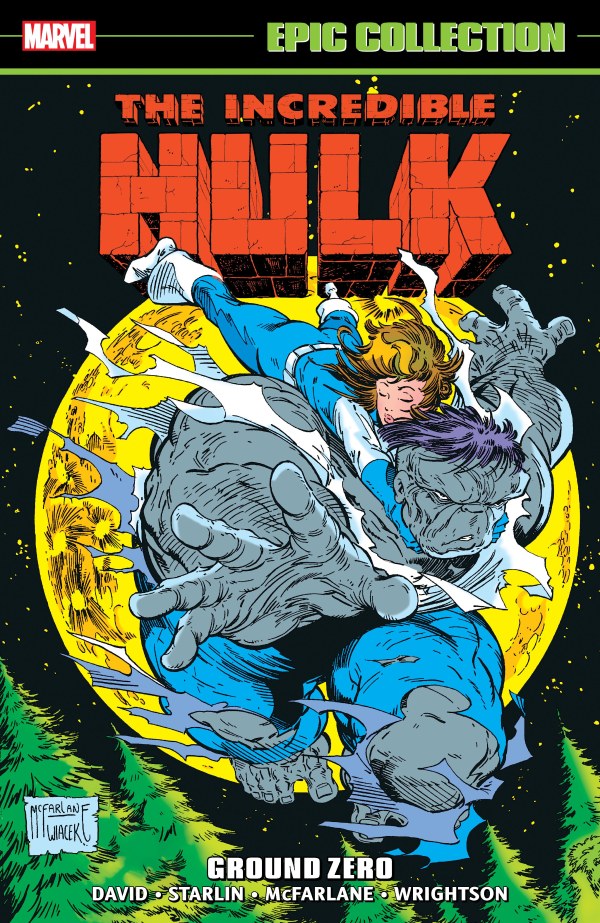

Perhaps no creator had as much influence on the Hulk as Peter David did. Of the 414 issues of The Incredible Hulk (which includes the number-confusing period during which Hulk appeared in Tales to Astonish rather than his own book), Peter David wrote well over a quarter: a whopping 137 issues over eleven years. That’s discounting work outside the main title – he also wrote chunks of the following volumes, several major miniseries, and a handful of modern books revisiting periods of that mammoth run.

Few creators get the opportunity to spend that much time with any single title, let alone one so foundational to the Marvel canon. During that time, the very tenor of Hulk stories shifted away from the wandering buffoon stories being told in the 1970s to stories featuring an ever-evolving version of the Jade Giant. Major aspects of his personality – the antisocial Joe Fixit, the genius-level behemoth, the apocalyptic despot – all arose under David’s pen.
From the run’s earliest issues – collected in Incredible Hulk Epic Collection – Ground Zero – David makes no secret of his intentions to radically alter the the book. The status quo left behind by writer Al Milgrom is upended by issues of the changeover. Banner, who had been “cured” of the Hulk, radiates himself again; Rick Jones, who had been running about as another Hulk, is relieved of his burden. Bruce and Betty’s marriage is undermined, and supporting characters like Doc Samson are summarily abandoned. By his seventh issue, David blows up the book’s central setting, the S.H.I.E.L.D.-backed Gamma Base.
The Hulk, no longer an idiot, not quite a monster, is turned into a petulant social malcontent. Not quite fueled by rage, the Hulk seems perpetually annoyed – annoyed with Bruce Banner, annoyed with Rick Jones, annoyed with the tedium of his day-to-day.
But where the book shines is in its commitment to extreme pathos. A sort of brutal ennui begins to color the book, starting in issue #333, in which Hulk goes up against a much subtler monster than Abomination or Leader: a power-mad, wife-abusing small-town sheriff. Indeed, domestic tragedy and mundane human struggle form the bedrock of much in Ground Zero; everyday citizens and their troubles begin to take up as much consideration as Hulk’s mental anguish.

David seems keen to introduce many ready-made victims, each destined for death and each plagued by real-world concerns. One issue begins with a man crushed by tax debt dying in a bathtub, while another introduces a woman whose chief concern is the constant condescension of her boss; she is killed by a super-villain within the book’s first four panels. In this volume’s final, incredible climax, an entire small town is introduced, and we follow key characters as they struggle with their petty problems: embezzlement, star-crossed young love, stifling door-to-door salesman woes, and the breakdown of a lawyer’s righteous indignation.
The town is then annihilated by a gamma bomb.

It is this commitment to the tragedy of human life that sets Ground Zero apart from the preceding volumes of the Hulk Epic Collection; the book becomes pinned by earnest, real anxieties, and these eventually feed back into the strife of its chief protagonists.

The book is also noteworthy for the early work of Todd McFarlane, whose rubbery characters must have felt revolutionary to readers at the time. Each character develops their own elongated mopiness. Everyone juts their bottom lips into exaggerated pouts. The Leader develops a perpetual stiff and leering grin. This stylistic commitment veers Incredible Hulk away from its house-style standards and underpins the fresh and psychologically insightful narrative take. The Incredible Hulk was increasingly different from its peers on the comics rack, and McFarlane’s pencils made that as apparent as David’s brooding misery.
Incredible Hulk Epic Collection – Ground Zero encapsulates a period of extreme change – for the character, for the book, and for the larger industry. It seems impossible that the massive swings made in these issues are only opening notes of the massive sea change to follow. It’s the beginning of one of the most important periods of the Hulk’s long history, and every page makes the reader aware of that fact.




You must be logged in to post a comment Login