

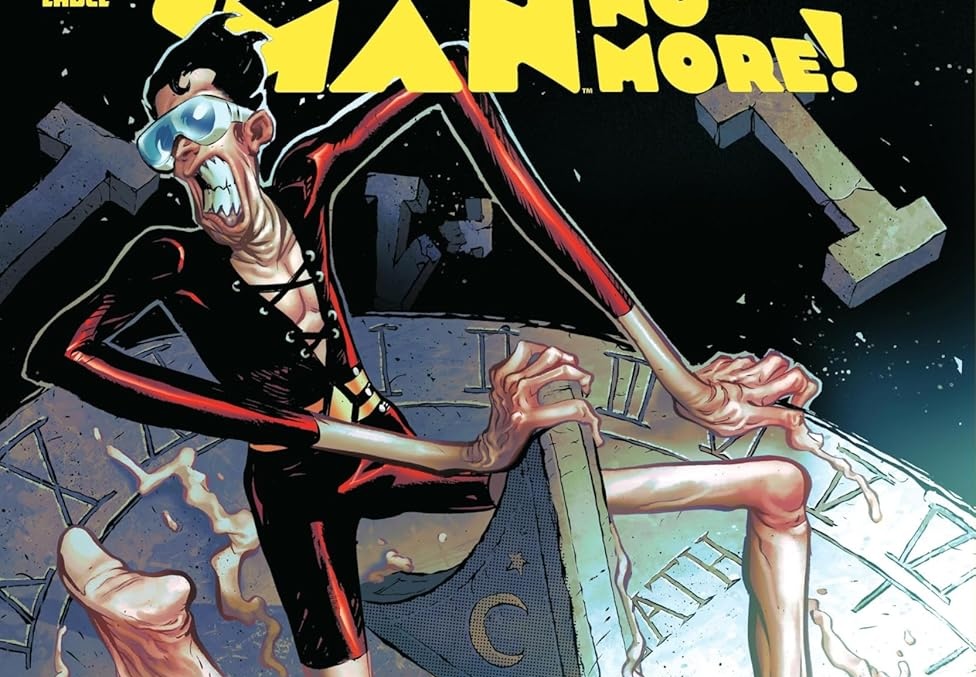

When Christopher Cantwell announced that he was working on a new DC Black Label book, Plastic Man No More is likely not what much of the audience initially expected. The first issue was developed with the combined work of Cantwell, Alex Lins, Jacob Edgar, Marcelo Maiolo, and Becca Carey, and it takes the laughable Plastic Man and questions exactly what would happen if he begins to crumble and die.
Yeah, it’s that kind of book.
Plastic Man No More balances a father’s failures with a superhero’s successes and a dying man’s fears. It takes the often happy-go-lucky face of Plastic Man and twists that face until it is unrecognizable. While the book opens with a compelling glimpse at his life before becoming a hero, it ends with a question of whether he has ever been a hero at all. The themes are impeccable, the concept is compelling, and the surreal Eel himself feels like nothing more than a typical man with doubts and fears.

DC Comics
In short, the writing is excellent. This book is a narrative standout that draws from the twisted and bizarre nature of Tom King’s Mister Miracle. The ending is as eerie as the rest of the story, but it hints at a coming confrontation that could shatter the entire public consciousness of the Justice League. It establishes Eel’s character with ease, then immediately shifts to the modern day without stumbling with its pacing.
Plastic Man No More‘s story largely hinges on the amazing art that plays with body horror in a way that any Plastic Man comic needs to. Eel is melting, oozing, and dragging pieces of himself everywhere he goes. It’s reminiscent of the artwork in Immortal Hulk, though the brighter tone creates an eerie contrast. His smarmy smile, combined with an arm that drips skin and fingernails on the cold concrete, paints a terrifying picture that will haunt a reader’s dreams. The book even regularly cuts off his face from the frame just to create an uncomfortable sense of closeness and incompleteness.
Two pages, in particular, feature an incredible layout that uses Plastic Man’s melting flesh as the barrier between the panels. It has an amazing effect that creates a sense of unease with every added memory. Most of the book takes advantage of atypical structures, which suits the atypical Plastic Man well. The paneling is only traditional when Eel is around the Justice League, as if Plastic Man No More is itself attempting to put up a front around the team, just as Eel is.
The coloring also presents an eerie picture. Plastic Man No More #1 oscillates between vibrant colors and dull blues and reds. It swells and ebbs with every development, making the reader feel for Eel’s every worry. With Plastic Man constantly smothering his worry, it’s left to the art to communicate the true horror of the situation, as it does so brilliantly.

DC Comics
Even the details are impeccable. The final page features a signpost at the end that directly communicates Plastic Man’s thought process. Even if he hadn’t spoken a word, it would have defined the next three issues of this miniseries.
There are some flaws, of course. Any reader expecting to see the Justice League at their best is sure to be disappointed. Cantwell’s depiction of the League in Plastic Man No More is less of an exploration of Batman’s opinions of Plastic Man or Superman’s potential respect for him, and it is instead Eel’s view of his teammates. They are generally depicted as laughing at him, never taking his opinions seriously, and dismissing his every word.
It’s a bizarre and surreal depiction of the iconic DC faces, but it works incredibly well for the tone that Cantwell hoped to establish. The portrayal is insulting at first glance, but Plastic Man No More manages to draw a better portrait by maintaining that appearance until it feels more stylistic than genuine. It’s hard to understand if Eel is even communicating with them directly, or if the reader is looking through his biased eyes. That confusion only makes the comic better.
Still, Plastic Man No More is not just worth reading; it’s worth recommending to anyone a reader can find. DC has knocked it out of the park, and not just because of the stakes. Comics are always at their best when they grapple with characters below the surface level, and this book represents a true foray into who Plastic Man is and why he joined the Justice League. Though it has a dark tone, it is absolutely worth a read. If the rest of the miniseries remains this effective, it could easily become one of the best books DC has developed in years.




You must be logged in to post a comment Login