

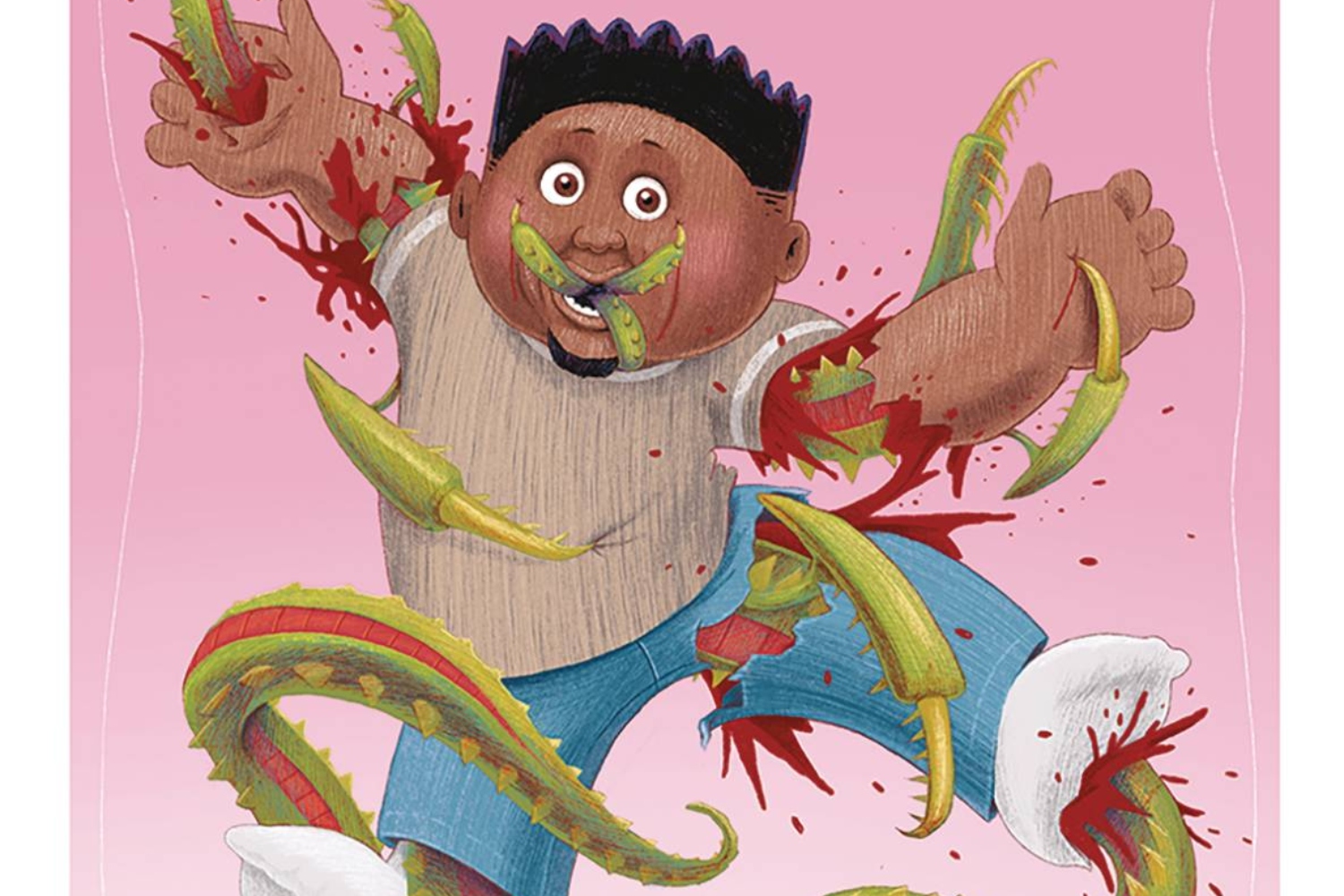

Can horror make you feel good? I mean, I connect it to my own emergence into the human experience, and there’s something to be said about the thrill of fear-related adrenaline. But in a larger sense, does horror have the power to promote goodness, bring people together, and affirm something about our existence?
The answer is “heck yes” if said horror title is Goobers.
Because, as evidenced in my rather long interview, creators Cody Ziglar and Ryan Lee clearly wanted to make Goobers about more than extra dope body horror. The pair touch on ideas of presenting a more natural, thoughtful take on the South; providing representation to POCs; honoring horror’s past; and even how the genre is a kind of “proving ground” for young creators. In short, a very human approach to things, and a way to ground and contextualize what horror is ultimately about (us).
And the end result is a story that feels truly personable — not just in its tone but its end goals. Ziglar’s story achieves those end goals of representation and emotional resonance because he clearly loves horror so much. Goobers plays out like Invasion of the Body Snatchers meets Cabin Fever meets Slither as friends Clayton, Andy, Kyle, and Laura head to Clayton’s Southern hometown for a long weekend/mini-vacation.

Courtesy of Vault Comics.
But it’s not just about combining and playing with these tropes, but what they all truly mean. Each of those aforementioned flicks tackles the idea of what it means to be human and what we see as non-human. (That’s maybe obvious for Invasion and Slither, but Cabin Fever is very much about the “other-ing” effect.) Goobers effortlessly does the same — Clayton’s hometown is regarded in such a way that its “transformation” into this haven for alien bugs forces the friends to examine not only the idea of community, but ideas of race and class, the value (or lack thereof?) of the concept of home, and even how we view ourselves and communities when tragedy strikes. (Just replace bugs with a global pandemic, yeah?)
And it’s not just heady, intellectual contemplation either, as the friends all feel really full formed. Sure, they may play certain roles — Kyle’s the clown and Andy seems to be the voice of reason — but this is horror after all, and a bit of cliche cataloging is important in telling a specific kind of story about people. And, as an extension of that personality, Goobers is funny — it may be in a kind of post-ironic, Gen Z-ian way, but that’s such a powerful counter to all the big ideas operating under the surface. You can’t have the depth without a glossy exterior, and Goobers manages all of this in a way that feels textured and nuanced like real people dealing with this bloody, horrid (but also hella funny?) situation.
And, speaking of shiny exteriors, you cannot address this book’s humanity without talking about the art (where Lee is joined by colorist Kurt Michael Russell and letterers AndWorld Design). The storyline may be about the true scope of humanity, and how these ideas inform certain practices and structures. But it’s the art where a lot of that is made truly and undeniably real.

Courtesy of Vault Comics.
To the aforementioned point about portraying the South, the art team give us something that’s both grounded and abstract/bizarre. So, while the world feels sort of relatable, the people are often a tad exaggerated and cartoonish in nature. But there’s a point to that: in trying to give people personality, and to have them stand out individually, the art team manage to play with our perceptions, nostalgia, and latent love of cartoons to create a world and people that hum with life and layers.
There’s a tension between the grounded and the exaggerated, the cartoon-y and the detailed to foster a baseline that brings us in and sets us on our toes. And from that, we’re able to connect with Goobers‘ world as you would with any other horror story, and in a way that leans into and against our expectations to prove especially entertaining. I liken it to, say, Tucker and Dale vs. Evil and/or Army of Darkness: there’s a joy and anxiety informing this world, and that’s the best speed for horror (as far as this fella’s concerned).
But, hey, this is a dang horror book after all, and you’ve likely came for the blood and guts as much as the multifaceted exploration of humanity. Luckily, if you just want that sweet, sweet body horror, Goobers delivers. From the gooey, pulsating vibes of the alien bugs to creepy crawly mandibles ripping from a person’s face and even that oh-so strategic use of blood, Goobers is wonderfully unsettling. Perhaps it all goes back to that slightly textured, uncanny valley-esque approach to world-building; there’s something fun about a bug exploding just even as you quickly realize what it truly means or facilitates for the story. But treating Goobers as just A-list gore is totally fine, and something that speaks to the art team’s ability to reference and remix your faves to create some big moments.

Courtesy of Vault Comics.
But, again, the humanity is everywhere here, and Goobers‘ best displays of horror intensity have greater meaning and real personality attached. There’s a scene in which the foursome “battle” their first Goobers monster is deeply funny — not only because they argue about what to call these suckers, but also that it plays out visually like extreme Three Stooges slapstick. And yet it never takes away from the serious nature of the gang’s situation, or the thematic gold being uncovered. That scene, especially, feels like an encapsulation of how Goobers humanizes itself and puts the emotions and tension on center stage at all times.
If anything, the gore of it all is contextualized in a way that it feels deeply satisfying because it always adds to the story by giving the group and its dynamics something really interesting to play off. To lean into another horror fave, it’s like Shaun of the Dead: things are always bloody and weird and silly, but they most always move around the people. (For instance, the last page of Goobers #1 and how it feels like the “garden fences” scene.)
Maybe what I’ve said isn’t all that novel or interesting. (Mary Shelley neatly summed about the horror-humanity connection when she said, “There is something at work in my soul which I do not understand.”) But Goobers gets extra points for wearing its humanity on its sleeve (of its half-mutated, pseudo-severed arm) and for doing so with gusto and passion. The book is still developing, but that sense of organic personality, emotion, and intellect is already such a big part of its early success.
It shocks and scares, yeah, but only to get us examining why we feel this way and what that means to ourselves, our institutions, and the ways we interact with one another. It affirms that reason why horror is a true community builder and why we need to scare ourselves half to death to really understand our condition. If this is only the debut, then may the poignant mayhem continue.




You must be logged in to post a comment Login