

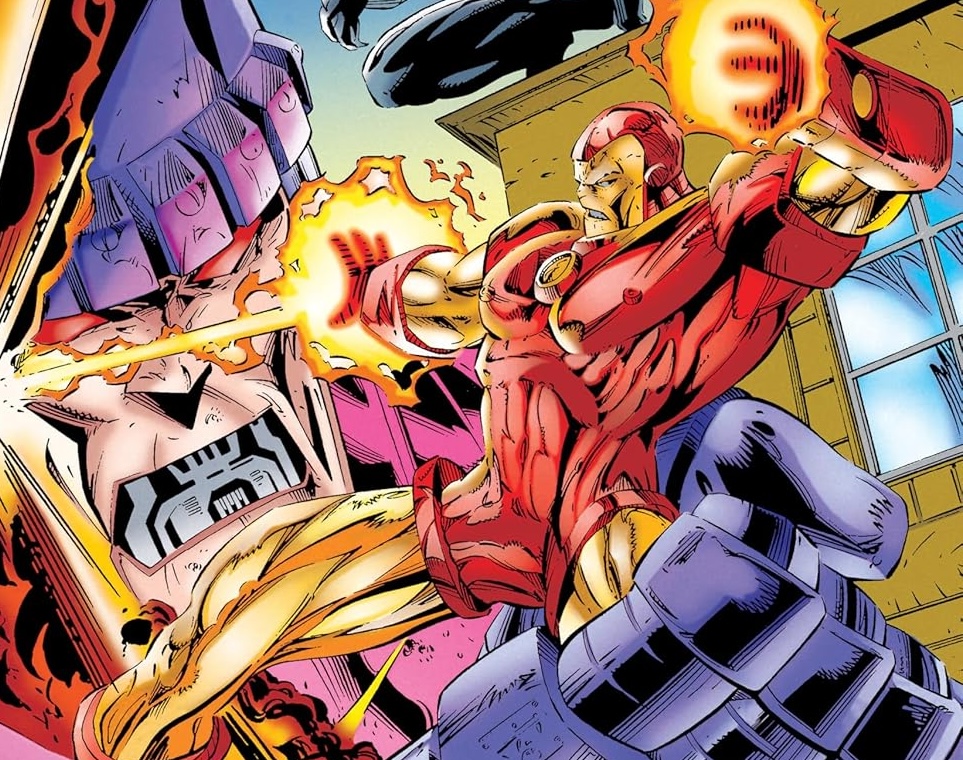

For the most part, every volume of Marvel’s Epic Collection is easily read on its own without troubling yourself with tracking down the previous volume (if the said volume has even been released yet). The project’s editors have gone to great lengths to find natural starting and stopping points for each volume, so while there will be dangling plot threads or unexplained context throughout the twenty or so issues, the central narratives stand up on their own.
Iron Man Epic Collection: Age of Innocence fails in that simple endeavor due to the unwieldy nature of Marvel Comics in the mid-1990s. The first third of Age of Innocence contains the final steps of an Avengers/Force Works/Iron Man/War Machine crossover so rambling and disorganized that it couldn’t be contained in one volume.

That crossover, beginning with The Crossing and including Time Slide, occurred at the peak of Marvel’s financial struggles of the decade – the comics in Age of Innocence were published in 1996, the same year the company declared bankruptcy. It’s an event that exhibits not only financial desperation but also a creative collapse.

Marvel Comics
With most top-billed talent shuffled to their more solvent books – the X-Men line and, to a lesser extent, Spider-Man titles – the Avengers titles were relegated to untested and wildly inconsistent artists, while less flashy but reliable old-hand writers like Bob Harras, Terry Kavanagh steered the ship. These were creators who weren’t drawing readers by name in an era where creators had cultivated individual fame and fandoms.
The tragedy is that the issues of Iron Man between The Crossing and Heroes Reborn were promising. A young Jim Cheung had taken over pencils, making the book more visually appealing than it had been in years. Though the story had grown convoluted – the whole of The Crossing sees Tony Stark manipulated to evil by Kang and replaced by his teenage self – the narrative facelift had provided a somewhat clean slate. The setup was rocky, but the ground was narratively fertile. For roughly six issues, Iron Man seemed like it could right its ship without the help of crossover sales.

Marvel Comics
While Old Tony’s supporting cast provides a nice throughline, concerning themselves with all of Tony’s financial holdings, the book introduces new cast members, each with their own interesting complications – Tony finds himself the time-displaced student of his now older ex-girlfriend, and the student body of his college includes several new love interests. A crew of frat-bros introduces the dangers of Tony’s propensity toward alcoholism as he walks the tightrope of underage binge drinking.
It wasn’t meant to last, however, and six issues was all the room those supporting cast members had to stretch out. Ultimately, the franchise was handed to those flashy and famous Image Comics creators for the line-rebooting Heroes Reborn; Age of Innocence ends with the massive and Universe-shifting Onslaught: Marvel Universe, which shows our brave (non-mutant, non-spider) heroes sacrifice themselves to save the world.
Iron Man Epic Collection: The Age of Innocence begins confusingly and unbearably, moves through a brief moment of promise, and then self-destructs; it is, therefore, the perfect illustration for the mid-’90s collapse going on at the center of Marvel Comics at the time.




You must be logged in to post a comment.